
When the steering wheel is turned, the rack and worm in the front steering housing move the rack in the desired direction. The rack controls the front wheels and also rotates the output worm shaft. The central shaft rotates, communicating the angle of rotation s to the rear housing, due to which the running rod moves. This rod is connected to the rear connecting rods, which turn the rear wheels.
In the rear housing, the input shaft rotates the planetary gear satellite along a fixed internal gear transmission. When the planetary mechanism rotates, its vertical movement is "absorbed" by the slider and guide, and only the lateral, or transverse, movement is transmitted to the running rod.
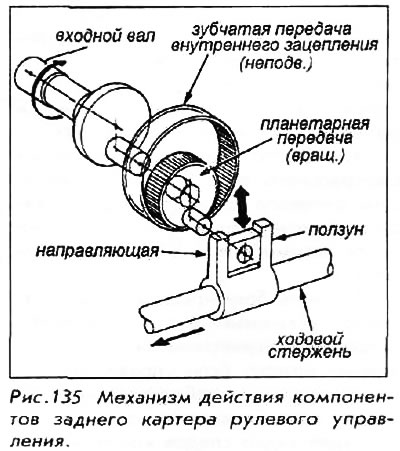
The action of the planetary mechanism moves the drive rod completely in one direction, then pulls it back, and then moves it completely in the opposite direction.
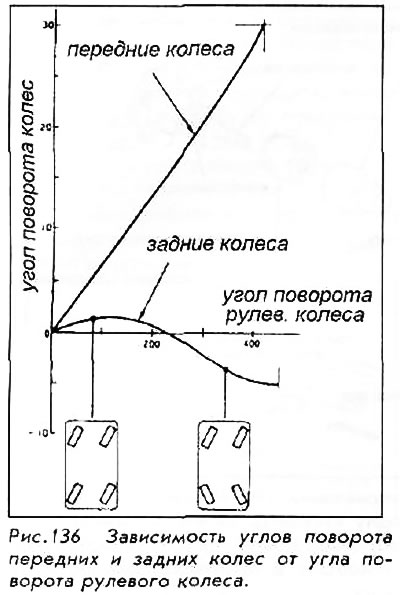
Up to approximately 127 degrees of steering wheel rotation, the rear wheels turn in the same direction as the front wheels, i.e. all to the left or all to the right. As the steering wheel angle increases, the rear wheels return to the center and then turn in the opposite direction to the front wheels. This provides increased maneuverability both at high speeds (changing lanes and other small turns) and at low speeds but large turning angles (for example, parking a car).
(Material obtained from the website: HONDABOOK.ru)