
Contents: Removal ⇊ Installation ⇊
Warning! The vehicles covered in this manual are equipped with the Supplemental Restraint System (SRS), better known as the airbag. Before performing any work near the airbag assembly or steering column, always disable the system to avoid injury from accidental deployment (see Chapter On-board electrical equipment). The insulation and connectors of the SRS circuit wiring are painted bright yellow. Do not connect any diagnostic equipment to this circuit!
The air conditioning system is under constant high pressure. Never disconnect refrigeration lines or remove any system components without first discharging the system. Discharging the air conditioning system must be done by an experienced technician in a car service workshop. Always wear safety glasses when disconnecting refrigeration lines!
Removal
1. Removing the heater assembly on the models in question is a fairly complex task for the average amateur mechanic. It requires patience and attention from the performer. Many of the electrical wiring connectors and fasteners are located under the instrument panel, which is why access to them is extremely limited. Usually, dismantling the heater requires preliminary removal of the instrument panel and discharge of the refrigeration tract of the air conditioning system. It is also necessary to disable the driver and passenger airbags and remove the steering column stop.
2. If the vehicle is equipped with a CV system, discharge the system in a specialized workshop. Disconnect the negative cable from the battery.
Warning! If the car stereo system is equipped with a security code, make sure you have the correct combination to activate the audio system before disconnecting the battery!
3. Drain the cooling system (see Chapter Settings and ongoing maintenance), - see warning at the beginning of the Section Antifreeze - general information.
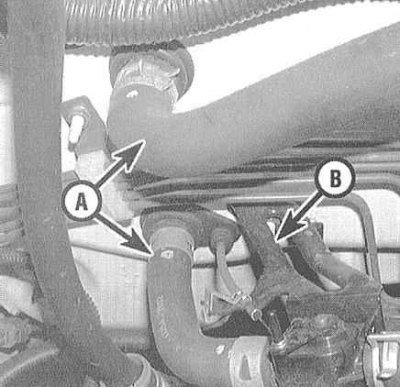
4. In the engine compartment, disconnect the engine cooling system hoses from the heater heat exchanger inlet and outlet pipes on the rear bulkhead of the engine compartment. Place a drain pan under the pipes to collect any spilled liquid.
Note: Disconnect one of the hoses from the heat exchanger and lower it into a drain container, then supply low-pressure air to the second hose - the coolant present in the heat exchanger should be forced out of its internal cavities, which will significantly reduce the risk of liquid getting on the interior trim elements during the assembly dismantling process.
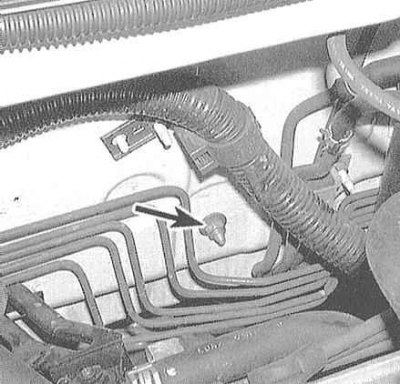
5. Disconnect the drive cable from the heater heat exchanger control flap, then loosen the nut securing the heater assembly to the engine compartment bulkhead - the nut is loosened from the engine compartment side.
Caution: Be careful not to bend or otherwise damage the fuel lines and brake lines located near the nut.
6. Remove the center console, glove box and instrument panel (see Chapter Body).
7. Disconnect the electrical wiring connectors and the air mix control drive cable from the heater assembly (see Section Removal and installation the heater and air conditioner control panel assembly, adjusting the drive cable)
8. On models without A/C, remove the air duct sleeve that runs between the heater and fan shroud assemblies. On models equipped with A/C, also remove the evaporator (see Section Removal and installation of the evaporator K/V with expansion valve).
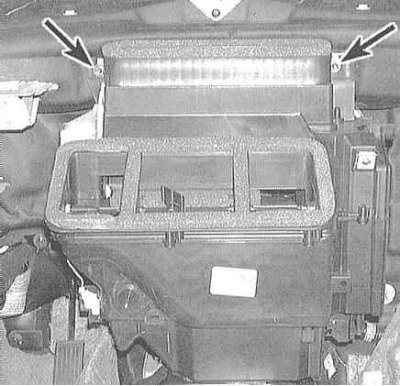
9. Remove the upper fasteners securing the heater assembly to the engine compartment bulkhead on the passenger compartment side. Remove the assembly.
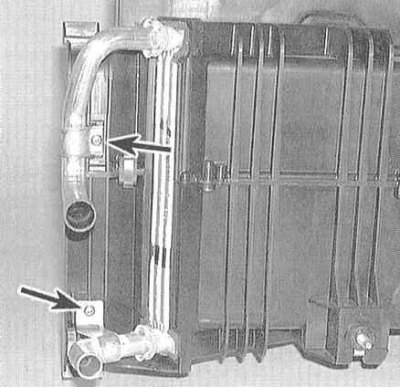
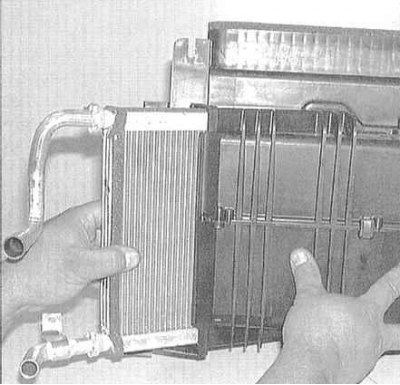
10. Loosen the clamps securing the heating tract inlet pipes to the casing and remove the heat exchanger.
 |
 |
Installation
1. Installation is carried out in the reverse order. Do not forget to check the proper functioning of the control flaps. If necessary, carry out the necessary repairs, replacing broken or deformed components. Make sure that the electrical components are functioning properly.
2. Fill the cooling system and remove air locks from it (see Chapter Settings and ongoing maintenance). Connect the battery and start the engine. Check the heating system components for signs of leaks and proper operation. If equipped, have the air conditioning system recharged in a specialized workshop.
Full text available on the portal hondabook