
Contents: Range selector position indicators ⇊ Positions of the range selector lever ⇊ Maximum permissible vehicle speeds ⇊ Disabling the selector lever lock ⇊ Car parking ⇊
Honda cars are equipped with a four-speed hydromechanical automatic transmission with a locking torque converter and an electronic-hydraulic control system. The transmission control system ensures timely and smooth switching of all forward gears. Locking the torque converter improves the fuel efficiency of the car. Subjectively, engaging the locking clutch of the torque converter is similar to a normal gear shift.
Range selector position indicators
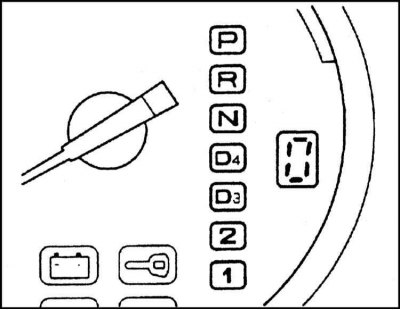
Additional indicator lamps are built into the tachometer assembly, allowing the driver to easily monitor the position of the AT range selector. To the right of the range indicators is the gear indicator, which functions in manual transmission control mode. The "D4" indicator automatically lights up for a few seconds when the ignition is turned on (the key is turned to the "ON" [II] position in the lock). Flashing of the "D4" indicator while the car is moving (regardless of the range selector position) indicates a possible AT malfunction. In this case, avoid sudden acceleration of the car. Urgently contact a Honda service station to check and repair the automatic transmission.
Positions of the range selector lever
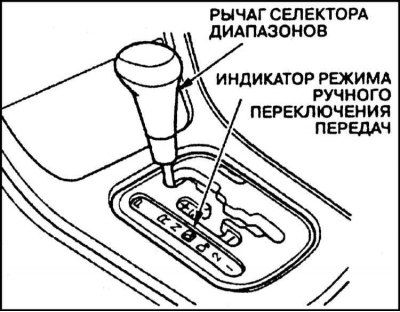
The transmission range selector lever can be in one of eight fixed positions. When starting the engine, the lever must be in the "P" or "N" position only. If the car is stopped when one of the "D4", "D3", "2", "1", "R", or "N" ranges is engaged in the automatic transmission, then it is necessary to fully release the gas pedal and press the brake pedal to reliably brake the car. To switch to manual control mode, move the selector lever from the "D4" position towards you. In this position, it becomes possible to switch manually.
When changing the ranges of the automatic transmission, move the lever along the guide groove. The range shift lever is locked in the "P" position if the ignition key is turned to the "LOCK" (0) or "ACC" (I) position. In this case, it is impossible to move the lever out of the "P" position even when the brake pedal is depressed.
Position "P". In this position of the range selector lever, the secondary shaft of the transmission is mechanically locked. Always move the range selector lever to the "P" position when turning off or starting the engine. In order to move the range selector lever from the "P" position, it is necessary to depress the brake pedal, having previously released the gas pedal. Move the range selector lever to the right and move it from the "P" position.
If after performing all the above steps it is still not possible to move the lever out of the "P" position, it is necessary to unlock it by following the instructions below.
To avoid damage to the AT, move the lever to the "P" position only after the car has come to a complete stop. Note: Removing the key from the ignition switch becomes possible only after the selector lever is in the "P" position.
Position "R". The techniques for operating the range selector lever when moving it to the "R" (Reverse) position from the "P" position are described above. Only move the lever to the "R" position from the "N" (Neutral) position after the vehicle has come to a complete stop.
The automatic transmission is equipped with a special safety device that prevents the lever from accidentally moving to the "R" position if the vehicle speed exceeds 10-12 km/h.
If reverse gear does not engage after the vehicle has come to a complete stop, depress the brake pedal and slowly move the range selector lever first to the "N" position, then to the "R" position.
If the safety device is faulty, or if the battery is disconnected from the vehicle electrical system or discharged, it is impossible to engage the reverse range. In this case, it is necessary to remove the reverse range engagement lock.
Position "N". Use the "N" (Neutral) position when starting a stalled engine while the vehicle is moving and when briefly stopping the vehicle with the engine running. If you need to leave the vehicle for any reason, first move the range selector lever to the "P" (Park) position. When moving the lever from the "N" position, depress the foot brake pedal.
Position "D4". The range selector lever should be kept in this position at all times when the vehicle is moving under normal road conditions. The "D4" (Drive) range provides automatic forward gear shifting depending on the vehicle speed and the degree of pressure on the accelerator pedal. When driving, you may notice that automatic upshifts occur later, i.e. at higher speeds, if the vehicle's engine has not yet warmed up to normal operating temperature. This ensures faster engine warm-up.
Manual gear shift mode. If the range selector lever is in the "D4" position, it is possible to engage manual gear shifting mode. In this mode, gears are changed using the same lever as on models equipped with a manual transmission, but without using the clutch pedal. To engage manual gear shifting mode, move the lever from the "D4" position to the left (towards the driver's seat). The gearbox returns to automatic control mode when the lever is moved back to the right (towards the passenger seat).
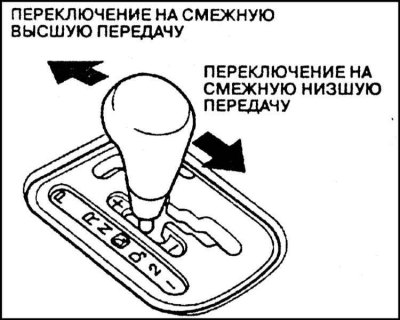
In manual gear shift mode, transmission control is performed by successive pressing the lever forward or backward. If you press the lever forward, the gearbox will shift to the next higher gear. Conversely, pressing the lever backwards will shift the gearbox to the adjacent lower gear. The number of the engaged gear is indicated on the instrument panel. The engaged gear indicator is located on the tachometer dial to the right of the "D4" indicator.
When the range shift lever is moved to the position corresponding to manual transmission control mode, the indicator of the currently engaged gear lights up on the instrument panel. For example, if fourth gear is engaged, the number "4" will light up to the right of the "D4" indicator. Subsequent gear changes in manual mode will cause the indicator readings to change accordingly. If manual transmission control mode is engaged when the vehicle is stationary, first gear will be engaged automatically, and the number "1" will light up in the indicator window.
The start of movement and acceleration of the car will occur in first gear, then it is necessary to manually engage second and subsequent gears. In manual gearbox control mode, it is necessary to monitor the tachometer so that the maximum permissible engine speed is not exceeded. In the process of accelerating the car, timely engage adjacent higher gears, preventing the tachometer needle from entering the red zone of the scale.
If the driver does not press the range selector lever, the gearbox will operate at the same stage (1, 2, 3 or 4), without shifting. When the gas pedal is fully depressed, the gearbox also does not shift.
In manual transmission control mode, it is possible to automatically switch the transmission from fourth to third gear in the following cases:
- a) The speed of the car dropped below 27 km/h.
- b) The car is moving uphill at a speed of 27 to 60 km/h.
- c) The foot brake pedal is depressed while the vehicle is moving downhill.
Automatic downshifting to third gear provides increased traction when driving uphill, and also improves engine braking when driving on a steep descent.
In addition, in manual control mode, the gearbox automatically switches to first gear when the car slows down and stops. This switching occurs when the speed drops to 10 km/h.
If you try to manually engage one of the lower gears while driving, at which the engine speed exceeds the maximum permissible value, then this switching is automatically blocked.
If the vehicle is moving in fourth gear and the driver's command to engage third gear is blocked, the "3" indicator on the instrument panel will flash several times, then the "4" indicator will light up again. Similarly, if the vehicle is moving in third gear and the driver's command to engage second gear is blocked, the "2" indicator on the instrument panel will flash several times, then the "3" indicator will light up again.
If, during the flashing of the locked gear indicator, the vehicle speed decreases so much that after changing gear the engine shaft speed cannot exceed the maximum permissible value, then the lock is removed and the adjacent lower stage is engaged in the transmission.
At low ambient temperatures, when the transmission temperature does not exceed -10°C, the manual gearshift mode may not work.
IN Specifications the recommended gear shift speeds in the gearbox are given.
Position "D3". When the range selector lever is in the "D3" position, the automatic transmission functions in the same way as when the "D4" (Drive) range is engaged. The difference is that the shift to fourth gear is excluded. The "D3" range is recommended for towing a trailer in hilly terrain or for engine braking on a steep descent. Engaging the "D3" range is also useful for eliminating unnecessary cyclic shifts of the automatic transmission between third and fourth gears. Such cyclic shifts of the transmission can be observed, for example, when driving in dense traffic with frequent slowdowns and stops of the car.
To accelerate the vehicle sharply when the gearbox is operating in the "D4" or "D3" range, press the gas pedal all the way down.
In this case, the gearbox will automatically shift to the adjacent lower gear. If the vehicle speed is low, the gearbox can immediately shift down two gears.
Position "2". When range "2" is engaged, the automatic transmission will constantly operate in second gear. When the vehicle stops, the gearbox does not shift to first gear. Constant engagement of second gear ensures good traction dynamics of the vehicle on climbs and the possibility of intensive engine braking on steep descents. Range "2" is recommended to be engaged when starting off on slippery road surfaces, as well as when driving in deep snow. This helps prevent severe slippage of the vehicle's drive wheels.
When the "2" range is engaged while the vehicle is moving, the engagement of the second gear in the transmission is automatically delayed and occurs only after the vehicle speed has decreased to a safe level at which the engine crankshaft speed does not exceed the maximum permissible value.
Position "1". When range "1" is engaged, the automatic transmission will constantly operate in first gear. If range "1" is engaged at a speed of over 50 km/h, the transmission will first switch to second gear. Engaging the intermediate stage allows you to avoid sudden and unexpected engine braking.
Maximum permissible vehicle speeds
The Specifications provide the maximum permissible vehicle speeds when engaging the various ranges of the automatic transmission. If the speeds specified in Specifications values, the tachometer needle enters the red zone of the scale, indicating that the permissible engine speed has been exceeded. At the same time, the electronic unit of the engine control system begins to limit the crankshaft speed, reducing the fuel supply, which can be felt by the change in the engine operating mode. The engine operation returns to normal as soon as the tachometer needle leaves the red zone of the scale.
To avoid engine damage, before changing gears, make sure that the tachometer needle does not go beyond the maximum permissible speed in this gear and is not in the red zone of the scale.
Disabling the selector lever lock
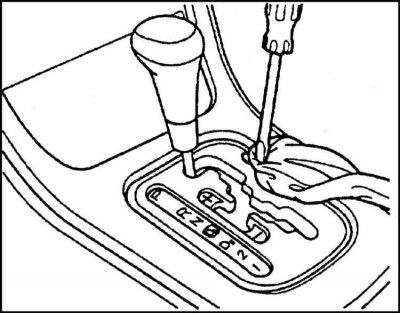
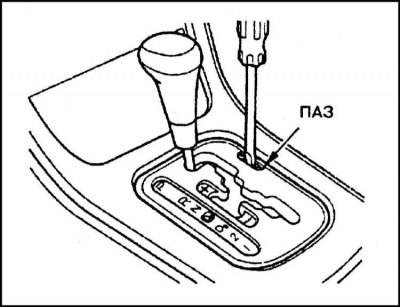
If you cannot move the range selector lever from the "P" position using the normal method (while simultaneously depressing the brake pedal), perform the following operations (the same procedure should be followed to release the reverse range lock):
- a) Set the parking brake;
- b) Check that the ignition is switched off (the key must be turned to the "OFF" [0] position). If the reverse range lockout needs to be released, the ignition key must be in the "ACC" (I) position;
- c) Place a piece of cloth over the cover located to the right of the lever guide slot and covering the access to the release device, use a small flat-head screwdriver (not included in the tool kit) or other suitable tool to gently press on the edge and remove the cover;
- d) Insert the tip of the screwdriver into the slot
- e) Press the screwdriver from above and at the same time move the lever from the "P" position to the "N" position;.
- f) To release the reverse range lock, move the lever from the "N" position to the "R" position, then to the "P" position;
- g) Remove the screwdriver from the slot and install the new cover. Press the brake pedal and start the engine.
 |
 |
If you had to use the above method to unlock the range selector lever, the possible cause of the problem is a transmission malfunction. Contact a Honda service station to have the vehicle checked and repaired.
Car parking
When leaving the vehicle parked, always set the parking brake. Remember that the parking brake warning light mounted in the instrument panel only serves to remind the driver to release the parking brake before driving off. The lighting of the warning light does not guarantee that the parking brake is fully set. To avoid the vehicle rolling away on a slope, make sure that the parking brake is properly set.
First, set the parking brake and then move the automatic transmission range selector lever to the "P" position. This sequence of actions prevents accidental starting of the vehicle and eliminates the transfer of significant load to the transmission secondary shaft locking mechanism from the force rolling the vehicle. Relieving the transmission secondary shaft locking clutch from the force rolling the vehicle. Relieving the transmission secondary shaft locking clutch ensures that the lever can be easily moved out of the "P" position when the vehicle is subsequently started.
When parking your car on a hill, turn the front wheels away from the curb, and vice versa.
Before driving, make sure that the parking brake is fully released. Driving with the parking brake not fully released may cause overheating and failure of the rear wheel brakes. In addition, this may lead to malfunction of the ABS.