
Contents: Maximum load capacity of the vehicle ⇊ Transportation of cargo in the…⇊ Carrying cargo in the luggage…⇊
The vehicle is equipped with several containers designed to accommodate transported items.
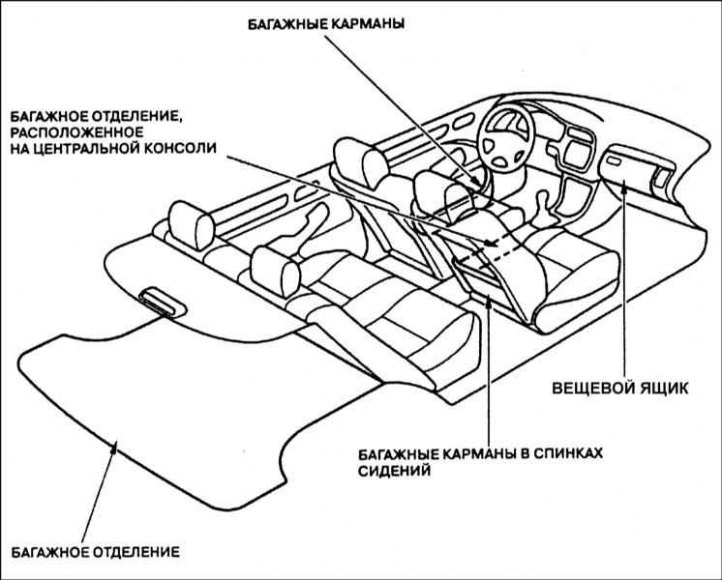
The storage compartments located in the car's interior are designed to accommodate small items. These include the main storage compartment in the instrument panel, door pockets and pockets located in the seat backs, as well as a storage compartment built into the center console.
Large items should be placed in the luggage compartment of the car. The transportation of long items is made possible by the folding design of the rear seat backs.
It is important to remember, however, that improper transportation of cargo may adversely affect the vehicle's handling and stability, and therefore reduce safety. Before transporting any cargo in your vehicle, please read the information below.
Maximum load capacity of the vehicle
Exceeding the maximum permissible load capacity of the vehicle or improper placement of cargo may cause a traffic accident and result in injury or even death of the driver or passengers in the vehicle. Do not exceed the maximum permissible gross weight when loading the vehicle, as well as other restrictions mentioned in this Manual. When transporting goods in a vehicle, it should be taken into account that the total weight of the vehicle must not exceed the maximum permissible value. The total weight of the vehicle includes: the unladen weight of the vehicle, the weight of the driver and passengers, the weight of the towing device installed on the vehicle, as well as the weight of the trailer falling on it. With any vehicle loading options, the axle loads must also not exceed the maximum permissible values. Information on the maximum permissible values of the total weight and axle loads is provided in the Specifications.
Transportation of cargo in the passenger compartment of a vehicle
Securely fasten all items placed in the vehicle to prevent them from shifting in the event of a traffic accident.
Do not place large objects on the rear shelf of the passenger compartment - they narrow the driver's field of view and can be thrown forward in the event of a collision or sudden braking.
Make sure that objects placed on the floor behind the front seats cannot roll forward and cannot under any circumstances interfere with the driver's free manipulation of the control pedals or interfere with the correct adjustment of the front seats.
Keep the glove compartment closed while driving.
Carrying cargo in the luggage compartment or on a roof rack
Try to distribute the load evenly, placing the luggage as close to the seats as possible. Heavy loads should always be placed at the bottom, on the floor of the luggage compartment. Securely fasten the transported items with a strong cord so that they cannot shift while the car is moving. Never place luggage higher than the level of the front seat backs.
When transporting large or long items with the rear seats folded down, try to secure them securely with a strong cord to prevent the load from shifting during emergency braking of the car. Do not place luggage above the level of the seat backs to avoid reducing the driver's field of view.
A description of the operations for folding the rear seat backs and setting them to their original position is given in Section Vehicle equipment, arrangement of instruments and controls.
If you need to transport long objects that do not allow you to close the tailgate/trunk lid, remember that engine exhaust gases may enter the vehicle interior - take appropriate precautions (see Section Elements of vehicle safety systems).
When placing cargo on the roof rack, make sure that the total weight of the cargo does not exceed the permissible value. For more information, contact your Honda dealer.