
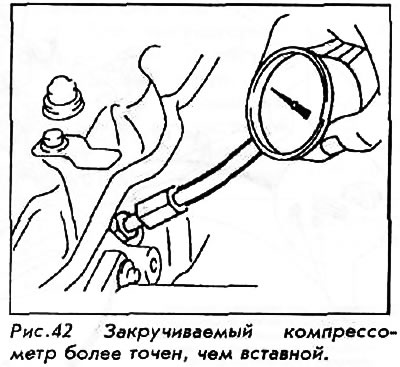
As mentioned in the section "Tools and Equipment" Chapter 1, the screw-in type compression tester is more accurate, although it takes longer to measure. It is worth it to get more accurate measurements. Follow these steps:
1. Warm up the engine to normal operating temperature.
2 Turn off the engine, then remove all spark plugs.
3. Disconnect the high-voltage wire from the ignition coil.
4. Screw the compression gauge tightly into the hole of spark plug No.1.
CAUTION: Be careful not to damage the plug hole threads. On aluminum cylinder heads, the threads can easily be stripped.
5. Have an assistant release the gas pedal completely on both carbureted and fuel injected vehicles.
6. While you are watching the compression tester, have an assistant start the engine two or three times for short periods of time (10 seconds) using the ignition key.
7. Read the compression tester at the end of each series of starts and record the highest reading. Repeat this procedure for each of the engine's cylinders. Typically, new engines will have compression in the range of 1030-1170 kPa. This number will decrease with age and wear. The number your test shows is not as important as the evenness between all cylinders. Many engines run very well with compression in the range of 725 kPa in all cylinders. A lower number simply shows general internal deterioration. Such an engine is probably burning some oil and may be somewhat harder to start.
Compare the highest readings of all cylinders. Any deviation of more than 10% should be considered a sign of potential trouble. For example, on a 4 cylinder engine, if your compression readings for cylinders 1 through 4 were: 930 kPa, 860 kPa, 620 kPa, and 860 kPa, it would be fair to say that cylinder 3 is underperforming and is almost certainly the cause of oil burning, rough idle, or poor fuel economy.
8. If the cylinder compression is unusually low, pour a spoonful of clean motor oil into the cylinder through the spark plug hole and recheck the compression. If compression appears after adding oil, the piston rings or liner surface are damaged or worn. (Oil seals some leaks.) If the pressure remains low, the valves may be loose (the valves need work) or the head gasket next to that cylinder may be leaking. If the compression in any two adjacent cylinders is low, and if adding oil does not help the compression, there is a head gasket leak. The presence of oil and coolant in the combustion chamber can directly result from this problem, as can beadlets of water on the dipstick.
The text of the article is available on the website HONDABOOK