
1. The results of the compression test in the engine cylinders allow us to judge the condition of the engine parts (pistons, rings, valves and seats, cylinder head gaskets).
2. To obtain accurate test results, the engine must be warmed up to normal temperature and the battery must be fully charged.
3. Disconnect the ignition system, mark and disconnect the high-voltage wires from the spark plugs and unscrew the spark plugs. It is recommended that further testing be carried out by two people.
4. Open the throttle valve fully.
5. Insert the compression gauge into the spark plug hole of the 1st cylinder (photo).
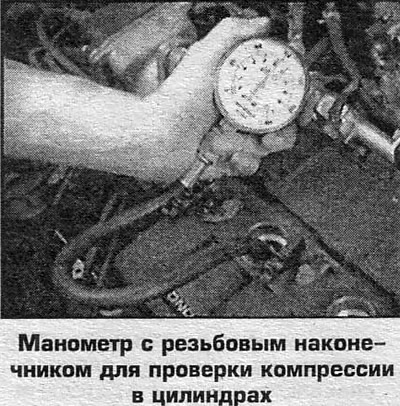
6. Turn on the starter for 5 seconds and record the highest compression value.
7. Repeat the procedure for the remaining cylinders, including the starter for the same amount of time.
8. Compare the compression readings in the cylinders. The compression value is considered normal if the lowest value is at least 75% of the highest reading.
9. If the compression is too low, pour about a tablespoon of oil into the cylinder. If after introducing oil into the cylinder the compression increases, then we can conclude that the piston rings are worn out. If the compression increases slightly, then the leak is through the valves or the head gasket.
10. If the compression is equally low only in two adjacent cylinders, then the most likely cause is a burnt gasket between these cylinders.