Front Suspension Components
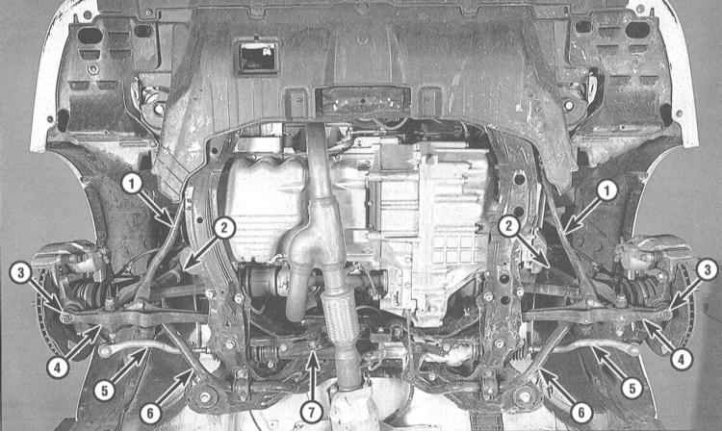
1 - Push bar; 2 - Assembling the shock absorber with a coil spring; 3 - Lower ball joint; 4 - Lower control arm; 5 - Tie rod end; 6 - Stabilizer bar for lateral stability; 7 - Assembly of the rack and pinion
Rear Suspension Components
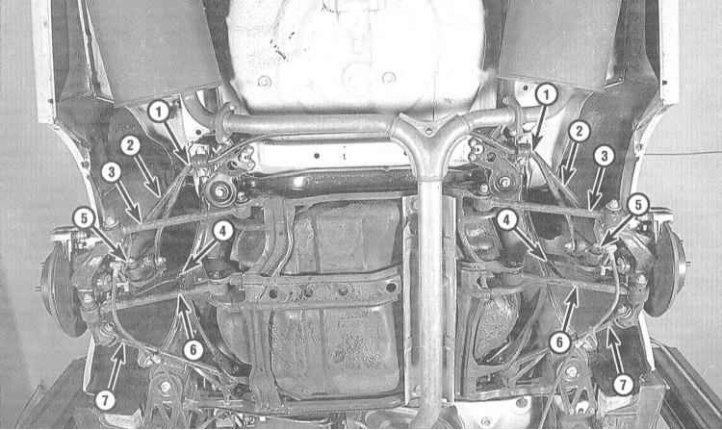
1 - Transverse stability stabilizer bar; 2 - Rear trailing arm; 3 - Control lever; 4 - Upper arm; 5 - Assembling the shock absorber with a coil spring; 6 - Lower arm; 7 - Front trailing arm
Rear suspension elements
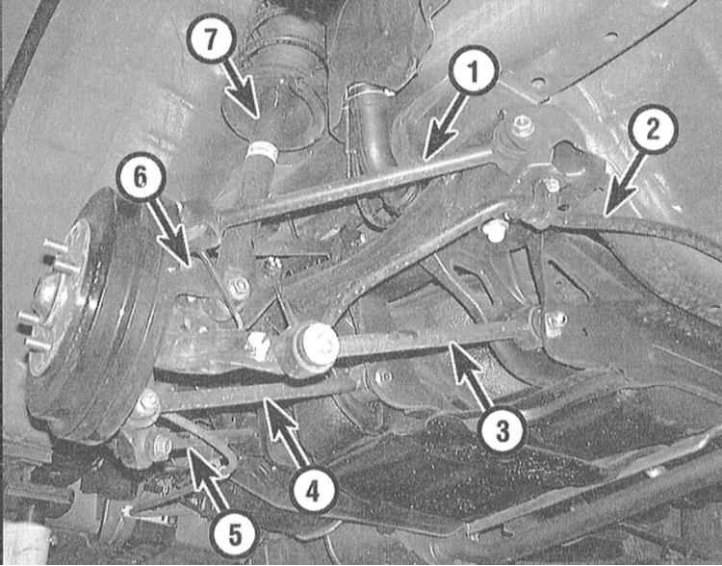
1 - Front trailing arm; 2 - Stabilizer bar; 3 - Lever; 4 - Lower arm; 5 - Rear trailing arm; 6 - Fist; 7 - Shock absorber strut
The front suspension is fully independent with upper and lower arms, shock absorbers with coil springs and an anti-roll bar.
The rear suspension uses trailing arms (front and rear), two lower control arms of unequal length (one is simply called the lower arm, the other is the control arm), an upper control arm, and shock absorber assemblies with coil springs. The anti-roll bar connects the right and left sides of the suspension, thereby compensating for body sway.
All models are equipped with a hydraulically assisted rack and pinion steering system. The power steering system (PAS) uses an engine-driven steering pump connected to the rack and pinion housing via flexible hydraulic hoses.
Often, when servicing suspension components, you have to deal with fasteners that cannot be loosened. The fasteners "stick" because they are constantly exposed to external influences, are in contact with water, dirt, soot and other substances that promote corrosion. In order to facilitate the procedure of loosening such "stuck" fasteners, they should be soaked in a large amount of penetrating oil beforehand. Cleaning the exposed threaded parts of the fasteners with a hard wire brush also helps to loosen rusted nuts. Sometimes, in especially difficult cases, you can use a drift to loosen a "stuck" bolt/nut. The drift rests against the edge of the nut/bolt head slot, then sharp blows are applied to its opposite end with a hammer. Make sure that the drift does not come off, try not to damage the thread with inaccurate blows. Another quite effective method is to heat the fastener that is difficult to loosen and the surface of the component around it with a blowtorch or gas torch, although the authors of this Guide do not recommend resorting to this technology unless absolutely necessary due to its potential danger associated with the possibility of fire and the risk of burns. Various types of extensions, collars and pipe attachments are designed to increase the torque when loosening the fastener. However, remember that you should not use such reinforcing devices in a set with a ratchet-equipped drive - the risk of failure of the ratchet mechanism is too great. Sometimes a nut/bolt begins to give in after it has been slightly tightened clockwise. All fasteners, the loosening of which required the use of extraordinary measures during assembly, are subject to replacement!
Note: After delivery, carefully check the condition of the fasteners and, if necessary, replace them with elements of the same size. When assembling, tighten the fasteners of the suspension and steering components strictly with the required force.
Attention! Never attempt to straighten deformed suspension and steering components - replace defective parts with new ones! Since suspension component maintenance procedures are performed under the vehicle, you should take care in advance of the ability to lift the vehicle and secure it in a raised position (prepare a reliable jack and supports).
Attention! Never perform any work under a vehicle secured in a raised position only by means of a jack!
[The article was copied from the website Hondabook.ru]