
Before starting the engine
Get into a comfortable position and make sure that you can press the accelerator and brake pedals securely with your right foot.
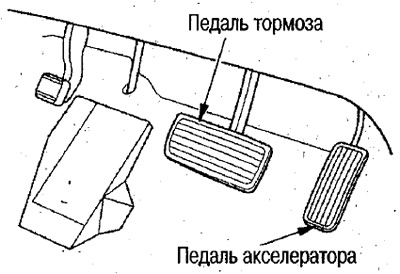
Starting the engine
1. Make sure the parking brake is applied.
2. Make sure that the automatic transmission selector lever is in position P.
Note: The engine can also be started in position N, but for safety reasons it is recommended to move the lever to position P.
3. Press the brake pedal with your right foot and start the engine.
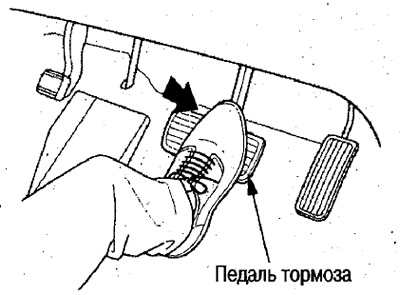
Note: If you need to press the accelerator pedal to start the engine, press it with your right foot and then press the brake pedal after starting.
Start of movement
Normal movement
1. Press the brake pedal with your right foot and move the automatic transmission selector lever to position D (or D ₃), or to position R if you want to move backwards.
2. Visually check that the lever is in the correct position.
3. Release the parking brake.
4. Make sure that the brake system indicator light goes out.
5. Gently release the brake pedal and lightly press the gas pedal.
Note:
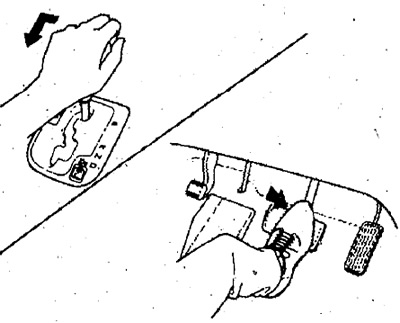
- If the automatic transmission selector lever is moved out of position P, the car will move even if the gas pedal is not pressed. To stop the car, press the brake pedal.
- The traction force will be greater in the initial stage after the engine starts, so in such cases, press the brake pedal harder.
- If, when moving the automatic transmission selector lever from position P, you first move it to the left side and then press the brake pedal, the lever may not move to the required position. You must first press the brake pedal and then move the lever.
- While on models with a manual transmission, when starting off, it is necessary to operate the clutch pedal and the accelerator pedal simultaneously, on models with an automatic transmission, it is sufficient to operate only the accelerator pedal.
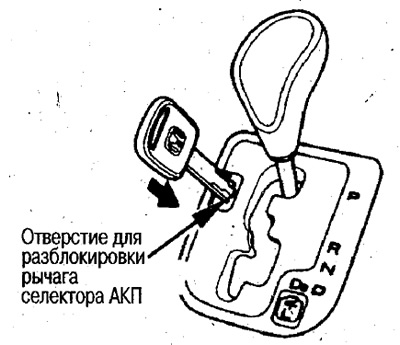
- If for any reason the automatic transmission selector lever does not move out of position P, even with the brake pedal depressed, do the following.
1. Remove the cover.
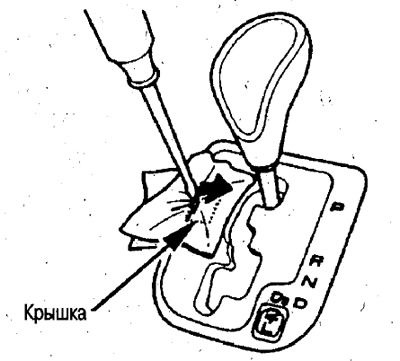
2. Insert the ignition key or screwdriver into the automatic transmission selector lever release hole and move the automatic transmission selector lever while holding the key (screwdriver) pressed.
Starting off on a steep climb
Visually determine the position of the automatic transmission selector lever.
With the parking brake applied, slowly release the brake pedal.
Press the gas pedal slowly and make sure the car is ready to move.
Release the parking brake and start moving.
Movement
Do not move the automatic transmission selector lever to position N while driving.
Note:
- With the automatic transmission selector lever in position N, engine braking does not operate, which may lead to unforeseen consequences.
- With the automatic transmission selector lever in position, fuel consumption remains virtually unchanged.
Normal movement
Forward movement begins after the automatic transmission selector lever is set to position D.
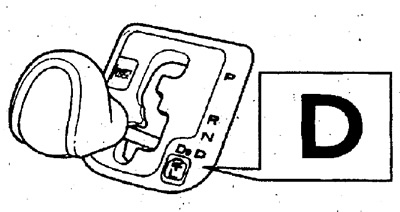
When you press the gas pedal, the gears are automatically shifted in accordance with the driving speed (on L, L-4V models: from first to fourth, on V, V-4 models: from first to fifth).
Caution: When driving at high speed, do not switch the selector lever to position 2 or engage L mode, as this will result in abrupt engine braking, wheel slippage and exceeding critical engine speed.
Sharp acceleration
While driving, sharply press the gas pedal all the way down. This will cause the car to shift to a lower gear and accelerate sharply.
Movement on the rise
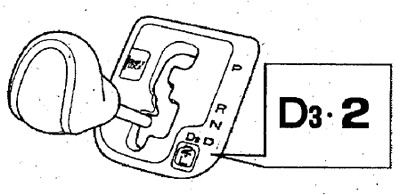
If you set the automatic transmission selector lever to position D ₃ or 2, depending on the steepness of the climb, sudden changes in engine speed will be reduced and the car will move more smoothly.
Movement on the descent
If the automatic transmission selector lever is in position D on a downhill slope, engine braking may not be sufficient and the car will accelerate. In such cases, set the automatic transmission selector lever to position D3 or 2. If very strong engine braking is required, set the selector lever to position 2 and engage L mode.
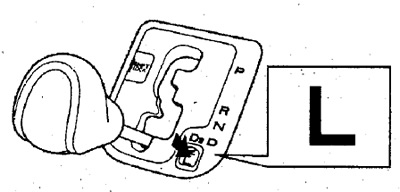
Caution: If you press the brake pedal frequently, the brake pads may overheat and reduce braking efficiency, so be sure to use engine braking on long descents.