
About the IHCC system
The distance between cars is measured by laser beams reflected from the car in front. The system operates at a distance of up to 100 m.
About the system operation
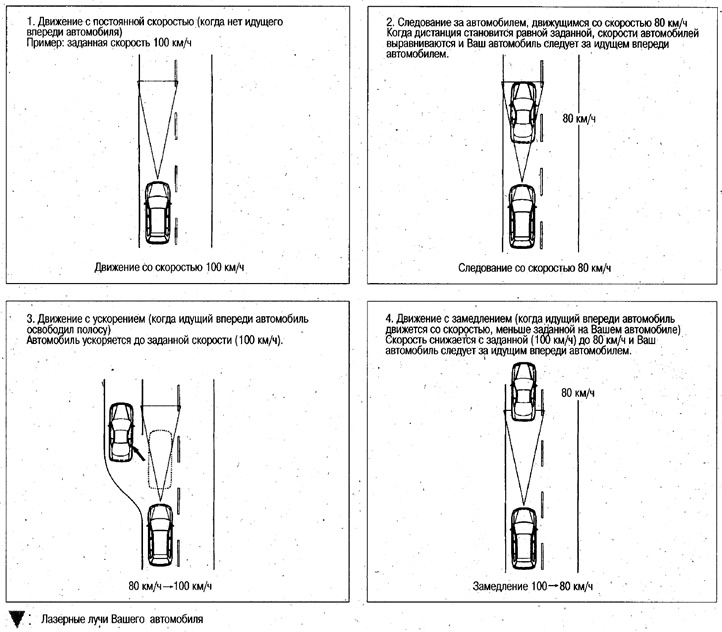
When there is no car in front
1. The car moves at a constant set speed (within 65-100 km/h).
When there is a vehicle in front
2. The system maintains a distance corresponding to the speed of the car by changing the speed of your car (not higher than the set speed). The speed of your car changes in accordance with the change in the speed of the car in front, i.e. your car follows it. (Distance corresponding to the speed: with a decrease in speed, the distance increases, and with an increase, it decreases).
3. When the vehicle in front disappears, your vehicle slowly accelerates to the set speed (65-100 km/h).
4. When a slower car appears in front, the speeds of the cars equalize and your car follows the car in front. If the car in front has suddenly slowed down or another car has cut in between you and the distance has become very small, the driver is notified by a buzzer and a display. (In such cases, reduce speed by pressing the brake pedal and ensure a safe distance.).
Attention:
If the IHCC (Distance Control, Close Range Caution) system unexpectedly fails at high speed, a fatal accident may occur. Maintain sufficient distance and pay attention to the road conditions at all times.
Do not turn on the IHCC system in the following cases:
- In bad weather (rain, fog, snow, etc.)
- Accurate distance measurement becomes impossible. In addition, after switching the windshield wipers to the "H1" mode, the IHCC system is switched off.
- On roads with heavy traffic.
- Choose a speed that suits the traffic conditions.
- On a steep descent.
- Engine braking may not be sufficient to maintain a constant speed on a winding road.
- Choose a speed that suits the traffic conditions.
- On slippery or snowy roads.
- Wheel slip makes it impossible to control the system.
- In situations that require frequent acceleration and deceleration of the vehicle.
- Choose a speed that suits the traffic conditions.
- Before entering an intersection, service area or parking lot from a highway.
Note:
The IHCC system does not automatically stop the vehicle. In addition, it has limitations in speed control (slowing down to approximately 60 km/h). Therefore, if the vehicle ahead has slowed down and stopped (a warning about dangerous approach is triggered (display on the display and buzzer), the driver must press the brake pedal and stop the vehicle.
The IHCC system does not monitor road conditions, so maintain a safe distance from the vehicle in front and constantly monitor road conditions.
In the following cases, the system no longer recognizes the vehicle in front and safe distance control may not be performed correctly.
- When the vehicle in front is high above the ground (e.g. a truck). When the rear of the vehicle in front is heavily soiled.
- When clouds of water droplets or snow rise up behind the car in front.
- When the reflective surface of the vehicle in front is covered with film or broken.
The IHCC system does not recognize a vehicle ahead traveling at a speed lower than 20 km/h or a parked vehicle. (The distance is not measured, so press the brake pedal to maintain a safe distance.) In addition, the driver is not warned of a dangerous distance in these cases. Be careful on a high-speed road when approaching a toll booth or the last vehicle in a traffic jam.
In the following cases, the system does not alert you to a dangerous distance.
- When your car is moving at almost the same speed as the car in front.
- When the car in front accelerates and the distance begins to increase.
- When you press the gas pedal.
There are times when the system measures the distance to an object other than the vehicle in front. On a winding road or when you turn the steering wheel, the system may briefly measure the distance to a vehicle in another lane or to a surrounding object.
If there is a cyclist in front, the system does not work in the following cases.
- The bicycle does not have a reflector, the reflector is broken or dirty.
- The bicycle is moving along the very edge of the traffic lane.
Start turning the ignition key or set the ignition key to position "II" only when the vehicle is stopped. In addition, when the vehicle is on a parking lot turntable and the vehicle's direction changes, turn the ignition key to position "0". Otherwise, subsequent recognition of the vehicle ahead may become impossible.
When starting the engine or setting the ignition key to position "II", a characteristic sound may be heard from the engine compartment, caused by the IHCC system being checked, which is not a malfunction.
Depending on the steepness of the ascent or descent, the system may not provide a constant speed of movement.
[Original published on this resource: www.hondabook.ru]