


Car engine cooling system Honda Avancier 1

Location of cooling system components
Attention. Do not open the radiator cap when the engine is hot, as the coolant is under pressure and may spill out. After the coolant has cooled, cover the cap with a rag and open it slowly. When adding coolant, be...
Attention. Do not open the radiator cap when the engine is hot, as the coolant is under pressure and may spill out. After the coolant has cooled, cover the cap with a rag and open it slowly. When adding coolant, be...


Replacing the radiator
1. Drain the coolant (see below). 2. Disconnect the upper and lower hoses and the automatic transmission radiator hoses. When connecting the automatic transmission radiator hoses, see. ch. Automatic transmission . 3....
1. Drain the coolant (see below). 2. Disconnect the upper and lower hoses and the automatic transmission radiator hoses. When connecting the automatic transmission radiator hoses, see. ch. Automatic transmission . 3....

Replacing the coolant and bleeding air
To protect the cooling system from corrosion, replace the coolant in a timely manner. Attention: Do not mix with other liquids. Using a non-recommended fluid may cause corrosion of the system. Do not reduce the...
To protect the cooling system from corrosion, replace the coolant in a timely manner. Attention: Do not mix with other liquids. Using a non-recommended fluid may cause corrosion of the system. Do not reduce the...

Checking and replacing the radiator cap
Caution: Do not open the radiator cap when the engine is hot, as the coolant is under pressure and may spill out. After the coolant has cooled, cover the cap with a rag and open it slowly. 1. Install the 2-cap radiator...
Caution: Do not open the radiator cap when the engine is hot, as the coolant is under pressure and may spill out. After the coolant has cooled, cover the cap with a rag and open it slowly. 1. Install the 2-cap radiator...

Checking for coolant leaks
The check is performed on a cold engine. 1. Fill the coolant to the top of the radiator neck. 2. Install the radiator cap tester. 3. Create the required pressure in the cooling system and check for coolant leaks....
The check is performed on a cold engine. 1. Fill the coolant to the top of the radiator neck. 2. Install the radiator cap tester. 3. Create the required pressure in the cooling system and check for coolant leaks....


Checking the Thermostat
1. Place the thermostat in water. 2. Heat the water gradually and determine the opening temperature of the thermostat valve. Attention: If the thermostat valve is slightly open at normal temperature, replace it. Since...
1. Place the thermostat in water. 2. Heat the water gradually and determine the opening temperature of the thermostat valve. Attention: If the thermostat valve is slightly open at normal temperature, replace it. Since...

Checking the radiator fan thermal switch
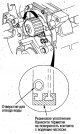
Caution: Do not open the radiator cap when the engine is hot, as the coolant is under pressure and may spill out. After the coolant has cooled, cover the cap with a rag and open it slowly. After installing the thermal...
Caution: Do not open the radiator cap when the engine is hot, as the coolant is under pressure and may spill out. After the coolant has cooled, cover the cap with a rag and open it slowly. After installing the thermal...
Checking the water pump
1. Remove the timing belt (see above). 2. Turn the water pump pulley counterclockwise and make sure it rotates smoothly. 3. Make sure that there is no coolant leaking from the pump. Note: A small amount of coolant may...
1. Remove the timing belt (see above). 2. Turn the water pump pulley counterclockwise and make sure it rotates smoothly. 3. Make sure that there is no coolant leaking from the pump. Note: A small amount of coolant may...

Replacing the water pump
1. Remove the timing belt (see above) 2. Remove the water pump. Caution: Check and clean the mounting surfaces. 3. Installation is performed in the reverse order of removal. Attention: Be careful not to drop the O-ring...
1. Remove the timing belt (see above) 2. Remove the water pump. Caution: Check and clean the mounting surfaces. 3. Installation is performed in the reverse order of removal. Attention: Be careful not to drop the O-ring...
This section is available on: russian, bulgarian, belarusian, ukrainian, serbian, croatian, romanian, polish, slovak, hungarian
Link in different formats to this section
TEXTHTMLBB Code
- General information
- Controls and instruments
- User manual
- Power unit
- Engine maintenance
- Engine repair
- Cooling system
- Engine management
- Power and exhaust system
- Transmission
- Automatic gearbox
- Drive shafts and differential
- Chassis and running gear
- Steering
- Car suspension
- Brake system
- Body and interior
- Doors, locks and windows
- Interior (internal elements)
- Exterior (external elements)
- Air conditioner
- Electrical equipment
- Power devices
- Equipment and devices
- Headlights and lighting
- Electrical circuits