
Examination
Caution: When performing the inspection, do not allow dust or other foreign objects to enter the gearbox.
Note:
- Check the fluid level with the engine warmed up to normal operating temperature (the radiator fan will turn on twice).
- Check the fluid level 60-90 seconds after the engine has stopped.
1. Park the car on a level surface, then turn off the engine.
2. Remove the dipstick (with a yellow ring) from the gearbox and wipe it with a rag.
3. Reinsert the dipstick into the gearbox, then remove it.
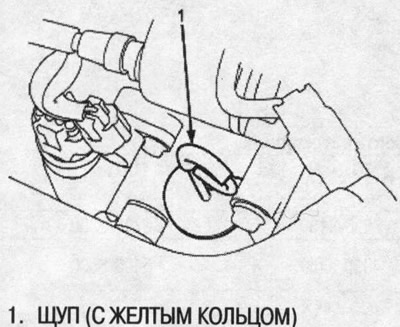
4. Check the fluid level. It should be between the upper and lower marks on the indicator.
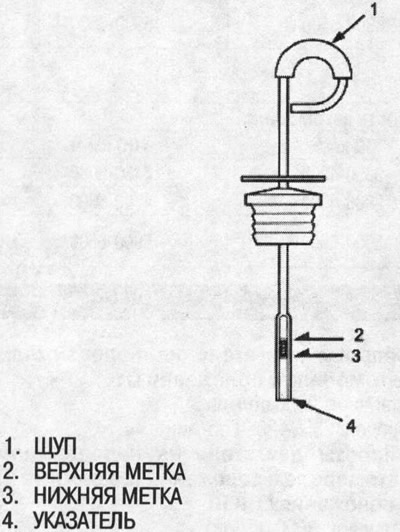
5. If the level is below the lower mark, add fluid into the filler hole and bring it up to the upper mark. Use only the following recommended fluid.
- European models: Genuine Honda CVT Fluid.
- Except for European models: Genuine Honda ATF PREMIUM (Automatic Transmission Fluid-PREMIUM).
Use of other fluids may adversely affect transmission performance and reduce transmission life.
6. Insert the dipstick back into the transmission.
Replacement
Caution: When replacing, do not allow dust or other foreign objects to enter the gearbox.
Replacement intervals:
- Models for Europe:
- Under normal and severe operating conditions: Every 45,000 km or 36 months.
Note: Replace the CVT fluid every 22,500 km or 18 months if, in addition to severe driving conditions, the vehicle is driven primarily at high speeds in high ambient temperatures (32°C).
- Except for European models: every 40,000 km or 24 months, then every 20,000 km or 12 months.
1. Warm up the transmission to normal operating temperature (the radiator fan will turn on) by driving the car.
2. Park the car on a level surface, then turn off the engine.
3. Remove the drain plug and drain the transmission fluid.
4. Screw the drain plug back in, installing a new washer.
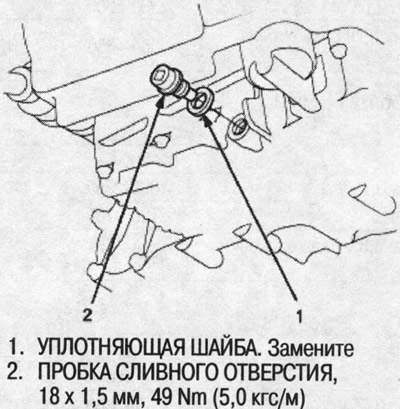
5. Fill the transmission with the recommended fluid through the filler hole to the upper mark on the level indicator scale. Always use the following recommended fluid:
- European models: Genuine Honda CVT Fluid.
- Except for European models: Genuine Honda ATF PREMIUM (Automatic Transmission Huid-PREMIUM).
Use of other fluids may adversely affect transmission performance and reduce transmission life.
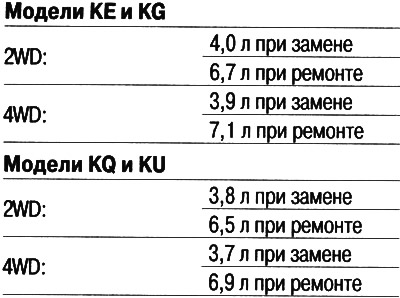
Transmission Fluid Capacity:
Pressure check
Warning!
- Beware of spinning wheels when performing the test.
- Ensure that lifts, jacks and safety stands are properly installed.
- Before testing, ensure that the gearbox is filled to the required level.
- Warm up the engine to normal operating temperature (the radiator fan will turn on).
- When performing the test, do not allow dust or other foreign objects to enter the gearbox.
1. Make sure the transmission fluid is filled to the required level.
2. Raise the car:
- 2WD: Raise the front of the vehicle and support it securely. Apply the parking brake and chock the rear wheels.
- 4WD: Raise the vehicle.
3. Ensure that the raised wheels rotate freely.
4. Warm up the engine to normal operating temperature (the radiator fan will come on), then turn it off and connect the tachometer.
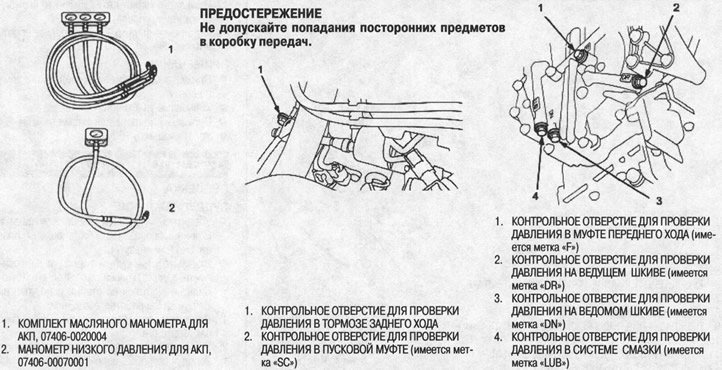
5. Connect the special tool to each of the test holes (figure on the adjacent page above).
Tightening torque: 18 Nm (1.8 kgf/m).
Note:
- If the transmission has a fault that causes the PCM to go into fail-safe mode, the pressure at the drive pulley may be higher than 3430 kPa (3.43 MPa, 35.0 kgf/cm²).
- Use an oil pressure gauge (commercially available) with a measurement range of up to 4900 kPa (4.90 MPa, 50.0 kgf/cm²) or more and an automatic transmission oil pressure gauge kit and an automatic transmission low pressure pressure gauge.
Warning!
- Connect the oil pressure gauge securely and prevent dust and other foreign objects from entering the gearbox through the inspection hole.
- If the D indicator lamp indicates a problem during troubleshooting, you must use an oil pressure gauge with a measurement range of up to 4900 kPa (4.90 MPa, 50.0 kgf/cm²) or more to measure the pressure in the drive and driven pulleys.
6. Start the engine.
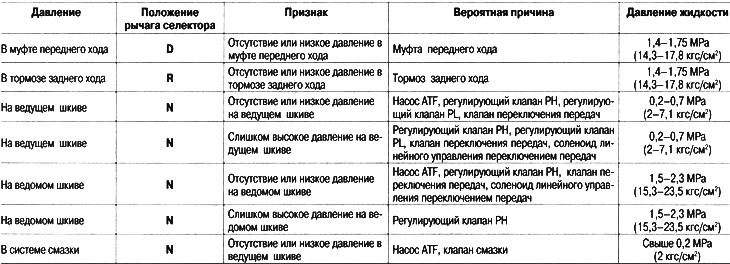
7. Move the selector lever to the appropriate position as shown in the table, and measure the pressure in the following components at 1500 rpm.
- Forward Clutch Pressure
- Reverse brake pressure
- Pressure on the drive pulley
- Pressure on the driven pulley
8. Shift to position N and measure the pressure in the lubrication system at 3000 rpm.
9. After performing hydraulic tests, disconnect the special tool.
10. Screw the plug into the inspection hole, installing a new sealing washer and tightening to the required torque.
Tightening torque: 18 Nm (1.8 kgf/m).
(The original is located on the website: HONDABOOK)