
2. Disconnect the vapor bleed tube from the EVAP two-way valve (A) and connect it to the tee (B) from the vacuum gauge (C) and vacuum pump (D) as shown in the illustration.
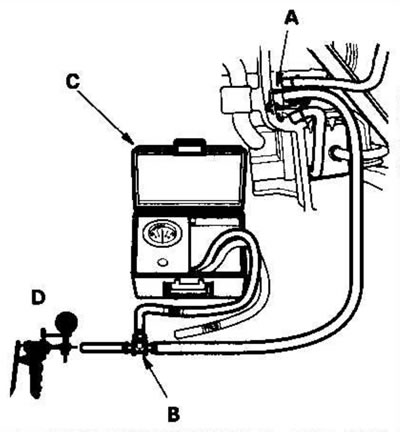
3. Slowly create a vacuum and continuously monitor the instrument readings.
The vacuum should immediately stabilize at 0.8-2.1 kPa (6-16 mmHg.).
If the vacuum stabilizes (the valve opens) at a level below 0.8 kPa (6 mmHg.) or higher than 2.1 kPa (16 mmHg.), install a new valve and retest.
4. Move the vacuum pump hose from the vacuum nipple to the pressure nipple, and the vacuum gauge hose from the vacuum side to the pressure side (A), as shown in the figure.
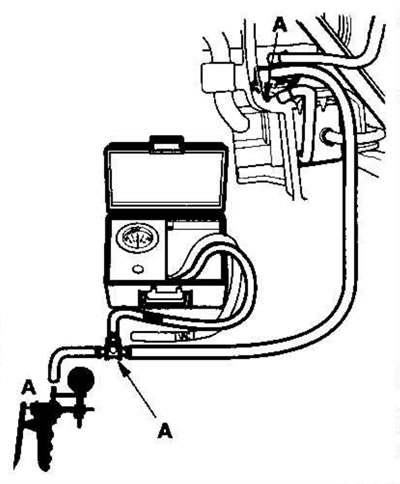
5. Slowly build up pressure in the vapor discharge tube while observing the instrument readings. The pressure should immediately stabilize at a level above 1.0 kPa (8 mmHg.).
- If the pressure stabilizes immediately (the valve opens) at a level above 1.0 kPa (8 mmHg.), the valve is ok.
- If the pressure stabilizes at a level below 1.0 kPa (8 mmHg.), install a new valve and retest.
(The original text of the article is located on the website HONDABOOK)