
Contents: Crankshaft, TDC and CYL sensors ⇊ Manifold Air Pressure (MAP) Sensor ⇊ Coolant Temperature Sensor (TW) ⇊ Intake Air Temperature (IAT) Sensor ⇊ Throttle Angle Sensor ⇊ Oxygen Sensor ⇊ EGR Valve Position Sensor ⇊ Atmospheric Pressure Sensor (PA) ⇊ Vehicle Speed Sensor (VSS) ⇊ Starter Signal ⇊ Signal Generator FR ⇊ Air conditioner signal ⇊ Battery Voltage (IGN 1) ⇊ Automatic Transmission Shift Lever…⇊ Power Steering Fluid Pressure Sensor ⇊ Electrical Demand Sensor (ELD) ⇊
Crankshaft, TDC and CYL sensors
The Crankshaft Angle Sensor (CRANK) signal is used to determine the injection timing and ignition timing, and to determine the engine speed. The TDC sensor signal is used to determine the ignition timing at startup and when the CRANK signal is incorrect. CYL (ЦЫЛ) - the sensor is used to detect the position of the first cylinder (to maintain sequential fuel injection into the cylinders). These sensors are located inside the distributor. Signals are generated when the gears pass by the sensing coils. In some cases, the CYL sensor is included together with the previous two. In this case, the function of these sensors does not change, but if any of these sensors is defective, the entire distributor must be replaced as a whole.
Manifold Air Pressure (MAP) Sensor
The sensor converts manifold air pressure into electrical signals and feeds them to the ECU. This information is used along with signals from the CRANK sensor to calculate the main injection duration.
Coolant Temperature Sensor (TW)
The sensor uses a temperature-dependent diode (thermistor) to measure changes in coolant temperature. The basic injection duration is based in part on signals sent from this sensor via the ECU. The thermistor's resistance decreases as coolant temperature increases.
Intake Air Temperature (IAT) Sensor
This device is also a thermistor and is placed in the intake manifold. It operates like many water temperature sensors but with a reduced thermal capacity for faster response to temperature changes. The injection duration determined by the ECU is changed for different operating conditions by signals sent from this sensor.
Throttle Angle Sensor
This sensor is a potentiometer that converts the valve position into an electrical signal. The signal is about zero volts when the valve is closed and increases to 5 volts when the valve is wide open. The sensor is mounted on the front side of the throttle valve.
Oxygen Sensor
The oxygen sensor senses the oxygen content in the exhaust gas and sends an electrical signal to the ECU. The ECU uses this signal to control the fuel injection duration to maintain a specific air/fuel ratio of 14.7:1.
The sensor is located either in the exhaust manifold or in the exhaust pipe before the catalytic converter. On 2.0 p models from 1990, 2 sensors are used.
This sensor is a conical shape made of zirconium. Its inner and outer surfaces are coated with platinum, which forms a platinum electrode. The inner surface contacts the atmosphere, the outer surface is exposed to the exhaust gas flow. When the oxygen concentration on the outer and inner surfaces differs, a voltage appears at the sensor output.
The device operates by changing the voltage caused by changes in the content of impurities in the exhaust stream. Oxygen sensors are effective only at the proper temperature. Some models use oxygen sensors with heaters. The heater stabilizes the sensor output signal and allows the sensor to warm up faster after starting the engine.
EGR Valve Position Sensor
The EGR valve position sensor is used on all Accords and Preludes. The ECU controls the operation of the EGR valve using the EGR control solenoid. The position sensor translates the movement of the EGR rod into an electrical signal that is returned to the ECU. For optimal control, the ECU compares this signal with programmed values. The sensor is located on the EGR valve.
Atmospheric Pressure Sensor (PA)
Similar to the MAP sensor, the barometric pressure (BA) sensor converts atmospheric pressure into a voltage signal that is sent to the ECU to vary the injection duration to compensate for changes in atmospheric pressure.
The PA sensor is located inside the passenger compartment. On the Prelude, the sensor is located on the ECU on the right side under the dash. On the Accord, the sensor is built into the ECU and is not accessible.
Vehicle Speed Sensor (VSS)
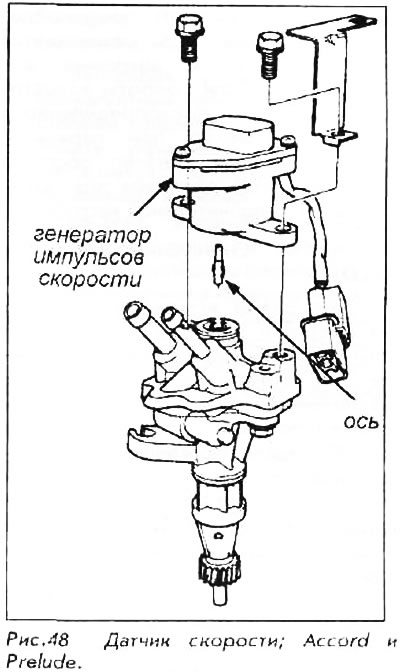
The signal from the vehicle speed sensor is used by the eCu, as well as the cruise control system and/or automatic transmission control units. The Accord and Prelude use an external sensor mounted on top of the speed sensor in the engine bay. The speed sensor has a gear mechanism driven by the engine and controls the power steering depending on the speed of the vehicle. An electrical pulse generator is mounted on top of this unit and is connected to it by a small shaft. The motion from the lower unit is transmitted to the upper unit; resulting in an electrical signal being sent to the appropriate control units.
Starter Signal
The START position of the ignition key sends a signal to the ECU. During starting, the ECU increases the amount of fuel injected according to engine temperature. The fuel supply is gradually reduced when the starter switch is returned to the OFF position.
Signal Generator FR
The ECU receives a signal from the generator when the system is charging.
Air conditioner signal
The load on the engine increases when the compressor is running; the ECU should increase idle speed as needed. In some cases, the ECU will limit the air conditioner by turning it off via the control relay. For example, when the throttle is wide open or when the engine is cold. If the car has a separate A/C control unit, both units exchange information regarding the state of the system.
Battery Voltage (IGN 1)
A 12-volt voltage signal controlled by the ignition key in the IGN1 (ON or RUN) position is sent to the ECU.
Automatic Transmission Shift Lever Position Signal
This signal is sent to the ECU via the neutral safety switch. The ECU will not allow the engine to start unless the gearshift lever is in the N (neutral) or PARK (stop) position.
Power Steering Fluid Pressure Sensor
When the power steering fluid pressure exceeds a predetermined level, the ECU is alerted by a pressure-sensitive switch. If the idle speed is below a predetermined level, such as when parking, the control unit will increase the engine idle speed to compensate for the additional load.
Electrical Demand Sensor (ELD)
This sensor is used only on the Accord and is located under the hood in the fuse and relay box. It detects the presence of increased current consumption in the system and sends a signal to the ECU.
The ECU will use idle speed control to compensate for the additional load from headlights and windshield heaters, heaters or similar high-power current consumers.
The ELD unit is integrated with the fuse box in which it is located; if the sensor is out of order, it is replaced with a working one together with the fuse box.
[The original is located on the website HONDABOOK]