
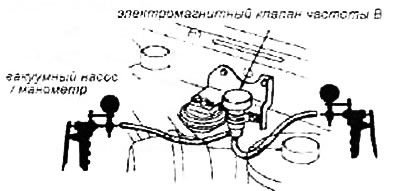
Disconnect the lower vacuum hose of the solenoid valve from the vacuum stabilizer generator and connect the vacuum pump.
Disconnect the upper solenoid vacuum hose from the rectifier and connect a pressure gauge.
Disconnect the 2-pin connector near the solenoid valve.
Create a vacuum.
If the solenoid valve does not hold vacuum, it should be replaced.
If the solenoid valve holds vacuum, then connect the positive battery terminal to the Green/Black terminal of the 2-pin connector and the negative battery terminal to the Black terminal.
Next, create a vacuum.
If the pressure gauge shows no vacuum, the solenoid valve should be replaced.
If the pressure gauge shows a vacuum, then you should disconnect the contacts of the 2-pin connector from the battery.
If the pressure gauge now shows a vacuum, then the solenoid valve should be replaced.
If the pressure gauge shows no vacuum, then the vacuum hose should be reconnected.
Next, warm up the engine to operating temperature until the cooling fan comes on.
Measure the voltage between the Green/Black (+) and Black (-) terminals on the main wiring harness while the engine is running at approximately 2500 RPM.
If the voltage alternates between 0 and 12 volts, the vacuum line should be checked for proper connection, cracks, plugs, or a disconnected hose.
If the voltage does not change as described, then measure the voltage between the Green/Black (+) and Black (-) terminals and ground while the engine is running at approximately 2500 rpm.
If the voltage alternates between 0 and 12 volts, then the break in the Black wire between the solenoid valve and point G5 should be repaired.
If the voltage does not change as indicated, then you should check for a break in the Green/Black wire between the electromagnetic valve and terminal 29 of the control unit. If the wire is normal, then you should refer to the diagnostics section of the control module inputs.
[Based on materials from the website: hondabook.ru]