
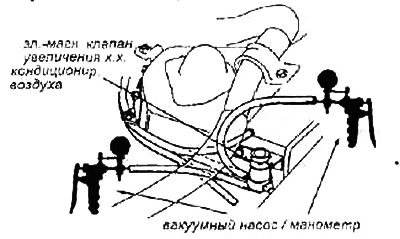
Disconnect the lower solenoid vacuum hose from the 3-way fitting and connect the vacuum pump.
Disconnect the upper solenoid vacuum hose from the vacuum manifold and connect a pressure gauge.
Start the engine. Create a vacuum. If the electromagnetic valve holds a vacuum, then see item A), if not - item B).
A) Turn on the A/C switch.
Create a vacuum.
If the pressure gauge shows the presence of a vacuum, then see point A1), if not - point A2).
A1) Turn off the A/C switch.
If the pressure gauge shows a vacuum, the solenoid valve should be replaced.
If not, the vacuum line should be checked for proper connection, cracks, plugs, or disconnected hoses.
A2) Disconnect the 2-pin connector near the solenoid valve.
Measure the voltage between the Red (+) and Black (-) terminals on the air conditioner wiring.
If there is battery voltage, then the solenoid valve should be replaced.
If there is no voltage, measure the voltage between the Red (+) terminal and ground.
If there is battery voltage, then the break in the Black wire between the solenoid valve and point G15 should be repaired.
If there is no voltage, then you should inspect for a break in the Red wire between the electromagnetic valve and terminal 17 of the control unit. If the wire is normal, then you should refer to the diagnostics section of the control module inputs.
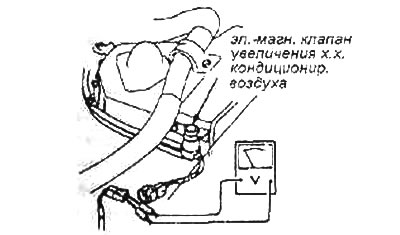
B) Disconnect the 2-pin connector near the solenoid valve.
Measure the voltage between the Red and Black terminals of the air conditioner wiring.
If there is voltage, then you should refer to the section on diagnostics of control module inputs.
If there is no voltage, then the solenoid valve should be replaced.
(The article was taken from the website «HondaBook»)