
HondaBook.ru
Auto companies Volkswagen Auto companies Ford Auto companies Lada Auto companies Skoda Auto companies BMW Auto companies Mazda Auto companies Peugeot
English Русский
Български
Беларускі
Український
Српски
Hrvatski
Română
Polski
Slovenský
Magyar
Bookmark Contacts Sitemap   


Accord Civic Fit / Jazz CR-V HR-V Others Articles
Accord 3 (1985-1989) Accord 6 (1997-2002)

Spark plugs (Honda Accord 3)

  • Main
  • Honda Accord
  • 3 (1985-1989)
  • Power unit
  • Engine adjustment
  • Spark plugs
0
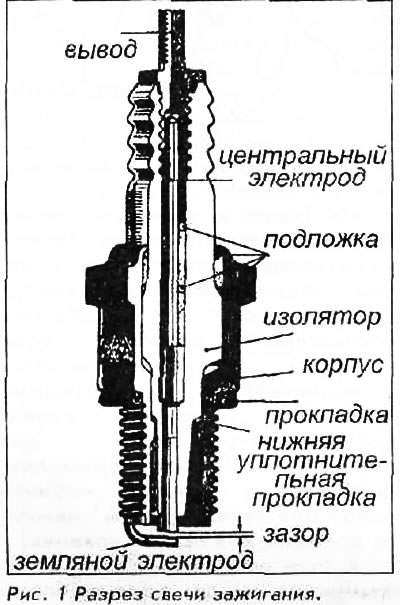
The spark plugs ignite the air/fuel mixture in the cylinder when the piston reaches its maximum compression point. The controlled ignition causes the piston to move downwards, turning the crankshaft and the rest of the engine.

The spark plugs ignite the air/fuel mixture in…


The average life of spark plugs depends on a number of factors: the mechanical condition of the engine, the type of fuel, driving conditions and the skill of the driver. Although a standard factory plug will last a considerable period of time, extended life can be achieved on some engines by using platinum-tipped plugs. Decide for yourself whether the extra cost is worth it.

When removing spark plugs, check their condition. The condition of the plugs is a good indicator of the condition of the engine. A slight deposit of light yellow or gray material (or rusty red on unleaded fuel) on spark plugs that have been in use for some time should be considered normal. Any other color, or abnormally large amounts of deposit, indicate that something is wrong with the engine.

The gap between the central and side (ground) electrodes increases slightly during normal operation.

When spark plugs are functioning properly, or more accurately, when the plugs are installed in an engine that is functioning properly, the plugs can be removed, cleaned, gapped, and reinstalled in the engine without any harm to the engine's operation. This is acceptable for some improvement in the plugs' performance or, in extreme cases (e.g., when there is nothing to replace them with), but new plugs are always preferable.


If the spark plugs are clogged (no normal spark), you need to find the cause (or source) of the contamination, eliminate it, and clean or replace the spark plug. Replacement is always recommended if possible.
If the spark plugs are clogged (no normal spark),…


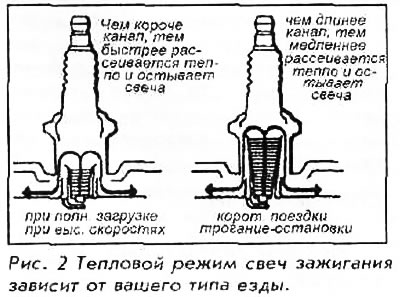
The different spark plugs suitable for use in your engine are designed to operate in different temperature ranges. The amount of heat the plug can absorb is determined by the length of the lower insulator. The longer the insulator, the higher the temperature the plug will operate at; the shorter the insulator, the lower the temperature. Spark plugs that absorb little heat and run too cool will accumulate lead, oil and carbon deposits because they are not hot enough to shed (desorb) the deposits. This leads to fouling of the plugs and, subsequently, poor ignition performance. Spark plugs that absorb too much heat will not accumulate deposits, but the electrodes will wear too quickly and, in some cases, overheating can lead to premature ignition.

Pre-ignition occurs when the spark plug tips become so hot that they ignite the air/fuel mixture before the spark actually occurs. Pre-ignition usually causes a knocking sound at low speeds and under heavy loads. In the most severe cases, the heat can become great enough to cause the air/fuel mixture to burn throughout the entire combustion chamber, rather than just at the front of the spark plug. In this case, the explosion is strong enough to damage pistons, rings, and valves.

In most cases, the manufacturer's recommended temperature range is correct; it is selected to provide adequate performance over a wide range of operating conditions. However, if most of your driving involves long distances and high speeds, you may want to set your spark plugs one step colder than the recommended standard. If most of your driving is short and involves a variety of conditions (such as start-stop) where the engine may not always reach operating temperature, a hotter plug may help burn off the deposits that tend to accumulate under these conditions.
This article is available at: russian, bulgarian, belarusian, ukrainian, serbian, croatian, romanian, polish, slovak, hungarian
This information has been verified: Yaroslav Shiryaev
Share with friends:
◀ Previous
Accord 3: Engine adjustment
Next ▶

Adjustment procedures
Specification of adjustments for gasoline engines
Removal spark plugs
Inspection of spark plugs
Installing spark plugs
Spark plug connection wires
Frequency of ignition
See also other articles from Honda manuals:
Spark plugs — inspection and replacement Honda Civic 3 and 4 (1983-1991)
Checking spark plugs Honda Fit 1 (2001-2008)
Spark plugs — checking and replacing Honda CR-V 1 (1995-2001, petrol)
Checking spark plugs Honda HR-V 1 (1998-2006, petrol)
Cleaning, checking and adjusting the spark plug gap Honda Avancier 1 (1999-2003, petrol)
Link in different formats to this article
Comments and feedback from visitors
No comments yet


How much will 35 + 23 ?


Accord 6 (1997-2002) 
  • General information
  • Introduction to the guide
  • User manual
  • Maintenance
  • Power unit
  • Four-cylinder engines
  • Six-cylinder engines
  • Engine overhaul
  • Cooling system
  • Heater and air conditioner
  • Power and exhaust systems
  • Engine electrical equipment
  • Engine management
  • Transmission
  • Mechanical gearbox
  • Automatic gearbox
  • Clutch and drive shafts
  • Chassis and running gear
  • Brake system
  • Car suspension
  • Steering
  • Body and interior
  • Exterior (external elements)
  • Interior (internal elements)
  • Electrical equipment
  • Equipment and devices
  • Electrical circuits
Accord 3 (1985-1989) 
  • General information
  • Maintenance
  • Power unit
  • Engine adjustment
  • Engine repair
  • Engine electrics
  • Emission management
  • Engine management (carburetor)
  • Electronic injection
  • Programmable injection
  • Schematic of emission system
  • Fuel system
  • Feedback management
  • Transmission
  • Manual gearbox
  • Automatic gearbox
  • Clutch
  • Chassis and running gear
  • Front suspension
  • Rear suspension
  • Steering
  • Brake system
  • Electrical equipment
  • Ventilation and heating
  • Air conditioner
  • Cruise control system
  • Equipment and devices
HondaBook.ru © 2018–2026 • Mobile version • Sitemap: EN BG BY UA RS HR RO PL SK HU • Feedback • Driver Information • Search system • Bookmark
Accord 3 (1985-1989) • Accord 6 (1997-2002) • Civic 3 and 4 (1983-1991) • Civic 5 and 6 (1991-2000) • Civic 6 (1995-2000) • Civic 7 (2000-2005) • Civic 8 (2005-2011) • Fit 1 (2001-2008) • CR-V 1 (1995-2001) • CR-V 2 (2002-2006) • HR-V 1 (1998-2006) • Avancier 1 (1999-2003) •
 
This website uses cookies to ensure proper functioning. By clicking "OK," you agree.