
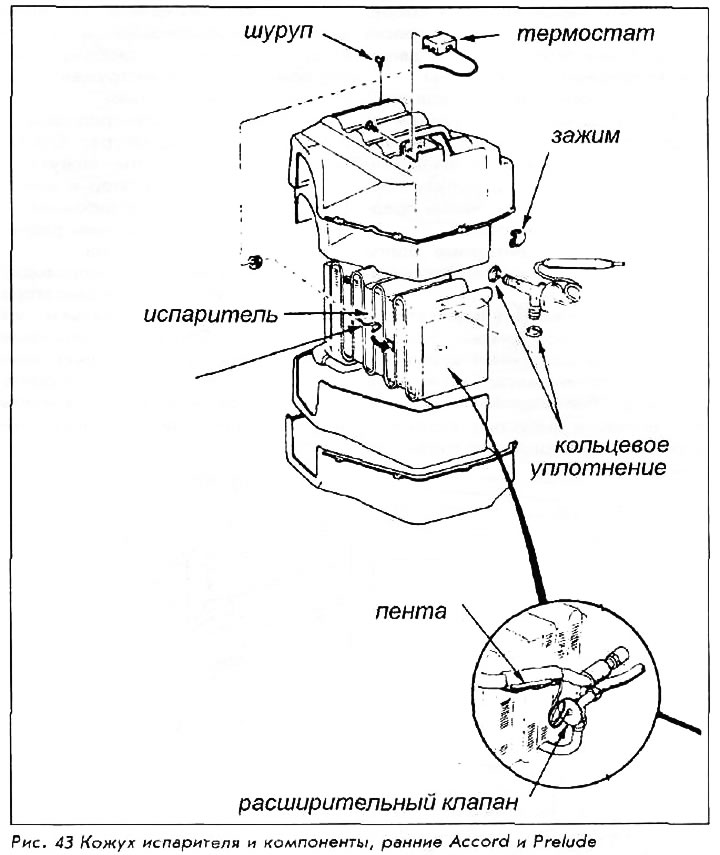
1. Disconnect the cable from the negative battery terminal.
2. Carefully drain the coolant.
3. Disconnect the line and hose from the evaporator joints on the firewall in the engine compartment. Support the joints with a second wrench. Immediately cover the joints to prevent dirt from entering
4. Remove the sealing rings from the thermal insulation partition.
5. Remove the glove box and its frame.
6. In the evaporator, loosen the right sealing strip; move it to the left.
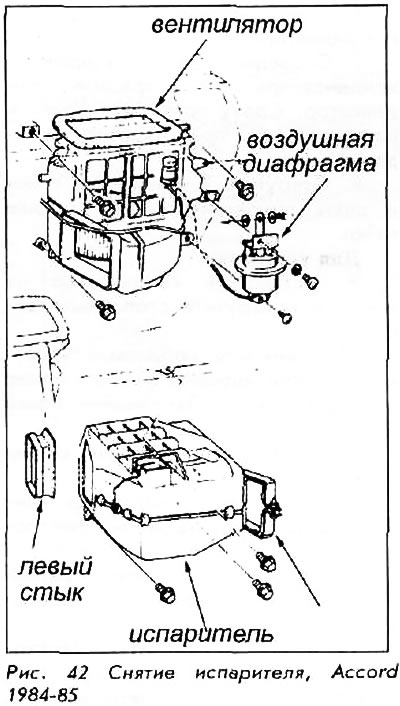
7. Remove the screw from the air diaphragm. Leave the diaphragm attached to the handle. Remove the fan mounting bolts and remove the fan assembly.
8. Remove the left sealing strip and disconnect the wiring. Unscrew the 3 bolts and remove the evaporator.
9. To disassemble the casing, unscrew the screw and remove the clamps from the casing.
10. Carefully move the compartment halves apart to gain access to the capillary tube. Remove the thermostat tube from the evaporator plates.
11. Separate the casing halves. Remove the cover.
12. Remove the expansion valve if necessary.
To install:
13. Assemble the housing components as needed. Install the capillary tube in its original location. Assemble the upper and lower halves of the housing, making sure there are no gaps in the housing.
14. Install the evaporator assembly and tighten the mounting bolts. Be sure to attach the evaporator drain hose and route it to the outside of the vehicle.
15. Install the left sealing strip. Connect the electrical wiring.
16. Install the fan assembly.
17. Install the air diaphragm and tighten the screw.
18. Install the right sealing strip and tighten it. Double check each strip; they should be positioned evenly and tightened well.
19. Install the glove box and frame.
20. Install the sealing rings. Lubricate the contact surfaces before installation.
21. Connect the line and hose to the evaporator joints. Replace the O-rings with new ones. Tighten the receiver-dryer line to 16 Nm and the suction hose to 30 Nm.
22. Fill the refrigerant and bleed the system. Start the system and check for leaks.
(The article was copied from the website: «hondabook»)