
Note: See fuel gauge wiring diagram in Chapter. "Body electrical equipment".
1. Before testing, check the INSTRUMENT UGHT (7.5A) fuse in the under-dash fuse/relay box.
2. Remove the inspection panel from the floor.
3. Turn the ignition switch to the OFF position, then disconnect the 5-pin connector from the fuel pump.
4. Measure the voltage between terminals #1 and #2 of the 5-pin fuel pump connector when the ignition key is turned to the ON (II) position. It should be between 5 and 8 V.
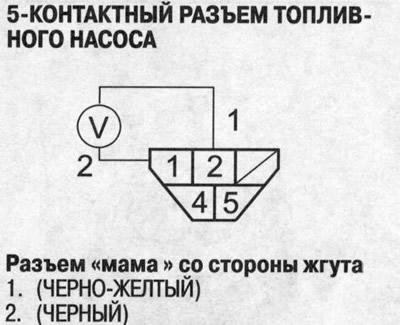
- If the voltage is within normal limits, proceed to step 6.
- If the voltage is different from the norm, check:
- Is there a break in the BLACK-YELLOW or BLACK wire?.
- poor grounding (G501).
5. Turn the ignition key to the OFF position.
6. Connect a jumper wire between terminals No.1 and No.2 of the 5-pin fuel pump connector, then turn the ignition switch to the ON (II) position.
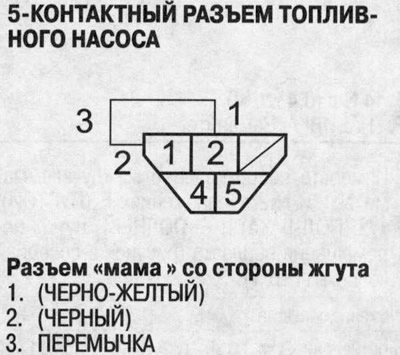
7. Make sure that the fuel gauge needle starts to move towards the "F" mark.
- If the gauge needle does not move at all, replace the fuel gauge.
- If the fuel gauge is OK, check the fuel gauge sensor.
Note:
- Before the needle reaches the "F" mark on the gauge scale, turn the ignition key to the OFF position. Failure to do so may damage the gauge.
- The fuel gauge is a coil type, therefore the fuel level is displayed continuously even when the ignition key is turned to the OFF position and the needle moves slower than the bimetal type gauge.
The original text of the article is located on the website HONDABOOK.ru