
Testing the signal lamp
Note: See fuel gauge wiring diagram in Chapter. "Body electrical equipment".
1. Before testing, check the INSTRUMENT LIGHT (7.5A) fuse in the under-dash fuse/relay box.
2. Park the car on a level surface.
3. Drain the fuel tank: Disconnect the fuel return line from the fuel pressure regulator and connect a suitable hose to the regulator nipple. Place the other end of the hose in a container suitable for gasoline. Start the engine and let it run until the tank is empty (the engine will stall).
4. Add less than 6.9 L of fuel and turn the ignition switch to the ON (II) position. The low fuel warning light should come on within four minutes.
Low fuel warning light
- If the lamp lights up after four minutes, proceed to step 9.
- If the lamp does not light after four minutes, proceed to step 5.
5. Remove the inspection panel from the floor.
6. Turn the ignition switch to the OFF position, then disconnect the 5-pin connector from the fuel pump.
7. Turn the ignition key to the ON (II) position.
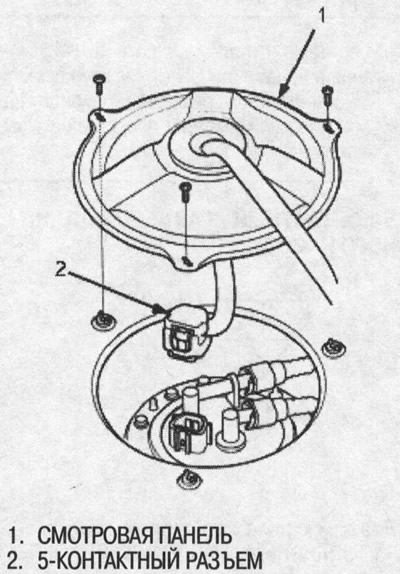
- If the light comes on, replace the fuel gauge sensor (see above).
- If the lamp does not light, check:
- Is there a break in the BLACK/YELLOW wire between the fuel gauge sensor and the fuel gauge assembly?.
- Is the light bulb burnt out?.
- Poor grounding (G501).
- Is the fuel level indicator assembly faulty?.
8. Add 4 liters of fuel. The lamp should go out after four minutes.
- If the lamp does not go out, check:
- Is there a break in the BLACK/YELLOW wire between the fuel gauge sensor and the fuel gauge assembly?.
- Is the fuel level indicator assembly faulty?.
- If the light goes out, the low fuel warning light is OK.
Original published on this resource hondabook