Note:
- When replacing the primary, secondary piston or master cylinder body, check and adjust the push rod clearance (see below).
- Clean all components in brake fluid and dry in open air; blow out all channels with compressed air.
- Before assembly, make sure that the components are free of dust and other foreign particles.
- Replace parts with new ones when instructed to do so.
- Do not mix brake fluid of different brands, as they may be incompatible.
- Do not reuse drained brake fluid. Use only clean Genuine Honda brake fluid or equivalent DOT3 or DOT4 brake fluid.
- Apply clean brake fluid to the piston seals, grease nipple and master cylinder walls.
- Use the recommended grades of lubricants included with the master cylinder seal kit.
1. Install the reservoir seal into the groove in the reservoir lid.
2. Install new rubber bushings, mesh filter and cap onto the tank.
3. Install the reservoir onto the master cylinder.
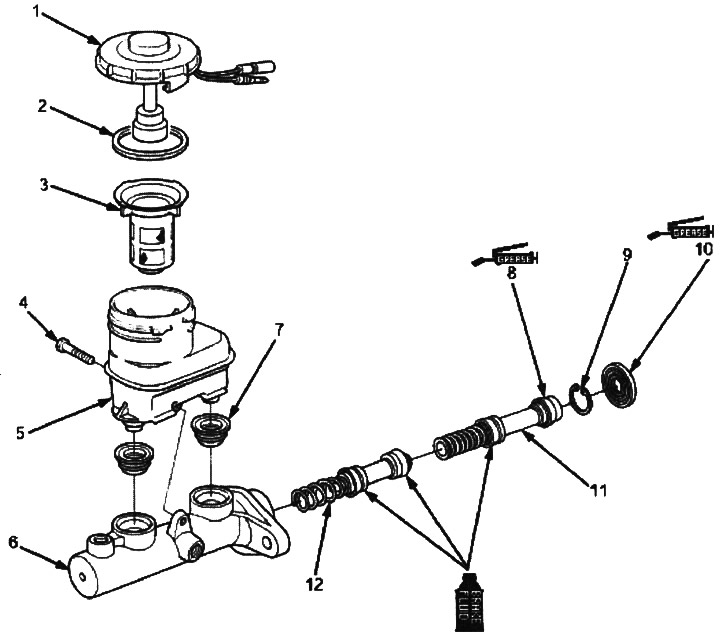
1. TANK LID
2. SEALING THE TANK
3. MESH FILTER
4. 3 Nm (0.3 kgf/m)
5. TANK
6. MAIN CYLINDER
7. RUBBER BUSHINGS. Replace
8. SECONDARY PISTON CUFF
9. RING CLAMP. Replace
10. ROD SEAL. Replace
11. SECONDARY PISTON. Replace
12. PRIMARY PISTON. Replace
4. Apply clean brake fluid to the seals of the new primary piston, then insert the primary piston into the master cylinder.
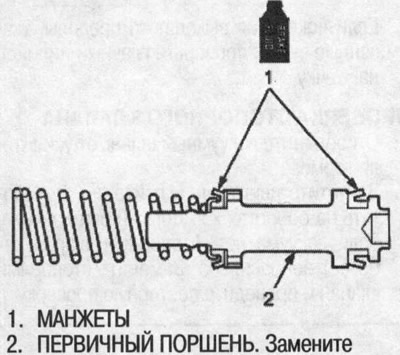
5. Apply the recommended rubber lubricant supplied with the master cylinder seal kit to the new secondary piston seal boot.
6. Apply clean brake fluid to the new secondary piston boot, then insert the secondary piston into the master cylinder.
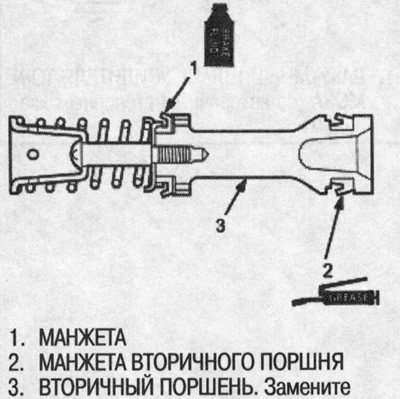
7. Install the new ring clamp by recessing the secondary piston.
8. Apply the recommended seal lubricant supplied in the master cylinder seal kit to the new rod seal and install it onto the brake booster mating surface.
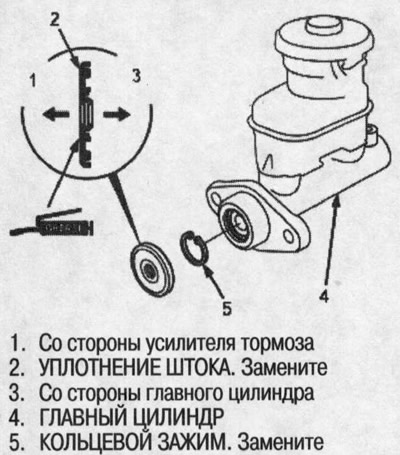
9. Adjust the clearance of the push rod (see below).
10. Install the master cylinder (see above).