
Note:
- The GVT type is stamped on an aluminum plate attached to the engine compartment bulkhead, in the line "TRANS/AXLE".
- For the procedure for replacing the working fluid in the variator, see the chapter "Maintenance and general check and adjustment procedures".
General information
The variator consists of a continuously variable transmission (two composite pulleys and a metal belt), a planetary gear (to ensure reverse movement), an intermediate gear, a main gear and control system elements.
The mechanical part of the variator consists of four parallel shafts (input shaft, shaft of the continuously variable transmission leading pulley, shaft of the continuously variable transmission driven pulley and shaft of the main gear). The input shaft is directly connected to the engine flywheel. The input shaft is connected to the shaft of the leading pulley via a planetary gear. A starting clutch is also installed on the shaft of the driven pulley, which ensures the start of the car's movement, and the driving gear of the intermediate gear. The driven gear of the intermediate gear is rigidly connected to the driving gear of the main gear.
To control the operation of the planetary gear set of the variator, a forward clutch and a reverse brake are used.
Electrical part of the control system
The electrical part of the variator control system consists of three parts:
- a) Sensors that determine the vehicle's condition parameters and transmit this data to the electronic control unit.
- b) The control unit, which determines the gear ratio of the continuously variable transmission, changes the direction of movement of the vehicle depending on the selected range.
- c) The actuator, which consists of electromagnetic valves.
The control unit uses electromagnetic valves to change the distance between the pulley cheeks, thus changing the gear ratio.
The speed change solenoid valve varies the pressure (DRC) supplied to the drive pulley control valve.
The pulley pressure control solenoid valve varies the pressure (DNC) supplied to the driven pulley control valve.
The starter clutch control solenoid valve varies the pressure supplied to the starter clutch (SQ), which varies depending on the degree of opening of the throttle valve.
The driven pulley control solenoid valve varies the pressure (DR) supplied to the driven pulley.
The driven pulley control solenoid valve changes the pressure (DN) supplied to the driven pulley.
Manual gear ratio change mode
Some modifications have a manual mode for changing the variator gear ratio.
In this mode, there are seven fixed positions of the variator pulleys, corresponding to the gears of a conventional gearbox. The seven "gears" are changed by the driver using the upshift and downshift switches on the steering wheel. The selected gear ratio number (range from "1" to "2") is displayed on the instrument cluster.
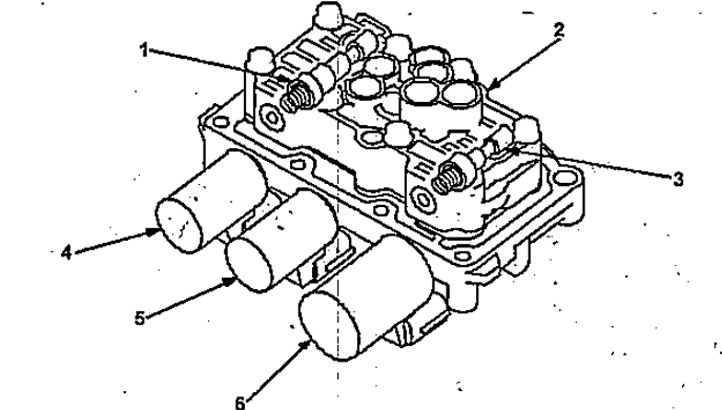
Solenoid valves.
1 - electromagnetic valve for controlling the drive pulley,
2 - valve bolt,
3 - electromagnetic valve for controlling the driven pulley,
4 - electromagnetic valve for speed measurement,
5 - electromagnetic valve for controlling pulley pressure,
6 - electromagnetic valve for controlling the starting clutch.
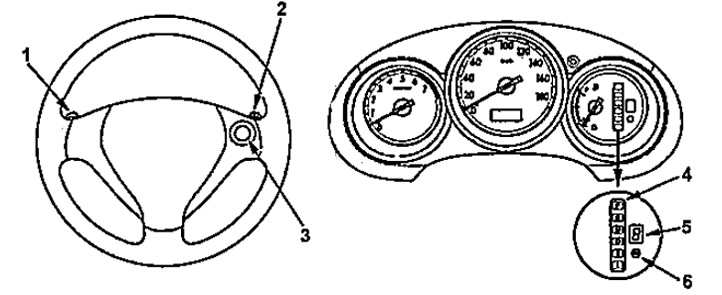
1 - manual shift upshift switch,
2 - manual gear downshift switch,
3 - manual switching mode switch,
4 - CVT selector position indicators,
5 - indicator of the selected gear ratio,
6 - indicator of manual switching mode activation.
Full version on the source website: HondaBook