
Note: Troubleshooting should begin with the simplest operations and proceed in order of increasing complexity.
1. Perform tire pressure checks and other preliminary checks.
2. Check for fault codes.
3. Check the gear shifting. If the shifting is normal, then check the electrical part of the control system.
4. Perform the following checks:
- a) Road tests. Make sure that the fault is related to the CVT.
- b) Hydraulic testing. Measure the pressure in the specified lines.
- c) Checking the gear engagement time. The wear of the variator parts is checked.
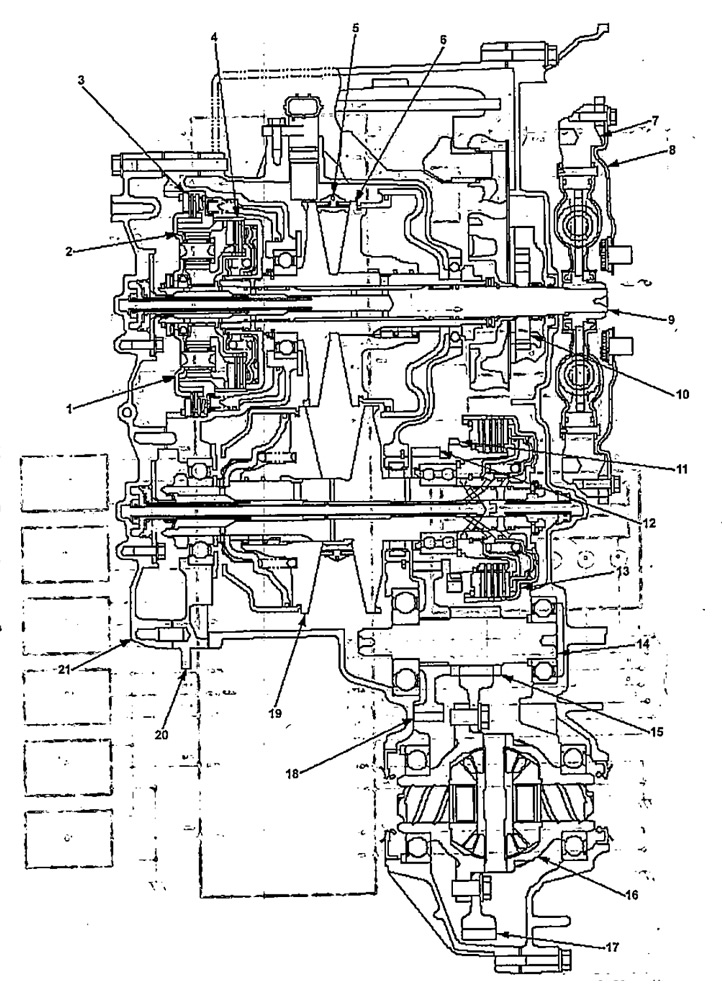
Variator.
1 - epicycle of the planetary gear set,
2 - planetary gear carrier,
3 - reverse brake,
4 - forward clutch,
5 - variator belt,
6 - leading pulley,
7 - flywheel,
8 - flywheel drive plate,
9 input shaft,
10 - variator pump,
11 - parking brake mechanism,
12 - intermediate gear drive pinion,
13 - starting clutch,
14 - main transmission shaft,
15 - main gear drive pinion,
16 - differential,
17 - driven gear of the main transmission,
18 - intermediate gear driven gear,
19 - driven pulley,
20 - intermediate part of the variator housing,
21 - CVT housing cover.
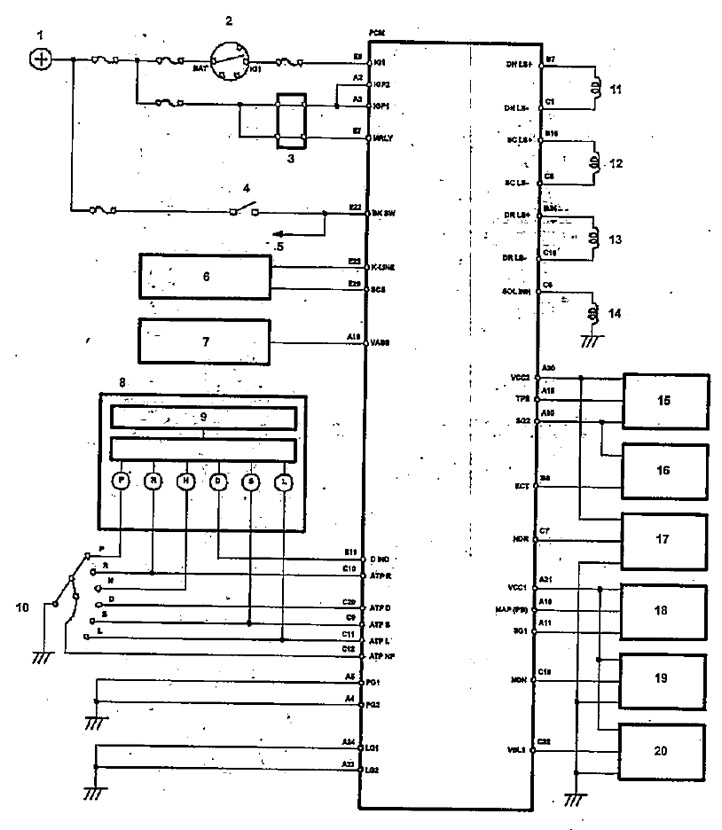
CVT control system signals.
1 - battery,
2 - ignition switch,
3 - main relay,
4 - brake light switch,
5 - to the brake lights,
6 - diagnostic connector,
7 - ABS control unit,
8 - instrument cluster,
9 - control unit,
10 - selector position sensor,
11 - electromagnetic valve for controlling pulley pressure,
12 - electromagnetic valve for control of start and clutch,
13 - electromagnetic valve for changing speed,
14 - electromagnetic start inhibit valve,
15 - throttle position sensor,
16 - engine coolant temperature sensor,
17 - drive pulley speed sensor,
18 - exhaust manifold pressure sensor,
19 - driven pulley speed sensor,
20 - CVT speed sensor.
[The original text of the article is located on the website «www.hondabook.ru»]