
a) Secure the brake disc by installing washers (A) and tightening the wheel nuts (B).
b) Install the pointer indicator.
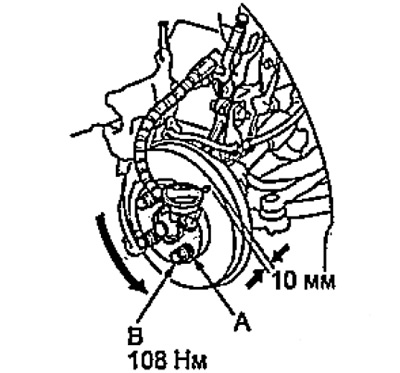
c) Rotate the brake disc and measure the axial runout of the disc at the outer edge of the disc surface that contacts the brake pads.
- Maximum axial runout - 0.1 mm
If the disc runout is not within the norm, check the bearing preload; hubs and the bearing itself. Adjust the preload if necessary.
2. Check the thickness and uniformity of wear of the brake disc.
a) Clean the surface of the brake disc that contacts the brake pads.
b) Using a micrometer, measure the thickness of the brake disc at a distance of approximately 10 mm from the edge of the disc every 45°.
- Nominal thickness - 9 mm
- Minimum allowable thickness is 8 mm
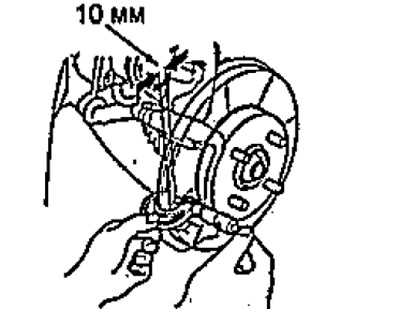
c) Subtract the minimum measured value from the maximum.
- Maximum measurement difference is 0.015 mm
If the brake disc is worn unevenly (the difference in measurements exceeds the maximum permissible value), grind or replace the brake disc.
If the brake disc thickness is less than the minimum allowable, replace the brake disc.
3. Check the thickness of the brake shoe linings.
a) Jack up the rear of the car and place it on stands.
b) Remove the wheels.
c) Check the thickness of the inner and outer brake shoe linings.
- Standard thickness is 7.5 mm
- Minimum thickness - 1.6 mm
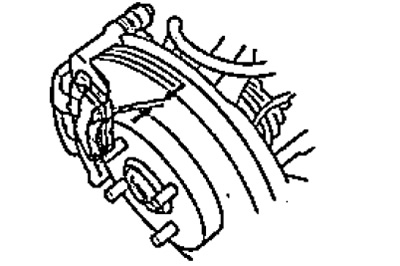
d) Replace the brake pads as a set (right and left sides at the same time) if at least one of the pad linings has a minimum or lesser thickness.