
Contents: General information ⇊ Key lock system ⇊ Gear shift lock system ⇊ Examination ⇊ Replacement and adjustment of the…⇊
Warning! The models of vehicles covered in this manual are equipped with a supplemental restraint system (SRS). Before performing any work near the air bag unit, steering column or instrument panel, turn off the SRS to avoid injury from accidental deployment (see Chapter On-board electrical equipment). The SRS circuit wiring is easily identified by the yellow color of the insulation.
General information
All AT-equipped models are equipped with a locking system that prevents unintentional gear shifting. The locking system consists of two subsystems: a gearshift locking system and a key locking system.
Key lock system
The system prevents the key from being removed from the ignition until the selector lever is moved to the "P" position. When the key is inserted into the ignition in any position other than "P", the electromagnetic actuator is activated, making it impossible to remove the key. To remove the key, move the lever to the required ("P") position.
Gear shift lock system
The system prevents the selector lever from being moved from the "P" position to the "R" or "D" positions without depressing the foot brake pedal. The lock is also activated when the brake and accelerator pedals are depressed simultaneously. In the event of a system failure, the lever can be unlocked by inserting the key into a special slot near the lever assembly.
Examination
1. The following checks of the electromagnetic actuators of both locks can be performed by an amateur mechanic at home. A more detailed diagnostics of the system should be performed in a car service workshop.
Note: Ignition Key Lock Electromagnetic Actuator
2. Remove the lower section of the instrument panel trim and knee support (see Chapter Body).
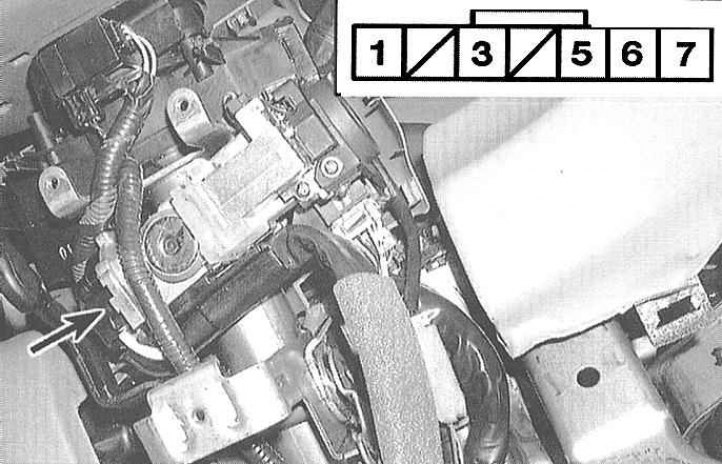
3. Disconnect the 7-pin main wiring harness connector.
4. Check the connector for conductivity between the terminals in different positions of the ignition switch. When the key is pressed into the lock, there should be conductivity between terminals 5 and 7 of the connector; when the key is released, there is none.
5. Make sure that it is not possible to remove the key when battery voltage is applied to terminals 7 (+) and 3 (-).
6. If the key cannot be removed, the locking system is functioning properly, otherwise the ignition switch assembly must be replaced (see Chapter On-board electrical equipment). Blockers are not produced individually.
Note: Shift Lock Electromagnetic Actuator
7. Remove the console (see Chapter Body).
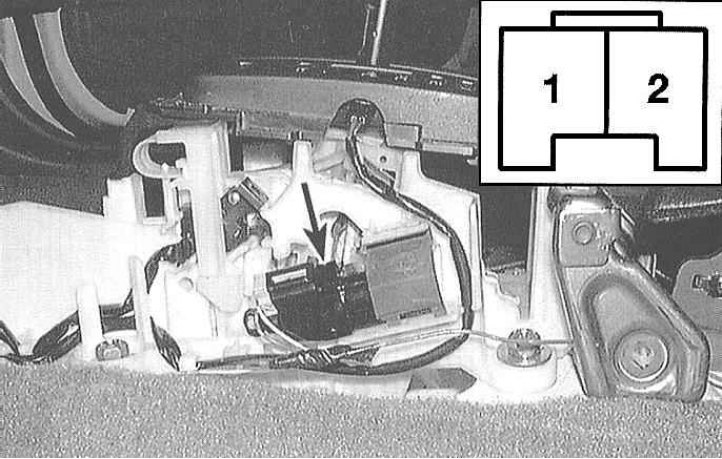
8. Disconnect the 2-pin shift lock solenoid connector.
9. Using two jumper wires, momentarily connect the battery to the connector terminals (positive pole to terminal 1, negative pole to terminal 2) - when power is supplied, it should not be possible to switch the lever, otherwise the device must be replaced.
Attention! Violation of the polarity of the battery connection may result in failure of the diode inside the electromagnetic assembly.
10. Remove the jumper wires and move the selector lever back to the "P" position.
11. Make sure that the lever lock disengages when it is pressed in and re-engages when released.
Note: Gear selector lever position switch
12. Remove the center console (see Chapter On-board electrical equipment).
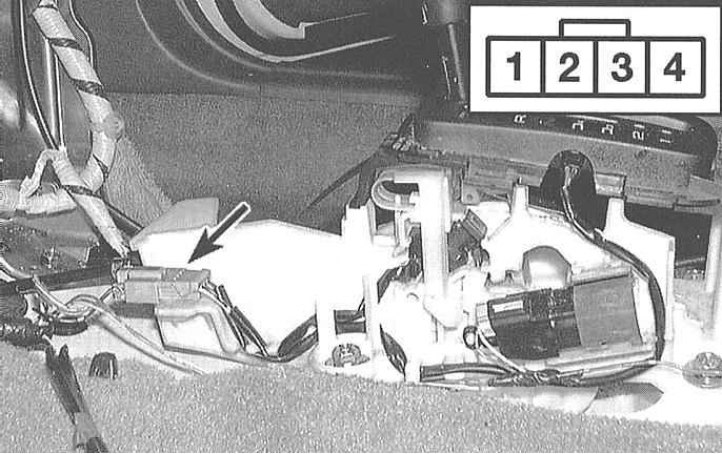
13. Disconnect the 4-pin connector of the selector lever position sensor-switch in the area of the center console.
14. Move the lever to the "P" position and check for conductivity between terminals 3 and 4 of the connector.
15. Now move the lever to the "N" position - the conductivity between terminals 3 and 4 should disappear.
16. If the results of the above check are negative, replace the sensor switch.
Replacement and adjustment of the electromagnetic actuator
Note: The following procedure applies to the shift interlock only. For information on replacing the ignition key interlock solenoid actuator, refer to the Ignition Lock Cylinder Replacement Section (see Chapter On-board electrical equipment).
1. Remove the center console (see Chapter Body).
2. Disconnect the 2-pin electromagnetic actuator wiring connector.
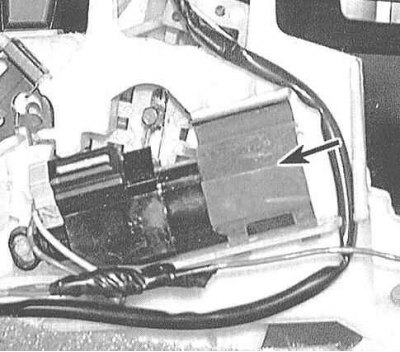
3. Pry off the actuator retainer.
4. Remove the actuator assembly with the plunger and plunger spring.
5. Installation is carried out in reverse order.