
Contents: Removal ⇊ Installation ⇊
Removal
1. Jack up the vehicle and place it on supports. Remove the gearbox (see Chapter Gear shift box).
2. On models with manual transmission, remove the clutch assembly (see Chapter Clutch and drive shafts). Immediately check the condition of the clutch components and the guide bearing.
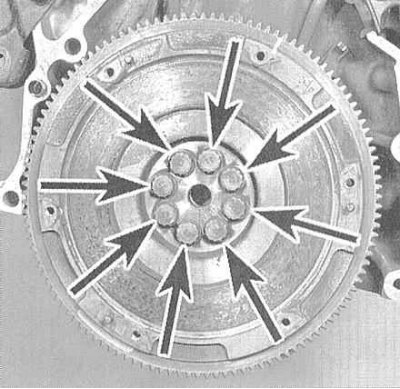
3. Loosen the flywheel/drive plate bolts on the crankshaft. If the shaft starts to turn while loosening the bolts, remove the starter (see Chapter Engine electrical equipment) and wedge a screwdriver between the teeth of the flywheel ring gear (manual transmission), or insert a long punch into one of the holes of the drive disk, resting it against the protrusion on the block (automatic transmission).
4. Remove the flywheel/drive plate from the crankshaft.
Note: The flywheel/drive plate assembly is quite heavy, so it is a good idea to have an assistant help you. Wear work gloves to avoid cutting your hands on the sharp edges of the teeth on the ring gear assembly.
5. Carefully wipe the flywheel with a rag soaked in acetone, completely removing traces of oil and grease. Check the working surface of the flywheel for cracks, grooves left by the heads of the clutch friction disk rivets, traces of overheating and scoring. Minor defects can be eliminated using fine-grained sandpaper. Check the toothed ring for cracks and chipped teeth. Place the flywheel on a flat surface to assess its flatness (use a flatness gauge). If necessary, give the assembly a turning.
6. Wipe the mating surfaces of the flywheel/drive plate and crankshaft. If there is evidence of oil leakage from the crankshaft rear oil seal, replace it (see Section Replacing the rear crankshaft oil seal).
Installation
1. Install the flywheel/drive plate onto the crankshaft.
Note: Some engines have a guide pin or asymmetrical mounting holes to ensure a consistent fit. Apply a sealant to the threads of the mounting bolts before installing.
2. With the flywheel/drive plate locked from turning (see paragraph 3), tighten the mounting bolts to the required torque in a diagonal pattern.
3. Further installation is carried out in the reverse order of dismantling the components.