
Contents: Examination ⇊ Replacement ⇊
Note: Powertrain suspension mounts rarely require attention, but damaged mounts should be replaced without delay to avoid increased stress and premature wear of transmission line components.
Examination
1. To check, it is necessary to slightly lift the engine, relieving the supports.
2. Jack up the car and place it on supports. Place the jack under the engine oil pan (to distribute the load, place a wooden block between the jack head and the pan). Raise the jack, slightly lifting the unit and relieving the supports.
Warning! Never perform any work under a vehicle that is supported in a raised position by a jack alone!
3. Check the support pads for cracks, signs of hardening of the rubber and delamination from the metal base. Sometimes the pads begin to break right in the middle.
4. Assess the amount of play between the support plates and the power unit/vehicle frame (use a crowbar or large screwdriver as a lever). If play is detected, lower the unit and tighten the support fasteners.
5. To avoid damage to the rubber, the cushions must be treated with a special protective compound.
Replacement
Disconnect the negative cable from the battery.
Warning! If the car stereo system is equipped with a security code, make sure you have the correct combination to activate the audio system before disconnecting the battery! Apply the parking brake, jack up the front of the car and support it. Support the engine (see paragraph 2 above).
Right support (passenger side)
1. The transmission end of the power unit is suspended by this support. The support pad is attached to the vehicle chassis and to a bracket secured to the top of the transmission case. After completing the procedures listed above, support the transmission with a jack, completely unloading the right support of the power unit.
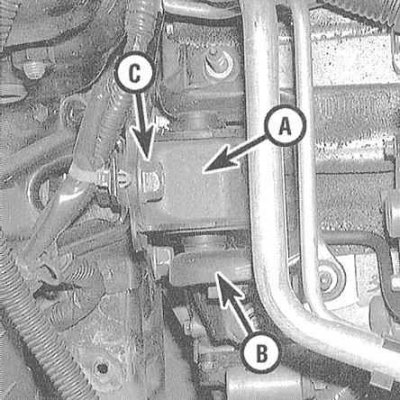
2. Unscrew the through bolt, then loosen the bolts securing the support to the vehicle chassis and remove the rubber cushion.
3. Installation is carried out in reverse order.
Note: The final tightening of the support fasteners to the required force should be performed only after the power unit has been lowered to the normal position. Proceed to the procedures listed below in paragraph 4.
Front support
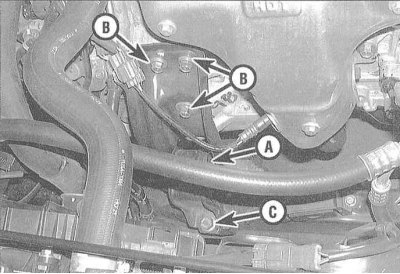
1. The front support of the powertrain suspension is located between the engine block and the radiator
2. Perform the procedures described in paragraph 1 of the Right Support (Passenger Side) section, then proceed in a manner similar to that described for the right support (see paragraphs 2 and 3 there).
3. Installation is carried out in reverse order.
Note: The final tightening of the support fasteners to the required force should be performed only after the power unit has been lowered to the normal position. Proceed to the procedures listed below in paragraph 4.
Rear support
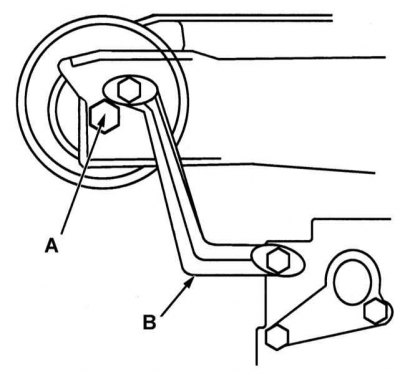
1. If the intake manifold is not removed, access to the support is very difficult and can only be opened from under the car. Loosen the through bolt and unload the support by jacking up the engine.
2. Loosen the bolts securing the support to the chassis, remove the through bolt, then lift the engine and release the support from underneath it.
 |
 |
3. Installation is carried out in reverse order.
Note: The final tightening of the support fasteners to the required force should be performed only after the power unit has been lowered to the normal position. Proceed to the procedures listed below in paragraph 4.
Left support (driver side)
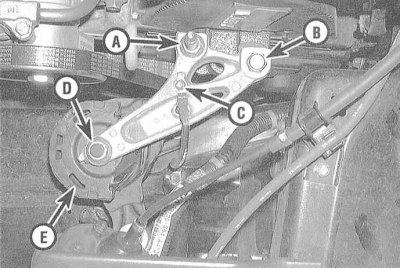
1. The left support of the power unit suspension is attached to the engine near the timing belt.
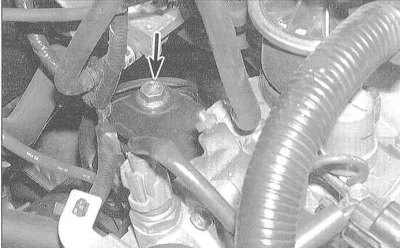
2. Support the engine, loosen the fasteners (see illustration) and remove the upper support bracket, then unscrew the through bolt and remove the support cushion from the bracket.
3. Installation is carried out in reverse order.
Note: Final tightening of the support fasteners to the required force should be performed only after the power unit has been lowered to the normal position. Proceed to the procedures listed below in paragraph 4. Final stage of tightening of fasteners of all supports.
4. In order to maximally extend the service life of rubber-metal mounts and reduce the level of noise and vibration, the final tightening of the mount fasteners with the required force should be carried out after lowering the power unit to the standard position (the car should be parked on a level horizontal surface).
Note. Use non-hardening sealant to lubricate the threaded portion of the fasteners (bolts and nuts). Make sure that the rubber bushings are not twisted or displaced from their seats. If more than one support has been replaced, or when installing the power unit, tighten the support fasteners in the following order:
- a) Rear support - first the bracket to block mounting bolts, then the through bolt and finally the support to chassis mounting bolts;
- b) Fasteners (bolt/nuts).
(The text can be found on the website: «hondabook.ru»)