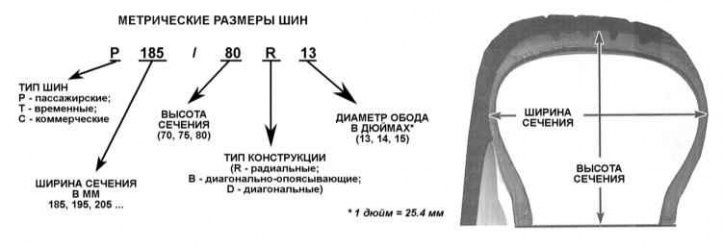
The wheels of all the models of cars described in this Manual are equipped with radial tires of metric size with fiberglass or steel cord. Installing tires of a different size on the car may affect its handling and ride comfort.
Attention! Never install tires of different designs on one vehicle axle! It is recommended to replace tires on both wheels of one axle at the same time. If only one wheel is replaced, make sure that the replacement tire matches the size of the pair.
Maintaining the correct tire pressure is extremely important for the vehicle's handling. Check your tire inflation pressure regularly, at least once a month (see Chapter Settings and ongoing maintenance). Also check the pressure before every long trip.
Wheel disks are subject to replacement in case of deformation, violation of the tightness of the tubeless tires on them, severe corrosion damage, violation of vertical symmetry, development to an oval shape of the bolt holes, as well as in case of constant spontaneous loosening of the fastening nuts. It is not recommended to carry out restorative repair of damaged disks using welding or riveting.
Wheel deformation is usually associated with running over curbs while parking the car carelessly. It is unacceptable to continue using the car with bent wheels - the wheel must be repaired at a tire shop. To check the condition of the wheels, jack up the car and place it on supports. Visually inspect the wheels for cracks and signs of deformation.
An important factor determining the parameters of movement and braking of the car is the balancing of the wheels as a whole. Violation of this parameter can significantly reduce the controllability of the vehicle, not to mention a noticeable reduction in the service life of the tires. Each time after replacing a tire, the wheel is subject to balancing in a tire shop.
[The article was taken from the website: HondaBook.ru]