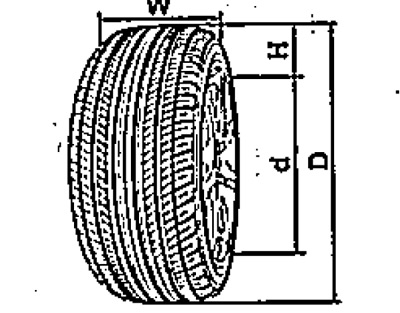
Tire sizes.
D - outer diameter,
d - wheel rim seat diameter,
H - tire profile height,
W - profile width.
When replacing tires, use only tires of the same size and design as the recommended tires for your vehicle and with the same or greater load capacity.
Using tires of any other size or type may seriously affect handling, comfort, speedometer/odometer accuracy, ground clearance, fuel economy, tire clearance or tire chain clearance.
Warning: Do not mix radial and bias tires. This may cause dangerous vehicle behavior, leading to loss of control.
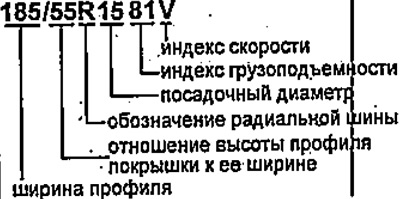
The following designations are possible in the marking:
185 - conditional width profit; expressed in millimetres. The value size is selected based on the table "Tire markings and tyre pressure" and must correspond to the tyre size recommended by the manufacturer.
55 - the ratio of the height of the tire profile to its width, expressed as a percentage (%),
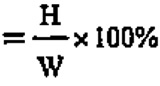
If this designation is absent, the ratio is 0.80...0.82. This size is selected based on the table "Tire markings and tire pressure" and must correspond to the tire size recommended by the manufacturer.
R - designation of radial tire.
B - designation of a diagonal tire. Radial and diagonal tires differ in the arrangement of the cord threads. Radial tires have lower rolling resistance and a longer service life compared to diagonal tires.
15 - tire seat diameter, expressed in inches. This size is selected based on the table "Tire markings and tire pressure" and must correspond to the tire size recommended by the manufacturer.
81 - conditional load-carrying capacity index. It is selected based on the table "Tire load-carrying capacity indices".
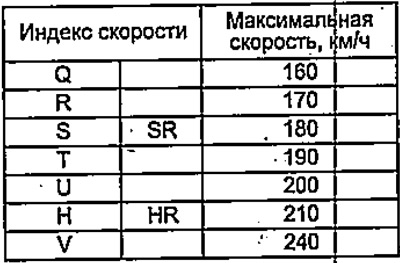
V is the tire speed index. It is selected based on the table "Tire speed indices":
Table. Tire speed indices