
Beginning in 1988, the Prelude ECU had a built-in self-test routine, typical of variable fuel injection models. This feature makes troubleshooting much easier, as the computer can tell you where to look for the problem.
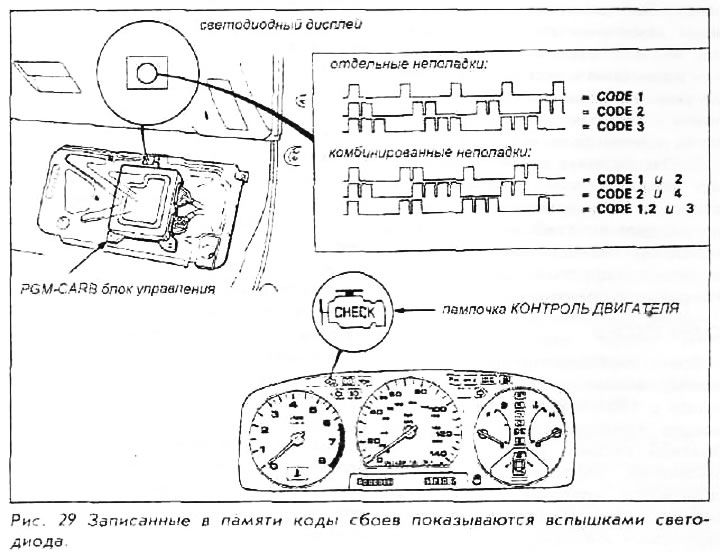
The engine control unit constantly monitors the input and output signals. As soon as it detects a signal outside the operating range - too small or too large a signal - it immediately turns on the CHECK ENGINE indicator light on the instrument panel. This alerts the driver to the presence of a malfunction. In addition, the ECU assigns a specific code to the malfunction that has occurred, which is written into the computer's memory. This code can later be retrieved and used to test the system.
The ECU has a software protection function. If there is an error in the real signal, the ECU ignores it and replaces it with a fixed value. When the control lamp is on, it means that the controller is currently using at least one fixed signal instead of the real one, which can worsen the driving characteristics of the car. Fixed signals are selected for the most standard driving conditions, such as a warm engine, moderate throttle opening, etc. If the fixed signal does not correspond to real conditions, the engine will operate differently from what is expected.
Several codes can be stored in the memory at once. The ability to narrow down the search for a faulty circuit to one or two significantly reduces testing time. The most common mistake when using fault codes is to assume that the component indicated by the code is faulty, and not the entire electrical circuit associated with it. (For example, code 1 indicates an incorrect oxygen content signal. But this does not automatically mean that the oxygen sensor is faulty. Usually, it works without failures. More often, a contact failure in the connector occurs.) Since the ECU monitors the incoming signal, any electrical component or component can cause a fault signal. A poor connection, poor grounding, and even a blown fuse can cause a noticeable change in the signal to the controller. When using fault codes, always remember to carefully check the entire circuit associated with the component indicated by the code. Most often, a fault is caused by a poor or corroded contact. The components themselves that generate the signals rarely fail under normal conditions.
Decoding codes
The ECU module is located in the front part of the floor, near the place intended for the front passenger's feet. Remove the floor mat. The large upper protective cover of this module will become visible. Fold back the diagnostic flap from the dashboard. There is a window on the upper edge of the cover through which the LED is visible. Turn on the ignition without starting the engine. The LED will start flashing. The number of flashes reflects the code number. For example, 14 flashes, a pause and 5 more flashes means code 14 and code 5.
In case the read code is not in the code list, you should recalculate the number of LED flashes. If, however, the code is incorrect, you need to replace the ECU module with a checked and working one and repeat the code reading. After reading the codes, refer to the corresponding diagnostic card for testing.
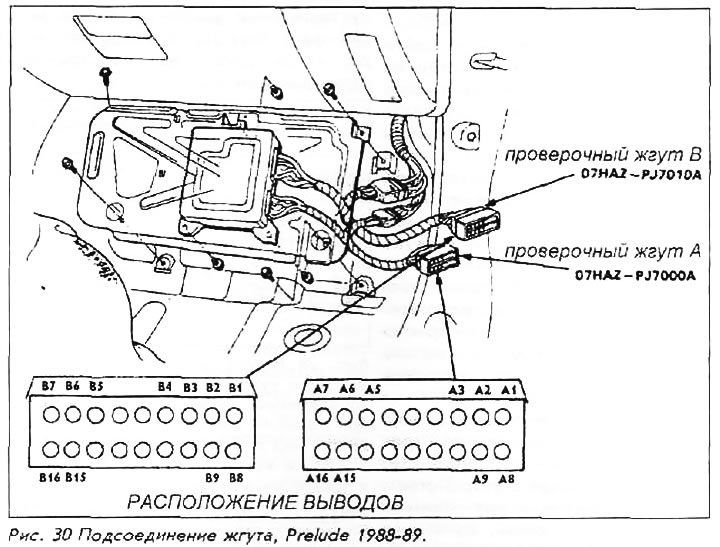
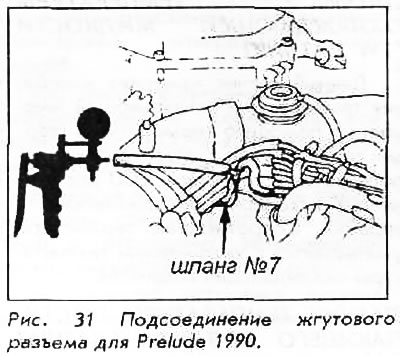
Please note that some tests require a Honda type tester. (Use part number 07HAZ-PJ7010A or 07HAZ-PH7000A for 1988-89 models and 07LAJ-PT30100 for 1990 models.) This tool allows safe testing of electrical circuits. It is connected between the ECU and the harness.
Prelude Model Error Codes (PGM-CARB System)
| Code 1 | oxygen content |
| Code 2 | vehicle speed pulse generator |
| Code 3 | manifold Absolute Pressure (MAP) electrical signal |
| Code 4 | signal from vacuum switch |
| Code 5 | manifold Absolute Pressure, Vacuum Signal (MAP) |
| Code 6 | coolant temperature |
| Code 7 | gear position signal (for automatic transmission); clutch switch signal (for manual transmission) |
| Code 8 | ignition coil signal |
| Code 10 | incoming air temperature |
| Code 14 | electronic Air Control (EACV) |
(Article source on the website: Hondabook.ru)