
1. Place the special tool firmly on the master cylinder as shown in the figure.
2. Press the central axis of the special tool so that it lightly touches the end of the secondary piston and, turning the lock nut in the direction of the arrow, fix the axis.
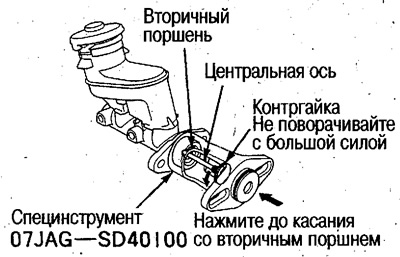
Caution: Be careful not to create a gap between the special tool and the master cylinder by applying excessive pressure to the center axis.
3. Without disturbing the position of the central axis, turn the special tool over and install it on the brake booster.
4. Secure the special tool with nuts (8 mm) and tighten them to the required torque.
5. Using a suitable hose, connect a vacuum gauge (special tool) between the brake booster and the brake booster vacuum hose.
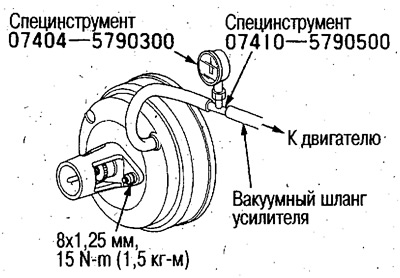
6. Start the engine and warm it up until the radiator fan runs twice.
7. Create a vacuum of 66.7 kPa (500 mmHg) in the master cylinder and stop the engine.
8. Using a feeler gauge, measure the gap between the adjusting bolt lock nut and the housing.
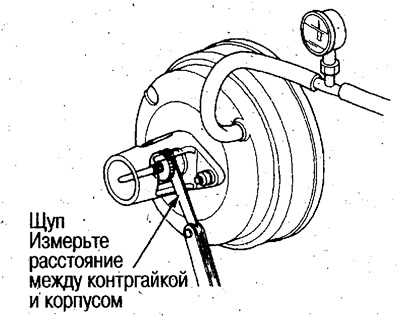
During the measurement, make sure that there is a vacuum of 66.7 kPa (500 mmHg) in the amplifier.
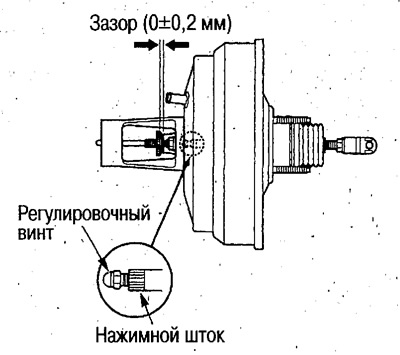
- Clearance: 0-0.2 mm
If the clearance of the special tool is 0.2 mm, the actual clearance of the push rod is 0 mm. If the clearance of the special tool is 0 mm, the actual clearance of the push rod is 0.2 mm or more. Therefore, when the clearance of the special tool is 0 mm, it may be that the clearance of the push rod is very large, so be sure to adjust.
9. If the clearance in the special tool is not within the standard, adjust it.
Adjustment is performed with a vacuum in the brake booster of 66.7 kPa (500 mm Hg).
10. Remove the special tool.
11. While holding the booster push rod with pliers, turn the adjusting screw.
12. Reinstall the special tool and check the clearance (see item 8).
13. Remove the special tool.
[The original is located on the website: hondabook.ru]