
Contents: Diagnostic Trouble Code (DTC)…⇊ Clearing Diagnostic Trouble Codes…⇊ Conditions under which the DTC is…⇊ Troubleshooting Index ⇊
Diagnostic Trouble Code (DTC) Indication
Note: This operation can also be performed using the Honda PGM Tester.
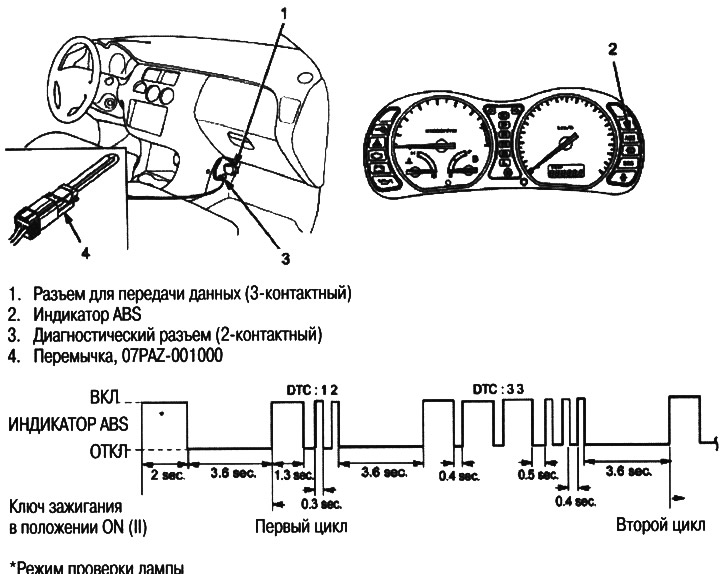
1. Connect a jumper to the diagnostic connector (2-pin) located on the center console on the passenger side.
2. Turn the ignition key to the ON (II) position.
Note: Do not press the brake pedal when turning the ignition key.
3. Record the number of flashes (blinks) of the ABS indicator, which indicates the DTC.
4. Turn the ignition key to the OFF position and remove the jumper from the diagnostic connector.
Note: If you leave the jumper wire in the diagnostic connector, the Malfunction Indicator Lamp (MIL) will remain illuminated after the engine is started.
5. Clear the DTC.
Conditions under which a DTC is set
- The car is standing still.
- The diagnostic connector is shorted with a jumper before turning the ignition key to the ON (II) position.
- The brake pedal is released.
- The diagnostic connector remains shorted with a jumper while performing this procedure.
The DTC code is no longer generated and the ABS control unit performs its programmed function if at least one of the following conditions is met:
- The car is not standing.
- The ABS control unit is supplied with a standard signal from the Honda PGM Tester.
- The jumper is removed from the diagnostic connector when performing this procedure.
Clearing Diagnostic Trouble Codes (DTCs)
Note: This operation can also be performed using the Honda PGM Tester.
1. Connect a jumper to the diagnostic connector (2-pin) located on the center console on the passenger side.
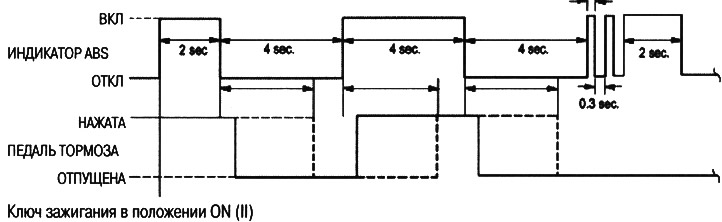
2. Press the brake pedal.
3. Turn the ignition switch to the ON (II) position while keeping the brake pedal depressed. The ABS indicator will go out after two seconds.
4. After the ABS indicator goes out, release the brake pedal. The indicator will come on after four seconds.
5. After the indicator comes on, press the brake pedal again. (The indicator will go out again after four seconds. The brake pedal is still pressed.).
6. After the indicator goes out, release the brake pedal again.
7. After four seconds, the indicator will flash twice for 0.3 seconds and the DTC will be cleared.
8. Check the DTC indication and make sure it is cleared.
Note: Always perform these operations. If you remove the jumper from the diagnostic connector and do not press the brake pedal as indicated by the indicator, the DTC will not be cleared.
Conditions under which the DTC is cleared
- The car is standing still.
- The diagnostic connector is shorted with a jumper before turning the ignition key to the ON (II) position.
- The brake pedal is depressed before turning the ignition key to the ON (II) position.
- The diagnostic connector remains shorted with a jumper while performing this procedure.
The DTC clearing process is stopped and the ABS control unit performs its programmed function if at least one of the following conditions is met:
- The car is not standing.
- The jumper is removed from the diagnostic connector when performing this procedure.
- The ABS control unit is supplied with a standard signal from the Honda PGM Tester.
- The brake pedal is not pressed as indicated by the indicator,
- DTC clearing completed.
Troubleshooting Index
Note: This operation can also be performed using the Honda PGM Tester.
| DTC code | ABS indicator | Brake system indicator | Diagnostics/Sign | Detection time | ||||
| Primary diagnostics | Without ABS control | with ABS control | When a warning signal is issued | Location of the malfunction | ||||
| There is no code | - | Lights up (ON) | The brake system indicator does not go out | - | - | - | - | |
| There is no code | Not lit (OFF) | - | ABS indicator does not light | - | - | - | - | |
| There is no code | Lights up (ON) | - | ABS indicator does not go out | - | - | - | - | |
| 11 | Lights up (ON)*1 | Lights up (ON)*3 | Wheel sensor (open/short to ground/short to power supply) | o | o | o | o | Front right side(FR) |
| 13 | Lights up (ON)*1 | Lights up (ON)*3 | Wheel sensor (open/short to ground/short to power supply) | o | o | o | o | Front left side (FL) |
| 15 | Lights up (ON)*1 | Lights up (ON)*3 | Wheel sensor (open/short to ground/short to power supply) | o | o | o | o | Rear right side (RR) |
| 17 | Lights up (ON)*1 | Lights up (ON)*3 | Wheel sensor (open/short to ground/short to power supply) | o | o | o | o | Rear left side (RL) |
| 12 | Lights up (ON)*1 | Lights up (ON)*3 | Wheel Sensor/Pulse Generator (Chipped Tooth Ring/Electrical Interference) | o | o | o | Front right side(FR) | |
| 14 | Lights up (ON)*1 | Lights up (ON)*3 | Wheel Sensor/Pulse Generator (Chipped Tooth Ring/Electrical Interference) | o | o | o | Front left side(FL) | |
| 16 | Lights up (ON)*1 | Lights up (ON)*3 | Wheel Sensor/Pulse Generator (Chipped Tooth Ring/Electrical Interference) | o | o | o | Rear right side (RR) | |
| 18 | Lights up (ON)*1 | Lights up (ON)*3*3 | Wheel Sensor/Pulse Generator (Chipped Tooth Ring/Electrical Interference) | o | o | o | Rear left side (RL) | |
| 31 | Lights up (ON) | Lights up (ON) | Solenoid (open/short circuit to ground/short circuit to power source/stuck) | o | o | o | Front right-intake(FR-IN) | |
| 32 | Lights up (ON) | Lights up (ON) | Solenoid (open/short circuit to ground/short circuit to power source/sticking) | o | o | o | Front right-outlet(FR-OUT) | |
| 33 | Lights up (ON) | Lights up (ON) | Solenoid (open/short circuit to ground/short circuit to power source/sticking) | o | o | o | Front Left-Inlet (FL-IN) | |
| 34 | On(ON) | Lights up (ON) | Solenoid (open/short circuit to ground/short circuit to power source/sticking) | o | o | o | Front Left-Outlet (FL-OUT) | |
| 35 | On(ON) | Lights up (ON) | Solenoid (open/short circuit to ground/short circuit to power source/sticking) | o | o | o | Rear Right-Intake (RR-IN) | |
| 36 | On(ON) | Lights up (ON) | Solenoid (open/short circuit to ground/short circuit to power source/sticking) | o | o | o | Rear Right-Outlet (RR-OUT) | |
| 37 | Lights up (ON) | On(ON) | Solenoid (open/short circuit to ground/short circuit to power source/sticking) | o | o | o | Rear Left-Inlet (RL-IN) | |
| 38 | Lights up (ON) | Lights up(ON) | Solenoid (open/short circuit to ground/short circuit to power source/sticking) | o | o | o | Rear Left-Outlet (RL-OUT) | |
| 51 | Lights up (ON) | Not lit(OFF) | Electric motor | o | o | |||
| 52 | Lights up (ON) | Off | Electric motor stuck in OFF position | o | o | |||
| 53 | Lights up (ON) | Off | Electric motor stuck in ON position | o | ||||
| 54*4 | Lights up (ON) | Lights up (ON) | The motor relay is stuck in the OFF position | o | o | o | ||
| 61 | Lights up (ON)*2 | Lights up (ON) | Ignition voltage (high voltage/low voltage) | o | o | o | o | |
| 81 | Lights up (ON) | Lights up (ON) | Hardware failure | o | o | o | o | |
| 81*5 | Lights up (ON) | Lights up (ON) | Interference detection | o | o | o | ||
*1: If DTCs 11 through 18 (wheel sensor codes) were detected the last time the vehicle was driven, the ABS indicator will remain on until the ignition switch is turned to the ON (II) position and the ECU confirms that the wheel sensors are normal.
*2: The ABS indicator goes out when the ignition voltage returns to normal.
*3: The brake system indicator comes on when the ABS control unit detects a malfunction in more than one wheel.
*4: This code is only displayed when using the Honda PGM Tester.
*5: Honda PGM Tester communication mode failure code is 82.
Original material on the website hondabook