
Warning! Avoid touching the impeller blades with your hands, tools, or clothing. To avoid injury or equipment damage, do not start the engine if the fan is faulty. Do not attempt to repair broken impeller blades - replace the entire impeller!
Examination
Note: All A/C equipped models have two fans, one to blow air over the engine cooling system radiator and one to blow air over the A/C condenser. The following procedures apply equally to both fans.
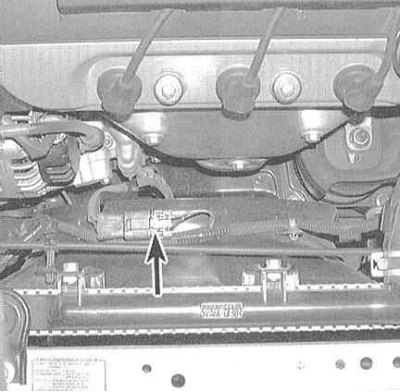
1. To check the proper operation of the fan drive electric motor, disconnect its wiring connector. Now, using a fused jumper wire, connect the fan directly to the battery. If the impeller does not start to rotate, replace the electric motor.
2. If the engine is OK, check the condition of the cooling fan fuses (the fuses are located in the mounting block located on the left under the instrument panel, on V6 models check the fuses #3 and #6, on 4-cylinder - #4), fan switch(es), cooling system fan relay, A/C fan relay (mounting block in the engine compartment) and connecting wiring of the corresponding circuit.
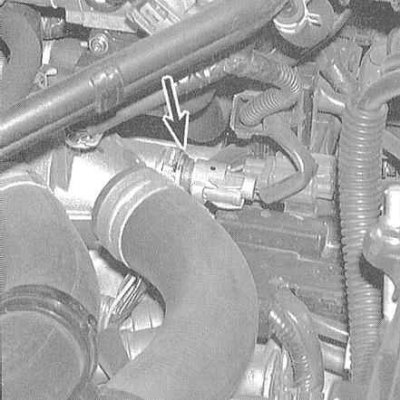
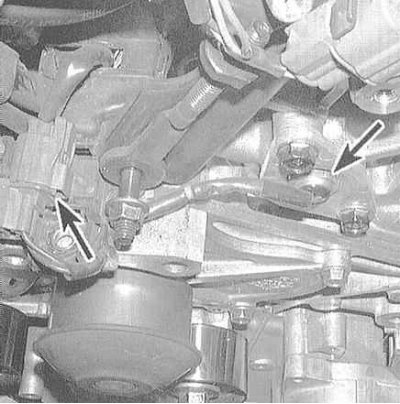
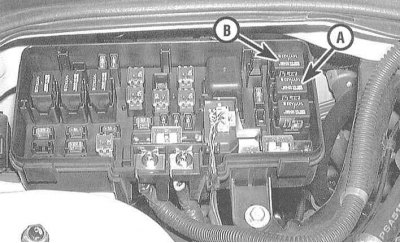
Attention! On 4-cylinder models there is only one sensor-switch for the cooling system fan, on V6 models there are two such sensors-switches ("A" and "B").
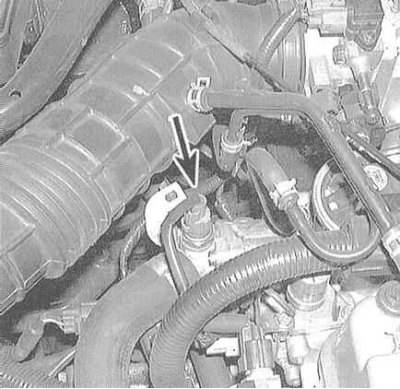
3. To check the proper functioning of any of the cooling system fan switches, disconnect its electrical wiring connector. Start the engine and use an ohmmeter to check for conductivity between the switch terminals when the engine is cold (there should be no conductivity below 88°C). The switch should close after the coolant has warmed up to a temperature above 92÷96°C. The closing temperature of the K/V capacitor switch is 108°C. If the described dependence of the presence of conductivity is violated, replace the faulty switch. Each of the switches should open at a temperature of 3÷8 degrees below their closing temperature.
 |
 |
Caution! Do not leave the engine running with the sensors/switches disconnected longer than necessary to perform the described checks. Do not delay in restoring the original wiring connection, then, after allowing the fan to rotate a little, turn off the ignition.
4. On 4-cylinder models, there is only one temperature sensor-switch that controls the operation of the fans of both systems (cooling and air conditioning). On V6 models, there are two such sensors-switches - one for each of the systems.
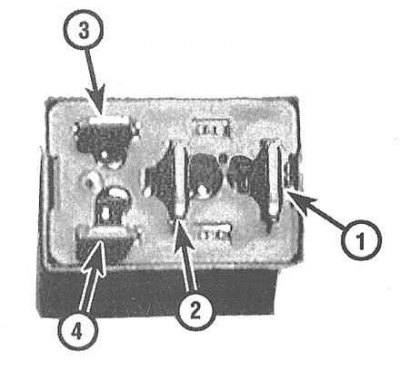
5. To test the fan relay, remove the appropriate relay from its socket in the mounting block, connect terminal 3 to the battery and ground terminal 4. A good relay should close, creating conductivity between terminals 1 and 2, which should disappear when the power is disconnected.
Checking the Fan Control Module
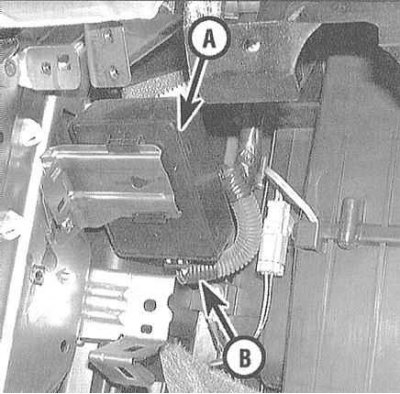
1. On V6 models, the cooling fan is controlled by a dedicated electronic module located under the front passenger knee support. Remove the support (see Chapter Body). Probe the terminals of each wire on the back side of the module connector with a sharp probe in both ignition switch positions (ON and OFF). Be careful - try not to pierce the insulation.
2. Check for continuity between the black wire terminal and ground. If there is no continuity, check the ground circuit for proper operation.
3. Check for battery voltage at the terminals of the following wires: white, black-yellow-1, black-yellow-2, yellow-white and yellow. If there is no voltage, check the condition of the corresponding fuses in both mounting blocks (under the instrument panel and in the engine compartment).
4. Turn the ignition back on, restoring the original wiring connection. Ground the green wire terminal to ground. If the fans do not operate, check the green, yellow and yellow/white wires for breakage
5. Measure the voltage at the terminal of the white-green wire. The required value at an engine temperature below 107°C is 11÷12 V, - otherwise check for a short circuit to the housing ground, assess the condition of the control module and the temperature-sensitive sensor-switch.
6. Before testing the new module, disconnect both fan relays and check for continuity between the yellow/yellow-white wire terminal and ground (set the ohmmeter to 20 kOhm). If there is continuity, the new module will also fail when turned on.
Replacement
Note: The procedures below apply equally to both fans.
1. Disconnect the negative cable from the battery.
Note: If your car stereo is equipped with a security code, make sure you have the correct combination to activate the audio system before disconnecting the battery!
2. Set the parking brake and support the rear wheels of the vehicle with wheel chocks. Jack up the front of the vehicle and place it on supports. If so equipped, remove the lower splash shield of the radiator.
3. Using a small screwdriver, insert it into the connector, release the locking tab and disconnect the fan wiring.
Note: On models equipped with a speed control system, release the cruise control drive cable from the two plastic clips on the top of the fan shrouds.
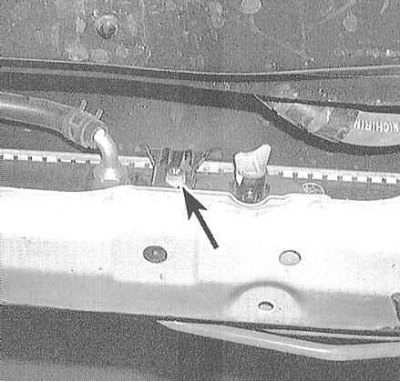
4. On the air conditioning fan assembly, remove the lower mounting bolt
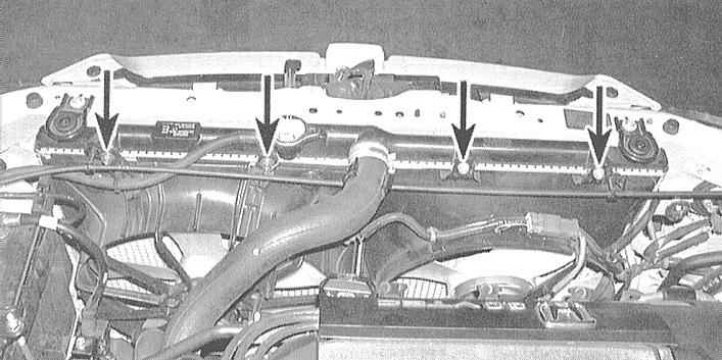
5. Unbolt the fan from the top of the radiator.
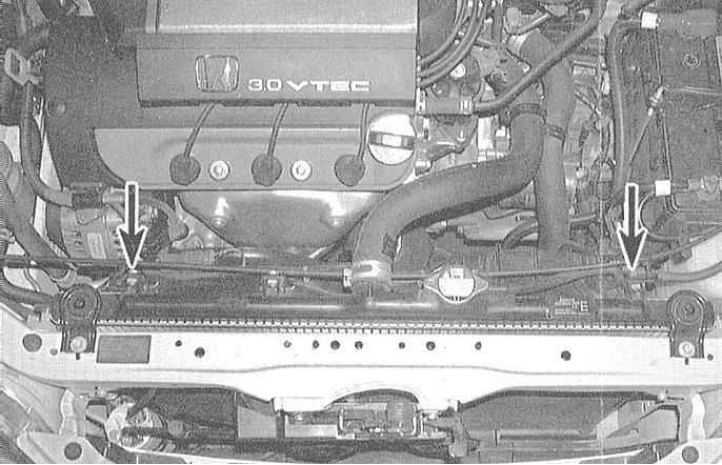
6. Carefully remove the fan from the engine compartment.
Attention! If equipped accordingly, it is necessary to move the cruise control drive cable released from the clamps to the side.
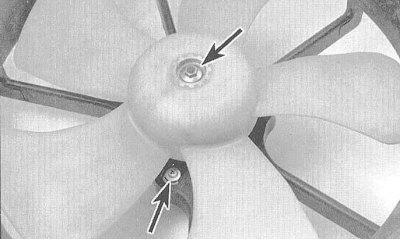
7. To remove the impeller from the motor shaft, loosen the central nut.
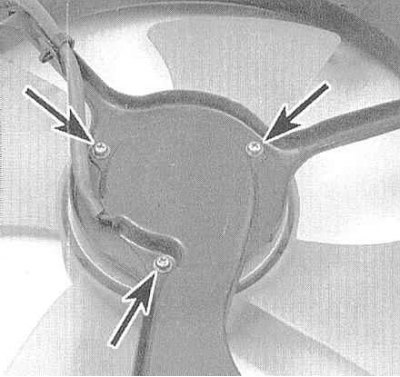
8. To remove the drive motor from the fan casing, unscrew the mounting screws.
9. Installation is carried out in reverse order.