
Contents: Examination ⇊ Replacement ⇊
Attention! Before starting the procedure, wait until the engine has cooled down completely!
Examination
1. The coolant temperature indicator device consists of a gauge mounted in the vehicle's instrument cluster and a temperature sensor mounted on the engine block, directly under the ignition distributor (4-cylinder models) or mounted in the thermostat housing (V6 models). Some models may have more than one temperature sensor, but only one is ever used in the indicator system.
Warning! The vehicles covered in this Manual are equipped with electric fans for the cooling and air conditioning systems. Avoid placing your hands near the fan impellers, which may start unexpectedly when the ignition is on, even when the engine is off.
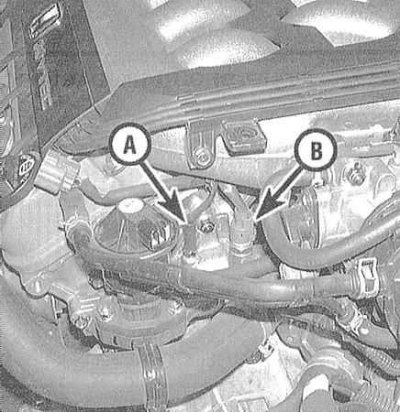 |
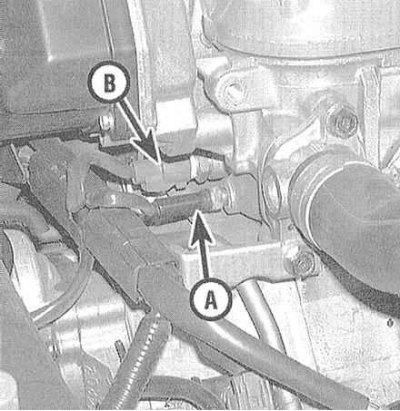 |
2. If the gauge shows overheating even when the engine is clearly cold, you should check the wiring between the instrument panel and the temperature sensor for signs of a short circuit.
3. If the meter does not function at all, check the condition of its electrical circuit by quickly short-circuiting the wire going to the temperature sensor to ground with the ignition on (the engine should not be started). If the indicator needle deviates to the end of the scale, replace the sensor.
Caution! Try not to touch the blades of the cooling system fan, which may turn on even when the engine is off!
4. If the arrow remains stationary, check the meter circuit wiring for a break.
5. If you are not sure that the temperature sensor is working properly, measure its electrical resistance with a cold and hot engine. The resistance of the sensor should change inversely proportional to the temperature measurement and with a cold engine (below 57°C) be about 137 Ohm. As the engine warms up, the resistance of the sensor should gradually decrease and at a temperature of 86÷101°C reach a value in the range of 30÷46 Ohm. A faulty sensor must be replaced.
Replacement
To replace the temperature sensor, simply unscrew it from the engine and quickly screw a new one into the vacated hole, the threads of which should be lubricated with sealant in advance (do not try to use Teflon tape or FUM tape to seal the sensor seat).
Caution! The temperature sensor must be replaced on a cold engine! Be prepared to collect any spilled liquid. After replacing the sensor, check the coolant level and make the appropriate adjustments if necessary (see Chapter Settings and ongoing maintenance).