
Contents: Final check ⇊ Checking gear shift points ⇊ Gear shift points in D range ⇊ Checking ranges ⇊ Stationary vehicle test (Stall test) ⇊
After repairing the automatic transmission, perform a final check on the vehicle, which includes checking the gear shift timing and the operation of the automatic transmission in each range.
Final check
1. Apply the parking brake and chock the front and rear wheels.
2. Start the engine and warm it up until the radiator fan comes on 2 times.
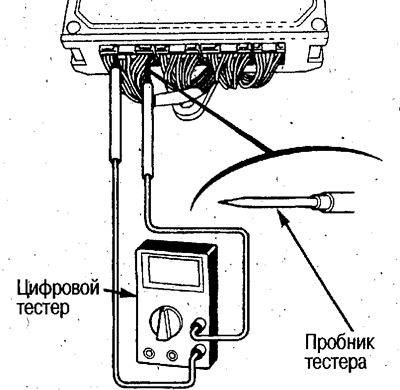
3. Press the brake pedal, then the accelerator pedal (selector lever in position D). Make sure that the engine does not stall if you release the accelerator pedal abruptly.
4. Repeat the check in position D3.
Checking gear shift points
Caution: Make sure that gear changes occur smoothly, without significant jerks, and without significant delay.
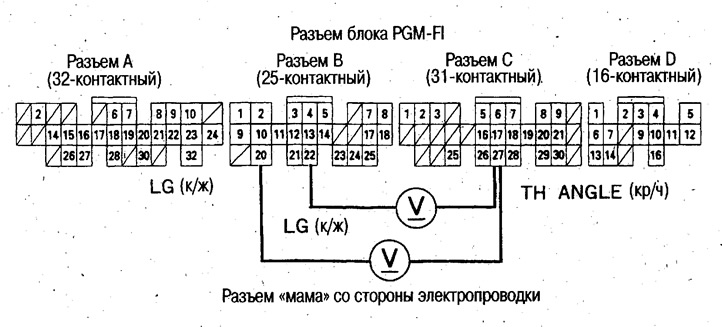
1. Connect the tester to contact No.27 (+) of connector C and contact No.20 (-) or No.22 (-) of connector B.
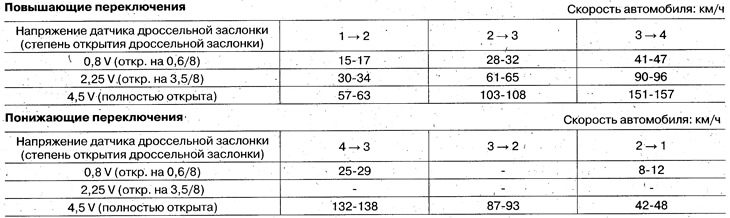
2. Check the gear shifting depending on the degree of throttle opening.
Before checking, place the vehicle on a level surface and warm up the engine.
Gear shift points in D range
2WD models
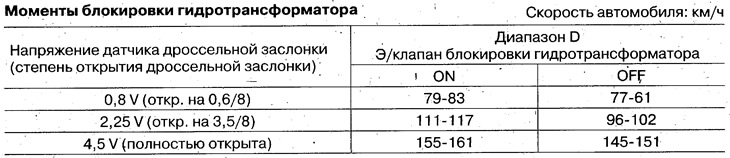
4WD models
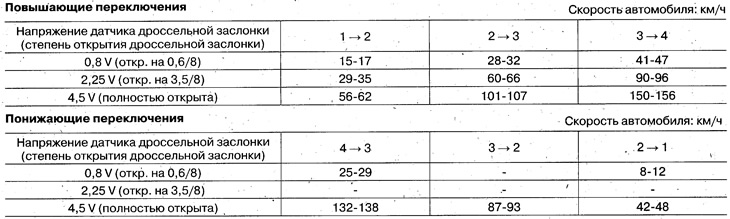
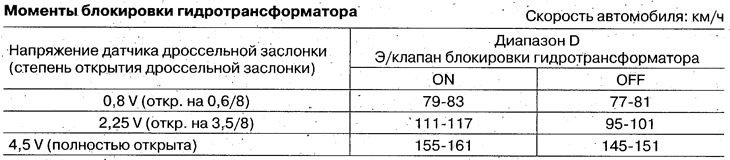
Checking ranges
L-range (1st gear)
1. Increase engine speed (from fully closed to fully open throttle position). Make sure there are no extraneous noises or clutch slippage.
2. Make sure that there is no upshifting.
Range 2 (2nd gear)
1. Increase engine speed (from fully closed to fully open throttle position). Make sure there are no extraneous noises or clutch slippage.
2. Make sure that there is no upshifting or downshifting.
R-range
Increase engine speed. Make sure there are no extraneous noises or clutch slippage.
Caution: Be careful when reversing.
Range P
When going uphill or downhill, press the brake pedal, stop the car and move the selector lever to position P. Release the brake and make sure the car remains stationary.
Caution: Before moving the lever from position P to another, press the brake pedal.
Stationary vehicle test (Stall test)
- This check should be performed as quickly as possible. The check should not last more than 10 seconds.
- Do not change the position of the selector lever while increasing engine speed.
- After disconnecting the pressure gauge, check it. There is a risk of damage to the pressure gauge or hose.
- Turn off the air conditioner while checking.
1. Position the vehicle horizontally, apply the parking brake and chock all 4 wheels.
2. Secure the vehicle with chains using the front hooks.
3. Connect the tachometer, start the engine and warm it up until the radiator fan turns on for the 2nd time.
4. Set the selector lever to position 2.
5. While holding the brake pedal, press the accelerator pedal all the way down for 6-8 seconds; Remember the maximum engine speed.
6. Let the engine run at idle speed for 2 minutes, then repeat the test in ranges D, L and R.
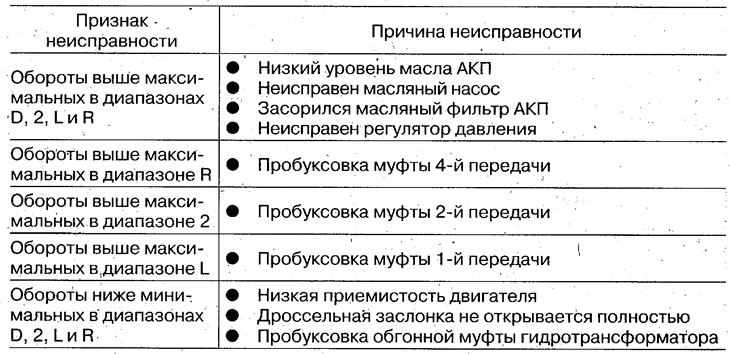
The measurement results in ranges D, 2, L and R must match and not go beyond the normal limits.
- Standard speed: 2450 rpm
- Maximum speed: 2300-2600 rpm
If the speed is outside the normal range, the following faults may be present:
(The original can be found on the resource «hondabook.ru»)