Contents: Hydraulic control system ⇊ Starting and accelerating in forward…⇊ Driving in forward gear at a…⇊ Slowing down in forward gear (2WD) ⇊ Driving and accelerating in reverse…⇊ Driving in reverse gear at a…⇊ Slowing down in reverse gear xofla…⇊ Thermal switch operation ⇊ Operation of the bypass valve ⇊
Hydraulic control system
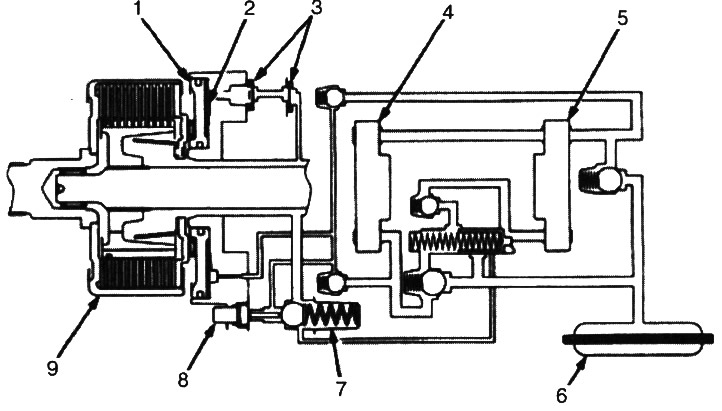
1. clutch piston; 2. disc spring; 3. diaphragms; 4. front oil pump; 5. rear oil pump; 6. oil filter; 7. bypass valve; 8. thermal relay; 9. differential clutch assembly
Starting and accelerating in forward gear (4WD)
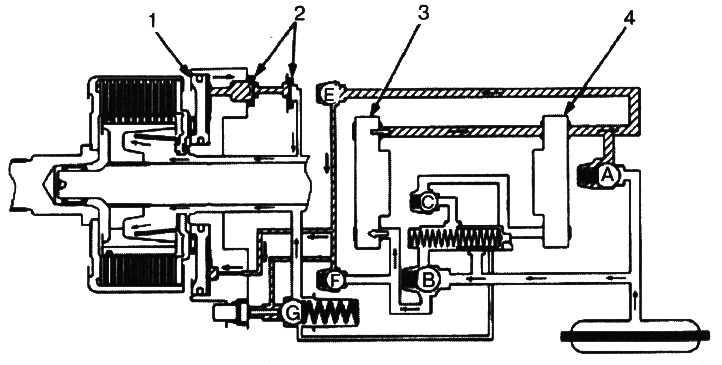
1. clutch piston; 2. diaphragms; 3. front oil pump; 4. rear oil pump
When starting off or accelerating in forward gear, the dual-pump system can engage all-wheel drive.
If the front wheels rotate faster than the rear wheels, the front oil pump rotates faster than the rear. The front oil pump sucks fluid through the stop valve B and drains it. Part of the fluid at the outlet of the front oil pump is sucked by the rear oil pump. The remaining fluid passes through the stop valve E into the clutch piston, where the hydraulic pressure is regulated by two diaphragms.
Adjustable hydraulic pressure on the clutch piston compresses the clutch plates and discs together to form a link. The engaged clutch then transmits traction from the transfer case to the rear wheels, creating four-wheel drive (4WD).
Driving in forward gear at a constant speed (2WD)
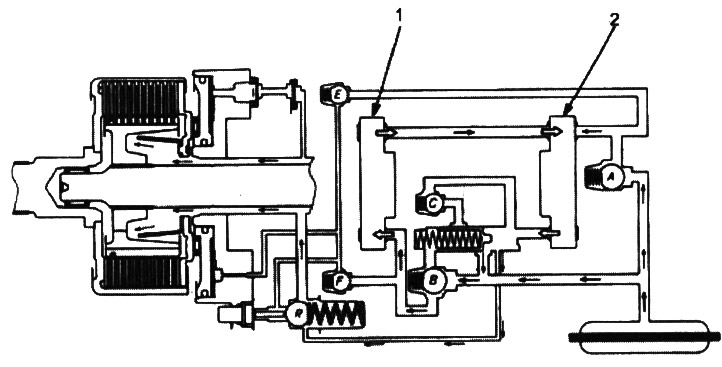
1. front oil pump; 2. rear oil pump
When driving in forward gear at a constant speed, the dual-pump system operates in two-wheel drive mode.
The speed of rotation of the front and rear wheels is the same, so the speed of the front and rear pumps is the same. The fluid at the outlet of the front oil pump is sucked by the rear oil pump and circulated through the system. Since pressure is not supplied to the clutch piston, the clutch does not engage and the car remains in 2WD mode (front wheel drive).
Slowing down in forward gear (2WD)
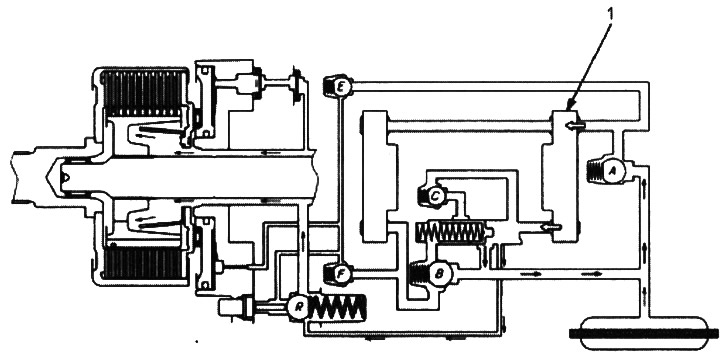
1. rear oil pump
When decelerating in forward gear, the dual-pump system operates in two-wheel drive mode.
Due to braking characteristics, when decelerating, the rear wheels may rotate faster than the front wheels. In this case, the rear oil pump rotates faster than the front one.
The fluid at the rear oil pump outlet is simply sucked back into the rear oil pump and recirculated. Since no pressure is applied to the clutch piston, the clutch piston does not engage and the vehicle remains in 2WD (front wheel drive).
Driving and accelerating in reverse gear (4WD)
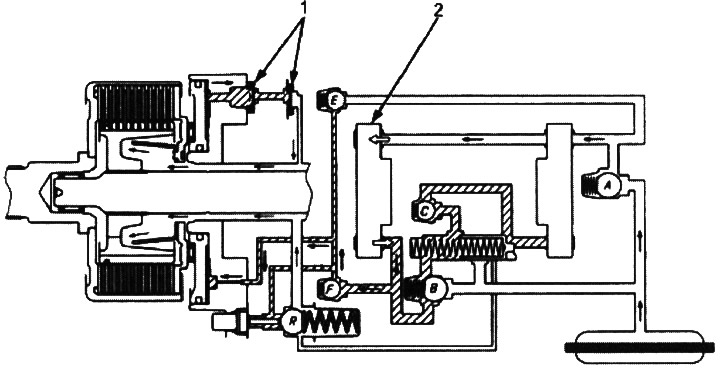
; 1. diaphragms; 2. front oil pump
When starting off and accelerating in reverse gear, the dual-pump system can engage all-wheel drive.
When the front wheels rotate faster than the rear wheels, the front oil pump rotates faster than the rear one. The front oil pump sucks in fluid through the stop valve A and drains it. (It should be noted that in the case of reverse gear, the direction of operation of the pumps is opposite to that in forward gear.).
Part of the fluid at the outlet of the front oil pump is sucked in by the rear oil pump. The remaining fluid passes through the stop valve F into the clutch piston cylinder, where the hydraulic pressure is regulated by two diaphragms.
Adjustable hydraulic pressure on the clutch piston can squeeze the clutch plates and discs together to form a link. The engaged clutch then transmits traction from the transfer case to the rear wheels, creating four-wheel drive (4WD).
Driving in reverse gear at a constant speed (2WD)
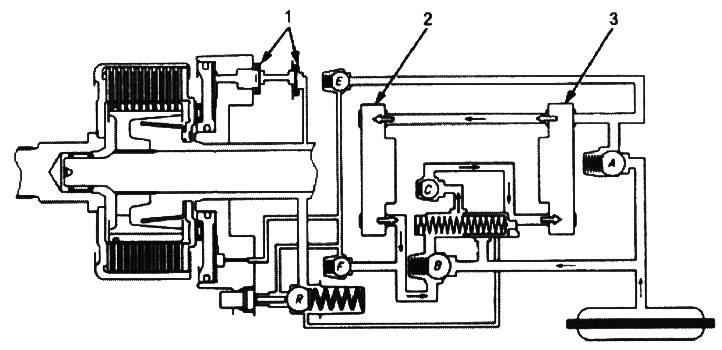
1. diaphragms; 2. front oil pump; 3. rear oil pump
When driving in reverse at a constant speed, the dual-pump system operates in two-wheel drive mode. The front and rear wheel speeds are the same, so the front and rear pump speeds are the same. The fluid at the outlet of the front oil pump is sucked up by the rear oil pump and circulated through the system, but because there is a difference in the pump output, the fluid flows through the check valve E and then through the diaphragms. This fluid lubricates and cools the clutch assembly and bearings.
Under these conditions, only a small amount of pressure is applied to the clutch piston, so the clutch does not engage and the vehicle remains in 2WD (front wheel drive) mode.
Slowing down in reverse gear xofla (4WD)
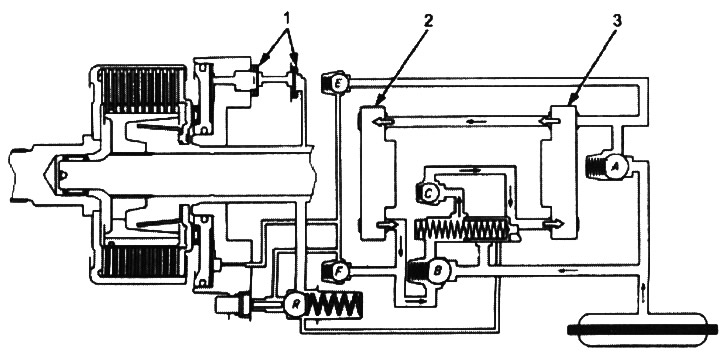
1. diaphragms; 2. front oil pump; 3. rear oil pump
When slowing down in reverse gear, the dual-pump system can engage all-wheel drive.
When decelerating in reverse, the rear wheels may rotate faster than the front wheels (due to engine braking). Under these conditions, the rear oil pump draws fluid through check valves B and C. The fluid at the rear oil pump outlet then flows through check valve E to the clutch piston, where the pressure is regulated by two diaphragms. The regulated hydraulic pressure on the clutch piston can squeeze the clutch plates and discs together to form a bond. The engaged clutch then transmits traction from the transfer case to the rear wheels, creating four-wheel drive (4WD).
Thermal switch operation
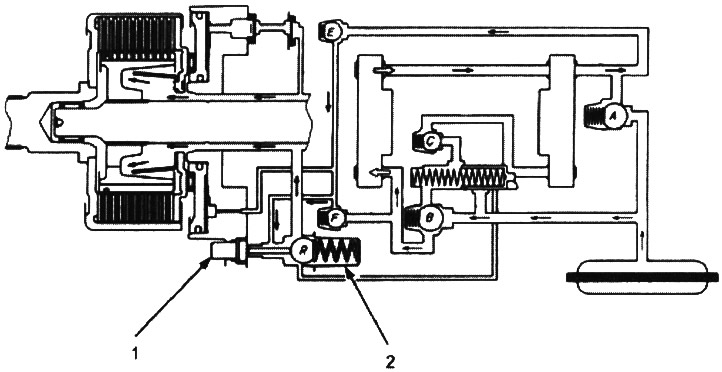
1. thermal relay; 2. bypass valve
When operating in 4WD mode (four-wheel drive), fluid under regulated pressure comes into contact with the clutch piston and the thermal switch. When the temperature of the fluid in the differential increases, the thermal switch opens the bypass valve R. This reduces the pressure on the clutch piston and exits 4WD mode.
Operation of the bypass valve
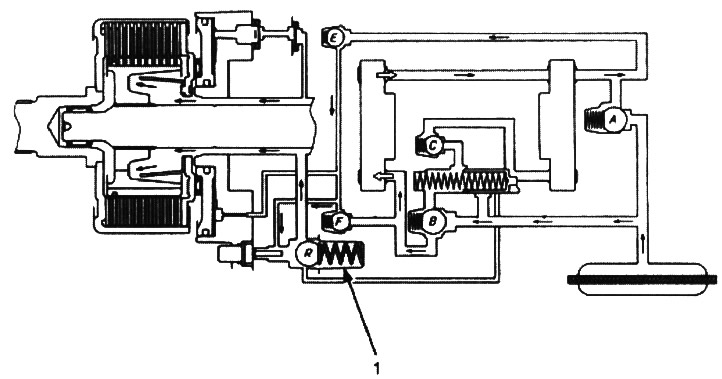
1. bypass valve
When the fluid pressure becomes greater than the resistance of the bypass valve spring, the stop valve R opens. The pressure supplied to the clutch piston is kept constant. Thus, excess torque is prevented in the rear-wheel drive system and the operating stability is improved.
[Original published on this resource: HondaBook.ru]