Contents: Transmission ⇊ Electronic control ⇊ Hydraulic drive control ⇊ Selector lever positions ⇊ Gear shift control mechanism ⇊ Automatic transmission range…⇊
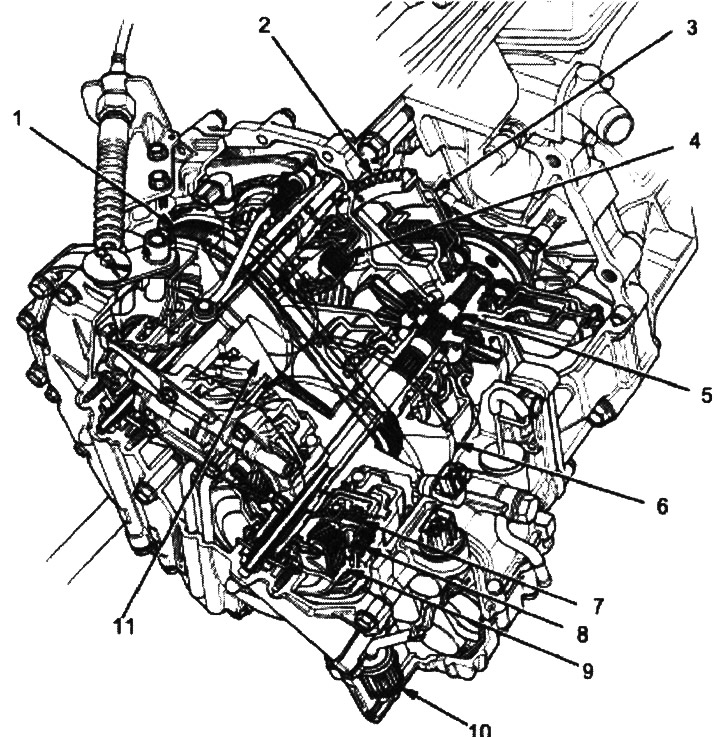
1. steel belt; 2. toothed crown; 3. flywheel; 4. starting clutch; 5. drive shaft; 6. drive pulley; 7. forward clutch; 8. reverse brake; 9. planetary gear set; 10. ATF filter; 11. driven pulley
The continuously variable transmission (CVT/Honda Multi Matic) is an automatic transmission equipped with a leading and a driven pulley and a steel belt. The CVT/Honda Multi Matic transmission provides continuously variable gear shifting for forward movement and one for reverse. The transmission assembly is located in line with the engine.
Transmission
On the outer part of the flywheel there is a toothed crown, which engages with the starter pinion when the engine is started. The box has four parallel shafts: the drive shaft, the drive pulley shaft, the driven pulley shaft and the secondary shaft. The drive shaft is coaxial with the engine crankshaft. Pulleys with a movable and fixed surface are fixed on the shafts of the drive and driven pulleys. Both pulleys are connected by a steel belt.
There is a sun gear on the drive shaft. On the drive pulley shaft sits the forward engagement clutch, on the drum of which the carrier assembly is installed. The carrier consists of satellites that engage with the sun gear and the crown gear. The reverse brake disc is mounted on the hub of the crown gear.
The driven pulley shaft carries the starting clutch and the secondary shaft drive gear, which is made integral with the parking gear. The secondary shaft is located between the secondary shaft drive gear and the final drive driven gear. The secondary shaft carries the secondary shaft driven gear, which serves to change the direction of rotation, since the shafts of the driving and driven pulleys rotate in the same direction. When certain combinations of planetary gears in the gearbox are engaged by means of clutches and the reverse brake, power is transmitted from the drive pulley shaft to the driven pulley shaft and provides movement in the L, D, R ranges.
Electronic control
The electronic control system consists of a powertrain control module (PCM), sensors, three linear control solenoids and one locking solenoid. Electronic control of gear shifting provides convenience in all driving modes. The Grade Logic Control System is also provided to control shifting in the D range when driving uphill or downhill. The PCM is located under the instrument panel on the passenger side behind the wheel arch panel.
Hydraulic drive control
The lower control valve box assembly consists of the main valve body, the low pressure (PL) control valve body, the gearshift valve body, the clutch distributor valve body and the secondary valve body. They are located at the bottom of the gearbox housing.
The main valve body consists of a high pressure (PH) control valve, a lubrication valve and a pitot control valve.
The secondary valve body contains the high-pressure (PH) regulating valve, the clutch pressure reducing valve, the starting clutch valve accumulator and the gearshift lock valve. The low-pressure (PL) regulating valve body contains the low-pressure (PL) regulating valve and the PH-PL (high pressure - low pressure) distribution valve, which is combined with the PH-PL linear control solenoid. The gearshift lock solenoid valve is bolted to the low-pressure (PL) regulating valve body.
The gear shift valve housing contains the gear shift valve and the gear shift distribution valve, which is combined with the gear shift linear control solenoid. The starting clutch distribution valve housing contains the starting clutch distribution valve, which is combined with the starting clutch linear control solenoid. The linear control solenoids and the gear shift lock solenoid are controlled by the RCM module. The manual control valve housing, in which the manual control valve and the reverse lock valve are installed, is bolted to the intermediate crankcase.
The ATF pump assembly is located on the gearbox housing and is connected to the drive shaft via sprockets and a chain. The fluid is supplied to the pulleys and clutch via the corresponding tubes, and to the reverse brake - from the internal hydraulic circuit.
Selector lever positions
The selector lever has five positions: P PARK, R REVERSE, N NEUTRAL, D DRIVE and L LOW.
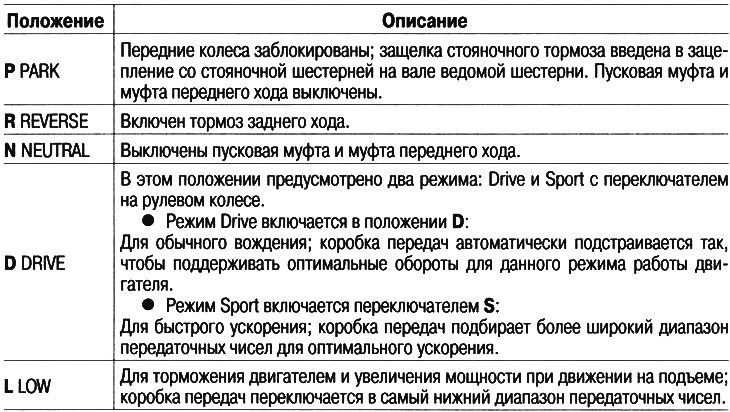
By using a sliding type engine start interlock switch, starting is only possible from positions P and N.
Gear shift control mechanism
The activation of a particular linear control solenoid by the PCM module occurs based on signals coming from various sensors located throughout the vehicle. When the linear control solenoid for gear shifting is activated, the pressure in the distribution valve for gear shifting changes, which causes the shift valve to move. This creates pressure on the leading and driven pulleys, which changes their ratio. When the linear control solenoid for the starting clutch is activated, the distribution valve for the starting clutch moves, which opens the channel, supplies pressure to the starting clutch and engages it.
Automatic transmission range indicator
The automatic transmission gear range indicator on the instrument panel shows the selected range and eliminates the need to look at the console.