
Contents: Operating principle ⇊ Controlled lift ⇊ Controlled descent ⇊ Hydraulic drive control ⇊ Main valve body ⇊ Secondary valve body ⇊ Low pressure control valve body (PL) ⇊ Starting clutch distribution valve…⇊ Gear shift valve housing ⇊ Manual control valve body ⇊
Operating principle
To control gear shifting when driving uphill or downhill, the PCM compares current driving conditions with data stored in memory based on signals received from the vehicle speed sensor, throttle position sensor, manifold absolute pressure sensor, engine coolant temperature sensor, brake light switch signal and selector lever position signal.
Controlled lift
When the PCM detects that the vehicle is driving uphill in the D position, the system selects the most appropriate shift pattern (pulley ratio) to suit the steepness of the hill, thereby providing a smooth ride and extra power when required. There are three hill-climb modes with different shift patterns depending on the steepness of the hill as programmed into the PCM.
Controlled descent
When the PCM detects that the vehicle is going downhill in position D, the system selects the most appropriate shift pattern (pulley ratio) according to the slope of the descent, thereby providing, in combination with engine braking, a smooth ride on the descent. There are three downhill driving modes with different shift patterns depending on the slope of the descent as recorded in the PCM.
Hydraulic drive control
The hydraulic drive is controlled by the ATF pump, valves and solenoids. The ATF pump is driven by the drive shaft. The ATF pump and the drive shaft are connected by a drive chain and ATF pump sprockets. The shift lock solenoid valve and the linear control solenoids located in the valve box are controlled by the PCM module. The fluid from the ATF pump flows through the PH control valve and maintains the set pressure on the drive pulley, driven pulley and manual control valve.
The lower valve body assembly consists of the main valve body, the low pressure (PL) control valve body, the gearshift valve body, the starting clutch distribution valve body and the secondary valve body.
Main valve body
The main valve body consists of a high pressure (PH) control valve, a lubrication valve and a pitot control valve.
High pressure distribution valve (PH)
The PH distribution valve supplies the PH control pressure (PHC) in accordance with the PH-PL control pressure (HLC), and supplies the PH pressure to the PH control valve, which also regulates the PH pressure. When a low gear is engaged, it increases the PH pressure, which increases the PH high pressure. At the same time, by releasing the reverse lock (RI) pressure on the lock solenoid valve, the shift time is reduced.
Lubrication valve
The lubrication valve regulates and maintains the lubrication pressure on each shaft. When the pressure is too high, the spring is compressed. This causes the lubrication valve to move and open the fluid discharge channel.
Pitot control valve
The Pitot control valve regulates the pressure in the starting clutch (SC) according to engine speed in the event of failure of the electronic control system.
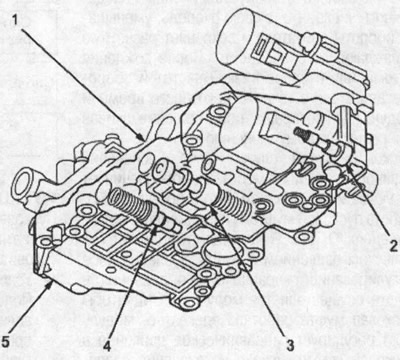
1. lower valve box assembly; 2. Pitot control valve; 3. lubrication valve; 4. PH distribution valve; 5. main valve body
Secondary valve body
The secondary valve body contains the high pressure (PH) control valve, the clutch pressure reducing valve, the starting clutch valve accumulator and the shift lock valve.
High pressure (PH) control valve
The PH control valve maintains the hydraulic pressure supplied by the ATF pump and supplies the PH pressure to the hydraulic control circuit and the lubrication circuit. The PH pressure is controlled at the PH control valve by the PH control pressure (PHC) from the PH distribution valve.
Coupling pressure reducing valve
The clutch pressure reducing valve is supplied with PH pressure from the PH control valve. It controls the reduction of the clutch pressure (CR). The clutch pressure reducing valve supplies the clutch pressure (CR) to the manual control valve and the starting clutch distribution valve, and supplies the signal pressure to the PH-PL distribution valve, the gear shift distribution valve and the lock-up solenoid valve.
Clutch starter valve accumulator
The starting clutch valve accumulator stabilizes the hydraulic pressure supplied to the clutch.
Gear shift lock valve
The shift lock valve switches the control of the fluid supply to the starting clutch from electronic to hydraulic in the event of failure of the electronic control system.
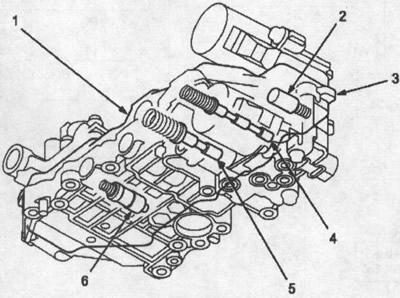
1. lower valve box assembly; 2. Starter clutch valve accumulator; 3. secondary valve body; 4. Gear shift lock valve; 5. coupling pressure reducing valve; 6. PH control valve
Low pressure control valve body (PL)
The low pressure regulating valve (PL) body contains the low pressure regulating valve (PL) and the PH-PL (high pressure - low pressure) distribution valve, which is combined with the PH-PL linear regulating solenoid. The gear shift lock valve is bolted to the low pressure regulating valve (PL) body.
Low pressure control valve (PL)
The PL control valve applies low pressure (PL) to the pulley to eliminate steel belt slippage.
Low pressure PL is regulated by the control pressure PH-PL(HLC).
Distribution valve PH-PL
The PH-PL distribution valve controls the PL control valve according to the engine torque. The PH-PL distribution valve supplies the PH-PL control pressure (HLC) to the PH distribution valve to regulate the PH pressure to a value higher than the PH-PL pressure. The PH-PL distribution valve is controlled by the PH-PL linear control solenoid. The latter is controlled by the TCM module.
Lock solenoid
The lock-up solenoid controls the reverse lock-up valve by turning it on and off. In addition, the lock-up solenoid regulates the PH control pressure by supplying the reverse lock-up pressure (RI) to the PH control valve. The lock-up solenoid is controlled by the PCM.
Starting clutch distribution valve housing
The starter clutch distribution valve housing contains the starter clutch distribution valve. Both are combined with a linear control solenoid.
Starting clutch distribution valve
The starter clutch control valve controls the engagement of the starter clutch in accordance with the throttle valve opening angle. The starter clutch control valve is controlled by the starter clutch linear control solenoid. The latter is controlled by the PCM module.
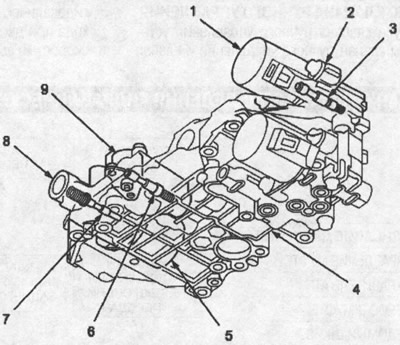
1. linear control solenoid of the starting clutch; 2. Starting clutch distribution valve housing; 3. Starting clutch distribution valve; 4. lower valve box assembly; 5. linear regulation solenoid ph-pl; 6. PL control valve; 7. distribution valve PH-PL; 8. PL control valve body; 9. lock solenoid
Gear shift valve housing
The housing contains a valve and a gear shift distribution valve. Both are combined with a linear gear shift control solenoid.
Gear shift valve
The shift valve is controlled by the pressure (SV) from the shift distributor valve. The shift valve distributes the PH pressure and PL pressure to the driving pulley and driven pulley and performs gear shifting.
Gear shift distribution valve
The distribution valve controls the gearshift valve in accordance with the degree of opening of the throttle valve and the speed of the vehicle. The distribution valve of the gearshift is controlled by the solenoid of the linear control of the gearshift. The latter is controlled by the TCM module. In the event of failure of the electronic control system, the distribution valve of the gearshift causes the gearshift lock valve to open the channel supplying pressure from the Pitot regulator to the starting clutch.
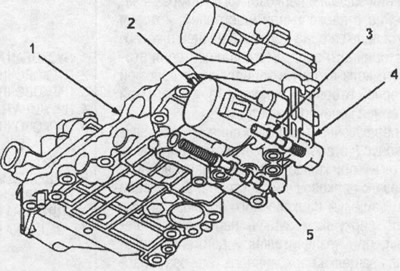
1. lower valve box assembly; 2. Linear shift control solenoid; 3. gear shift distribution valve; 4. gear shift valve body; 5. gear shift valve
Manual control valve body
The manual control valve body contains the manual control valve and the reverse locking valve. The manual control valve body is bolted to the intermediate crankcase.
Manual control valve
The manual control valve mechanically opens/closes the fluid channel in accordance with the position of the selector lever.
Reverse lock valve
The reverse lock valve is controlled by the reverse lock (RI) pressure. It cuts off the hydraulic circuit to the reverse brake when the vehicle is moving forward at speeds above 10 km/h.
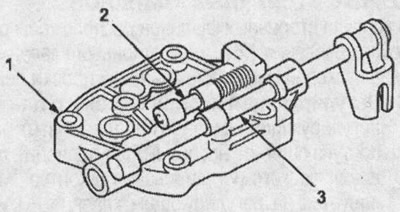
1. manual control valve body; 2. reverse lock valve; 3. manual control valve
Information obtained from this source HondaBook