
Position N
- Starting clutch: disengaged
- Forward clutch: disengaged
- Reverse brake: off
Hydraulic pressure is not supplied to the starting clutch, forward clutch and reverse brake. Power is not transmitted to the secondary shaft pinion.
Position P
- Starting clutch: disengaged
- Forward clutch: disengaged
- Reverse brake: off
Hydraulic pressure is not supplied to the starting clutch, forward clutch and reverse brake. Power is not transmitted to the secondary shaft pinion. The secondary shaft pinion is locked by the parking brake pawl, which locks the parking pinion.
Note: The picture shows a 4WD automatic transmission; the power flow in a 2WD transmission is similar to a 4WD automatic transmission, with the exception of components related to the transfer case.
Positions D and L (forward gear range)
- Starting clutch: engaged
- Forward clutch: engaged
- Reverse brake: off
1. Hydraulic pressure is supplied to the forward clutch and the starting clutch, and the sun gear drives the forward clutch.
2. The forward clutch drives the drive pulley shaft, which drives the driven pulley shaft, connected by a steel belt.
3. The driven pulley shaft drives the secondary shaft drive gear through the starting clutch.
4. Power is transmitted to the secondary shaft driven gear, which drives the final drive driven gear.
Note:
- The working hydraulic pressure on the moving surface of each shaft depends on the degree of opening of the throttle valve.
- The picture shows a 4WD automatic transmission; the power flow in a 2WD transmission is similar to a 4WD automatic transmission, with the exception of components related to the transfer case.
Position R
- Starting clutch: engaged
- Forward clutch: engaged
- Reverse brake: on
1. Hydraulic pressure is applied to the reverse brake and the starting clutch. The sun gear drives the pinions, and the planet gears roll around the sun gear. The carrier assembly rotates in the opposite direction to the sun gear.
2. The carrier assembly drives the drive pulley shaft through the forward clutch drum, and the drive pulley shaft drives the driven pulley shaft, connected by a steel belt.
3. The driven pulley shaft drives the secondary shaft drive gear through the starting clutch.
4. Power is transmitted to the secondary shaft driven gear, which drives the final drive driven gear.
Note: The picture shows a 4WD automatic transmission; the power flow in a 2WD transmission is similar to a 4WD automatic transmission, except for the components related to the transfer case assembly.
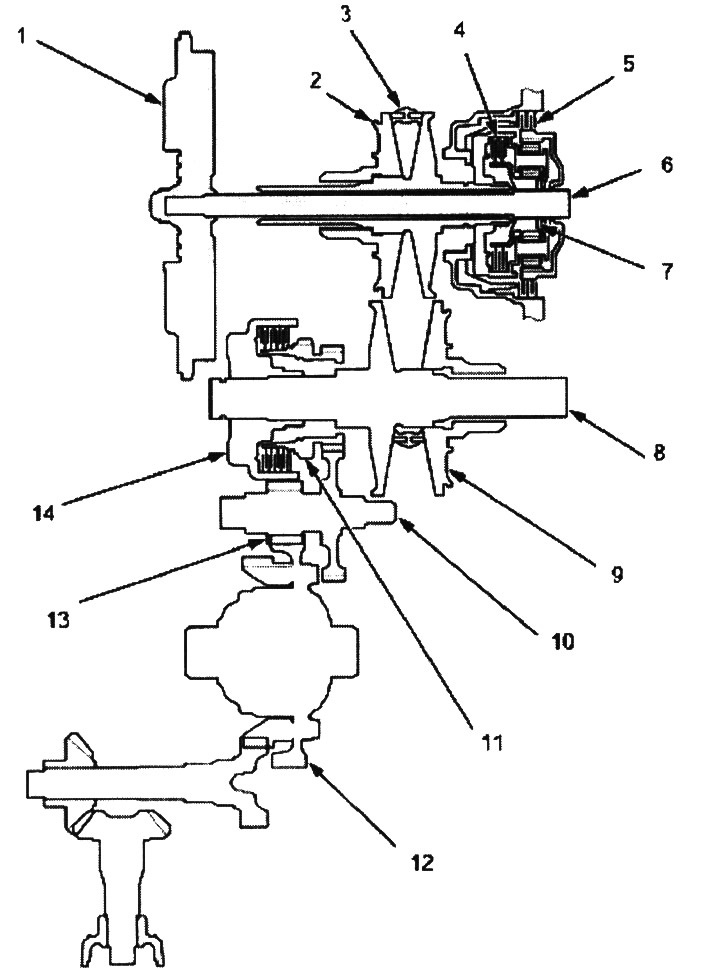
1. flywheel; 2. drive pulley; 3. steel belt; 4. forward clutch; 5. reverse brake; 6. drive shaft; 7. sun gear; 8. drive pulley shaft; 9. driven pulley; 10. secondary shaft drive gear; 11. parking gear; 12. final drive driven gear; 13. final drive pinion; 14. starting clutch
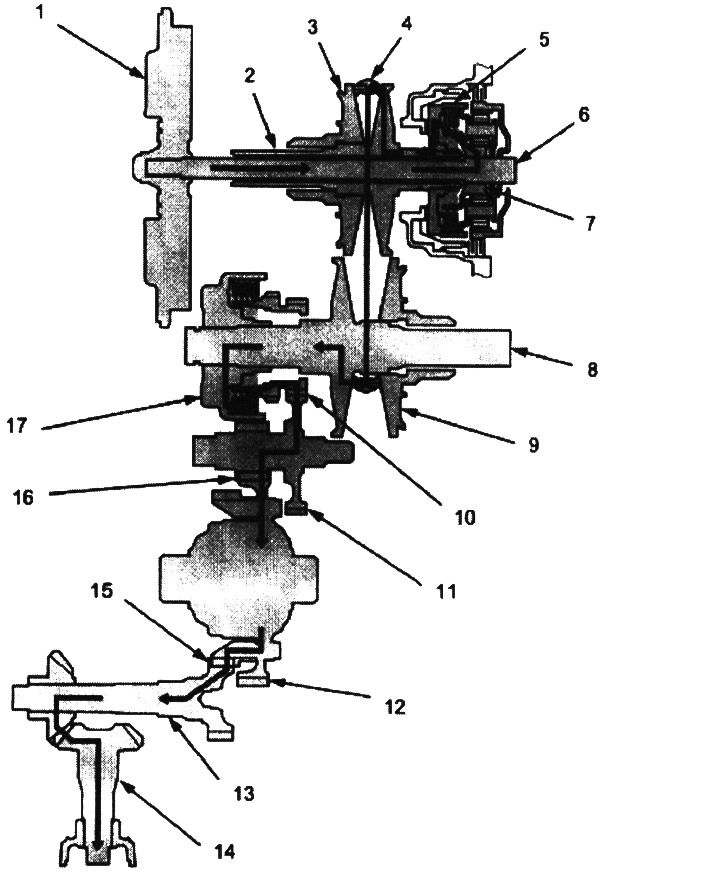
1. flywheel; 2. drive pulley shaft; 3. drive pulley; 4. steel belt; 5. forward clutch; 6. drive shaft; 7. sun gear; 8. driven pulley shaft; 9. driven pulley; 10. secondary shaft drive gear; 11. secondary shaft driven gear; 12. final drive driven gear; 13. Transfer case shaft; 14. Transfer case driven gear shaft; 15. Transfer case shaft drive gear; 16. final drive pinion; 17. starting clutch
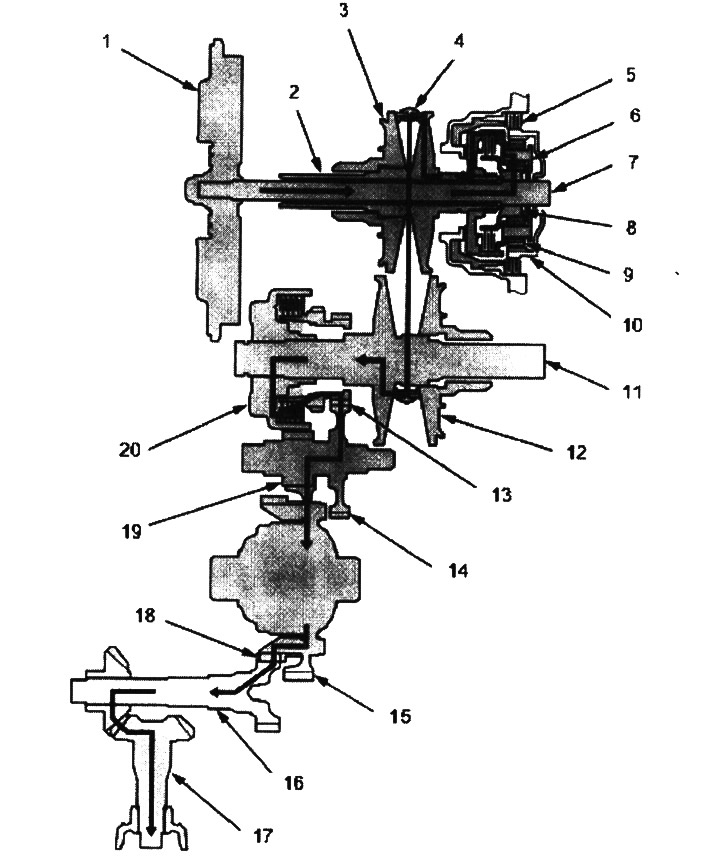
1. flywheel; 2. drive pulley shaft; 3. drive pulley; 4. steel belt; 5. reverse brake; 6. carrier assembly; 7. drive shaft; 8. sun gear; 9. satellite; 10. ring gear; 11. driven pulley shaft; 12. driven pulley; 13. secondary shaft drive gear; 14. secondary shaft driven gear; 15. final drive driven gear; 16. Transfer case shaft; 17. Transfer case driven gear shaft; 18. Transfer case shaft drive gear; 19. final drive pinion; 20. starting clutch