
Contents: Clutches/Reverse brake ⇊ Starting clutch ⇊ Forward clutch ⇊ Reverse brake ⇊ Planetary gear ⇊ Pulleys ⇊ Transfer case (4WD) ⇊
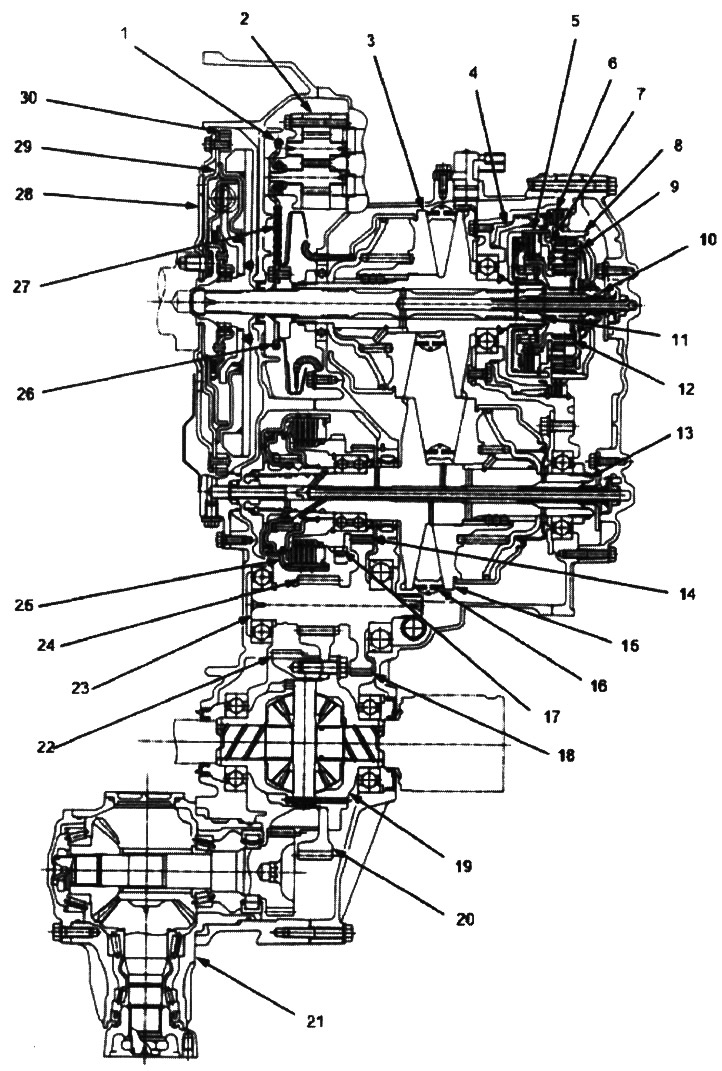
1. ATF pump drive sprocket; 2. ATF pump; 3. drive pulley; 4. reverse brake piston; 5. forward clutch; 6. reverse brake; 7. driver; 8. ring gear; 9. satellite; 10. drive shaft; 11. Drive pulley shaft; 12. sun gear; 13. driven pulley shaft; 14. secondary shaft drive gear; 15. driven pulley; 16. steel belt; 17. parking gear; 18. secondary shaft driven gear; 19. differential assembly; 20. final drive driven gear; 21. Transfer case assembly (4WD model); 22. Transfer case shaft drive gear (4WD model); 23. secondary shaft; 24. final drive pinion; 25. starting clutch; 26. ATF pump drive sprocket; 27. ATF pump drive chain; 28. drive disk; 29. flywheel; 30. toothed crown
Note: The figure shows a 4WD automatic transmission (sectional view); the 2WD gearbox does not have a transfer case assembly and the drive gear of the transfer case shaft on the differential assembly is missing.
Clutches/Reverse brake
The CVT uses hydraulically driven clutches and a brake to engage and disengage the automatic transmission gears. When hydraulic pressure is applied to the clutch drum and the cavity of the reverse brake piston, the clutch piston and the reverse brake piston move. In this case, the driven friction and leading steel disks are pressed against each other and locked in this state, eliminating slippage. Power is transmitted through the engaged clutch assembly to the gear installed on the hub and through the engaged ring gear to the satellites. Similarly, when hydraulic pressure is removed from the clutch assembly and the cavity of the reverse brake piston, the piston releases the friction and steel disks, which can rotate without touching each other. In this case, the gear rotates independently on its shaft and power is not transmitted.
Starting clutch
The starting clutch, located at the end of the driven pulley shaft, engages and disengages the secondary shaft pinion. Hydraulic pressure is supplied to the starting clutch through the ATF feed tubes in the driven pulley shaft.
Forward clutch
The forward clutch, located at the end of the drive pulley shaft, engages and disengages the sun gear. Hydraulic pressure is supplied to the forward clutch through the ATF feed tubes in the drive pulley shaft.
Reverse brake
The reverse brake, located inside the intermediate case around the ring gear, locks the ring gear in the R position. The driven discs of the reverse brake are mounted on the ring gear, and the pressure discs of the reverse brake are mounted on the intermediate case. Hydraulic pressure is supplied to the reverse brake through a circuit connected to the internal hydraulic circuit.
Planetary gear
The planetary gear consists of a sun gear, a carrier assembly, and a ring gear. The sun gear is connected to the splined drive shaft. The satellites are mounted on the carrier, which is located in the forward clutch drum. The sun gear supplies engine power through the drive shaft to the planetary gear, and the carrier delivers engine power. The ring gear is used only to change the direction of rotation of the pulley shafts.
In the D and L positions (forward range), the planet gears do not rotate or roll around the sun gear, so the planet carrier rotates. In the R position (reverse range), the reverse brake locks the ring gear and the sun gear causes the planet gears to rotate. The planet gears rotate and roll in the opposite direction to the sun gear, and the planet carrier rotates with the planet gears.
Pulleys
Each pulley consists of a movable and fixed surface and the gear ratio changes depending on the engine speed. The leading and driven pulleys are connected by a steel belt.
To obtain a low gear ratio, high hydraulic pressure is applied to the moving surface of the driven pulley, which reduces the average diameter of the driving pulley, and low hydraulic pressure is applied to the moving surface of the driving pulley to eliminate the slippage of the steel belt. To obtain a high gear ratio, high hydraulic pressure is applied to the moving surface of the driven pulley to eliminate the slippage of the steel belt.
Transfer case (4WD)
The transfer case consists of the transfer case shaft pinion, the transfer case shaft, the transfer case pinion gear, the transfer case shaft driven gear, and the coupling flange. The transfer case assembly is located at the rear of the gearbox, next to the differential. The transfer case shaft pinion gear drives the transfer case shaft driven gear on the final drive driven gear. Power is transmitted to the rear differential via the transfer case shaft and the propeller shaft.