Self-diagnostic indicators
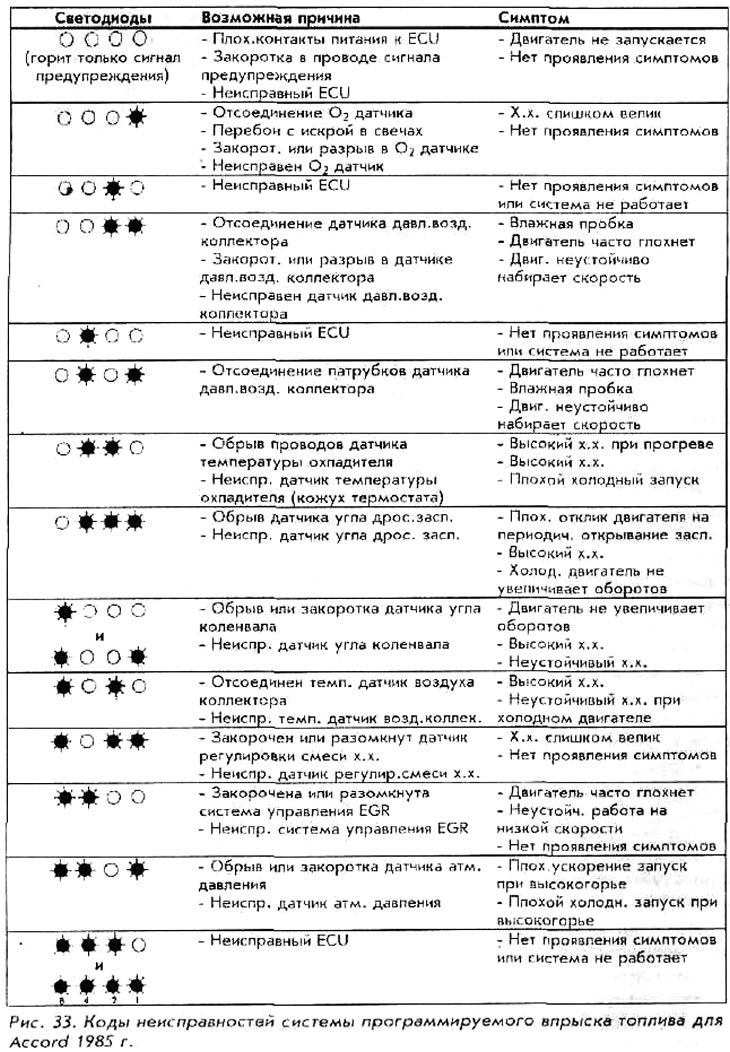
The Brief Index or Diagnostic Chart covers the most common faults in the electronic fuel injection system. The causes of faults are listed in order of difficulty of checking and correcting them. Review all the fault causes listed. If this does not produce results, then you should refer to a more detailed description of possible faults. These faults are classified by fault codes, determined by the LED flashes.
In almost all of the cases described, the SNEX ENGINE indicator light should light up (turn on and stay on). This immediately indicates that the electrical part of the fuel injection control system is faulty. Therefore, you should first check what the LED display of the self-diagnosis system located in the ECU module shows. On some models, only a very limited number of codes do not turn on the indicator light on the instrument panel. In the event that the driving characteristics of the car deteriorate, you should check whether there are any error codes in the computer's memory.
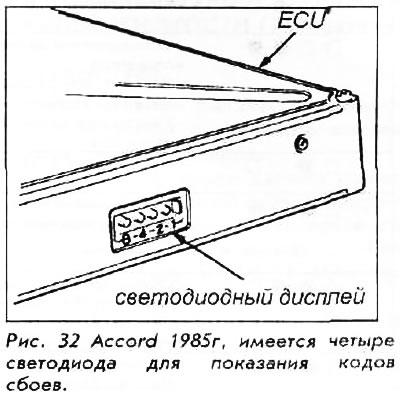
The 1985 Accord has four LEDs that display trouble codes. These LEDs are part of the ECU module, which is located under the passenger seat on the Accord and on the left side panel near the rear seat on the Prelude. The LEDs are numbered from right to left as 1,2,4,8.
The number of times the self-diagnosis indicator (left column) blinks and the systems it indicates malfunction (right column) for the 1986-89 Accord and Prelude.
| 0 | ECU |
| 1 | OXYGEN CONTENT A |
| 2 | OXYGEN CONTENT IN |
| 3 | ABSOLUTE MANIFOLD PRESSURE |
| 5 | |
| 4 | CRANKSHAFT ANGLE |
| 6 | COOLER TEMPERATURE |
| 7 | THROTTLE VALVE ANGLE |
| 8 | TDC POSITION |
| 9 | POSITION OF CYLINDER No.1 |
| 10 | INTAKE AIR TEMP |
| 12 | EGR SYSTEM |
| 13 | ATMOSPHERIC PRESSURE |
| 14 | ELECTRIC CONTROL XX. |
| 15 | OUTPUT. IGNITION SIGNAL |
| 16 | FUEL INJECTOR |
| 17 | VEHICLE SPEED SENSOR. |
On 1986-89 Accord and Prelude models, there is only one LED. It indicates a fault code by the number of consecutive flashes. The ECU is located under the driver's seat on these Accord models, and on the left side panel near the rear seat on Prelude models.
Sometimes the control lamp on the instrument cluster and/or the LED(s) on the ECU module will light up, which is nothing more than a poor electrical connection. To detect a poor connection, read the fault code from the LED and check all electrical contacts associated with the components listed in the diagnostic chart. Erase the ECU memory as described. Start the engine, drive the car for a few minutes and check the LED(s) again. If they show the same codes, then there is a problem with the components themselves. If the LEDs do not light, then the fault was only in the poor contacts.
The memory of the control lamp on the instrument panel is erased when the ignition is switched off. In contrast, the memory of the LED readings is not erased. The control lamp will not light up again when the ignition is switched on unless the malfunction is detected again. Therefore, troubleshooting should be carried out according to the LED readings, regardless of the control lamp.