
HondaBook.ru
Auto companies Volkswagen Auto companies Ford Auto companies Lada Auto companies Skoda Auto companies BMW Auto companies Mazda Auto companies Peugeot
English Русский
Български
Беларускі
Український
Српски
Hrvatski
Română
Polski
Slovenský
Magyar
Bookmark Contacts Sitemap   


Accord Civic Fit / Jazz CR-V HR-V Others Articles
Accord 3 (1985-1989) Accord 6 (1997-2002)

Positive Crankcase Ventilation (PCV) System (Honda Accord 3)

  • Main
  • Honda Accord
  • 3 (1985-1989)
  • Power unit
  • Emission management
  • Positive Crankcase Ventilation (PCV) System
0
Contents: Action ⇊ Testing and troubleshooting ⇊

Action


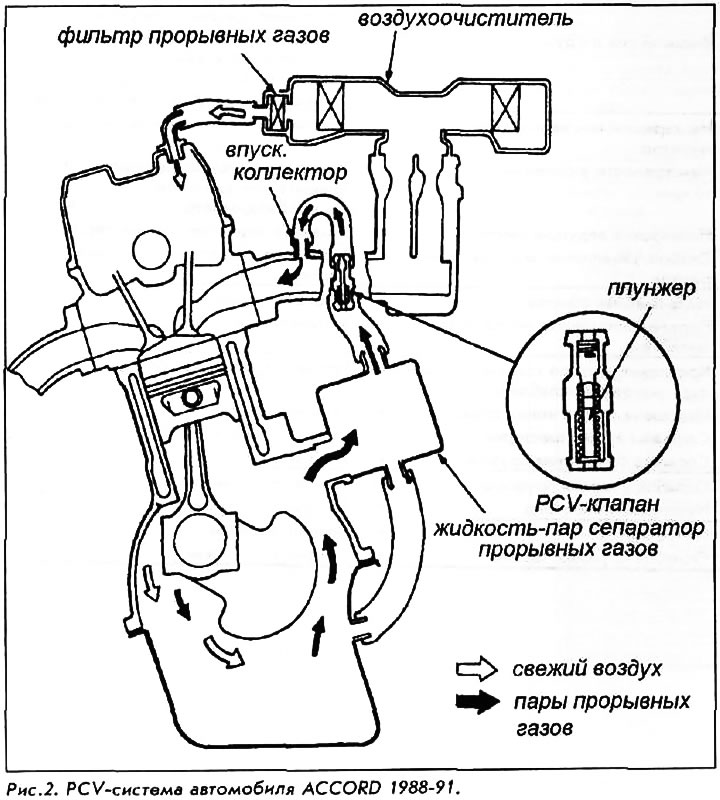
A closed crankcase ventilation system is used on all HONDA vehicles. This system returns unburned fuel (i.e., fuel that has leaked past the piston rings) to the intake manifold for combustion along with the air-fuel mixture. The oil cap is sealed, and air is released from the top of the crankcase into the intake manifold through a shut-off valve.
A closed crankcase ventilation system is used on…


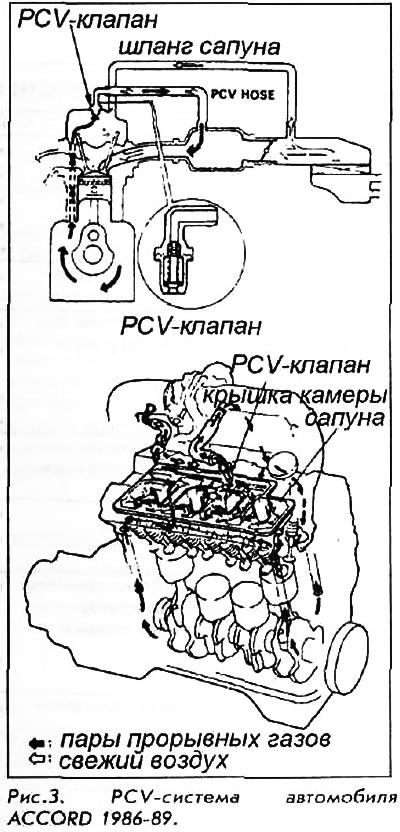
This valve (PCV valve) regulates the flow of air into the manifold depending on the vacuum in the manifold. When the throttle is wide open, the PCV opens to maximize flow, but at idle, when the suction action of the manifold is at its maximum, the PCV valve reduces flow because the need to recirculate the mixture entering the engine is reduced. The recirculation system depends on the tightness of its connections. An air leak anywhere: the valve cover, the cylinder head gasket, the oil pan, the dipstick location, the air collector passages in the oil cup cap or vacuum hoses can lead to an air-saturated air-fuel mixture and reduce the effectiveness of recirculation. And an incorrectly connected hose will cause the manifold to fill with oil, stall the engine and / or leak oil.


This valve (PCV valve) regulates the flow of air…


Testing and troubleshooting


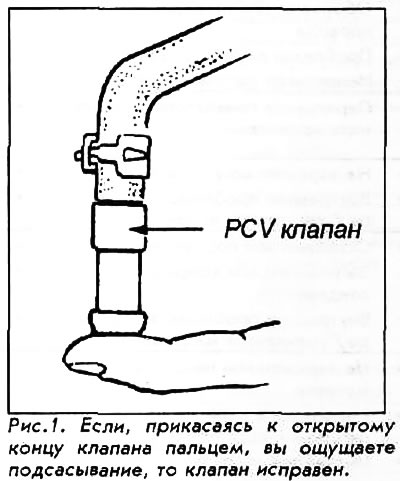
The PCV valve is easily tested by running the engine in normal idle mode (warm-up mode). Lightly press your finger on the open end of the valve. You should hear a whistling sound. If there is no whistling sound, remove the valve from the valve cover or separators, place your finger on the open end of the valve. You should hear a whistling sound and feel a vacuum.
The PCV valve is easily tested by running the…


If there is no vacuum, check the connected hoses and connections. If they are open, the valve is faulty. With the engine off, remove the valve completely. Shake it to listen for a rattling sound from the plunger inside the valve. If there is no rattling, the plunger is stuck (probably due to oil buildup) and the valve should be replaced. Never operate the engine without the PCV or with a clogged hose.


DO NOT attempt to blow out the valve: gasoline vapors and deposits on the valve are harmful to health.


(The original is located on the website «HONDABOOK»)
This article is available at: russian, bulgarian, belarusian, ukrainian, serbian, croatian, romanian, polish, slovak, hungarian
This information has been verified: Yaroslav Shiryaev
Share with friends:
◀ Previous
Accord 3: Emission management
Next ▶

Engine Emissions Management — General Information
Gasoline vapor recovery system
Exhaust Gas Recirculation System (EGR System)
Oxygen sensor — removal and installation
See also other articles from Honda manuals:
Crankcase ventilation system Honda Civic 3 and 4 (1983-1991)
Checking the crankcase ventilation system Honda Fit 1 (2001-2008)
Positive Crankcase Ventilation (PCV) System Honda CR-V 2 (2002-2006, petrol)
Positive Crankcase Ventilation (PCV) System Honda HR-V 1 (1998-2006, petrol)
Checking the crankcase ventilation system Honda Avancier 1 (1999-2003, petrol)
Link in different formats to this article
Comments and feedback from visitors
No comments yet


How much will 25 + 10 ?


Accord 6 (1997-2002) 
  • General information
  • Introduction to the guide
  • User manual
  • Maintenance
  • Power unit
  • Four-cylinder engines
  • Six-cylinder engines
  • Engine overhaul
  • Cooling system
  • Heater and air conditioner
  • Power and exhaust systems
  • Engine electrical equipment
  • Engine management
  • Transmission
  • Mechanical gearbox
  • Automatic gearbox
  • Clutch and drive shafts
  • Chassis and running gear
  • Brake system
  • Car suspension
  • Steering
  • Body and interior
  • Exterior (external elements)
  • Interior (internal elements)
  • Electrical equipment
  • Equipment and devices
  • Electrical circuits
Accord 3 (1985-1989) 
  • General information
  • Maintenance
  • Power unit
  • Engine adjustment
  • Engine repair
  • Engine electrics
  • Emission management
  • Engine management (carburetor)
  • Electronic injection
  • Programmable injection
  • Schematic of emission system
  • Fuel system
  • Feedback management
  • Transmission
  • Manual gearbox
  • Automatic gearbox
  • Clutch
  • Chassis and running gear
  • Front suspension
  • Rear suspension
  • Steering
  • Brake system
  • Electrical equipment
  • Ventilation and heating
  • Air conditioner
  • Cruise control system
  • Equipment and devices
HondaBook.ru © 2018–2026 • Mobile version • Sitemap: EN BG BY UA RS HR RO PL SK HU • Feedback • Driver Information • Search system • Bookmark
Accord 3 (1985-1989) • Accord 6 (1997-2002) • Civic 3 and 4 (1983-1991) • Civic 5 and 6 (1991-2000) • Civic 6 (1995-2000) • Civic 7 (2000-2005) • Civic 8 (2005-2011) • Fit 1 (2001-2008) • CR-V 1 (1995-2001) • CR-V 2 (2002-2006) • HR-V 1 (1998-2006) • Avancier 1 (1999-2003) •
 
This website uses cookies to ensure proper functioning. By clicking "OK," you agree.