
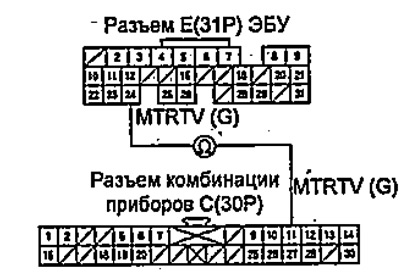
a) Check the operation of the "CHECK ENGINE" indicator.
- While the indicator is operating, the fault diagnostic mode is enabled;
- If the indicator does not light, follow the next step.
b) Disconnect the "E(31P)" connector of the "PGM-FI" electronic control unit.
c) Check the conductivity between terminal "24" of the "E(31P)" connector of the "PGM-FI" electronic control unit and terminal "11" of the "C(30P)" connector.
- If there is no conductivity, the wires or connector may be damaged.
- If there is continuity, replace the instrument cluster.
2. Checking pulses.
Before checking, please fulfill the conditions:
- Make sure that the output does not show the "P1607" fault code.
- Make sure that the output does not show the automatic transmission fault code "P0720".
- Disconnect terminal "16" (7.5A) of the connector.
- Make sure there is continuity between the terminal being tested and ground.
a) Rotate four wheels.
b) connect a tester or oscilloscope to the "C10" terminal of the "30P" connector of the instrument cluster.
c) Turn the ignition switch to the "ON" position and slowly rotate the front wheels.
d) Make sure that the voltage pulses reach approximately 0-5V or 12V.
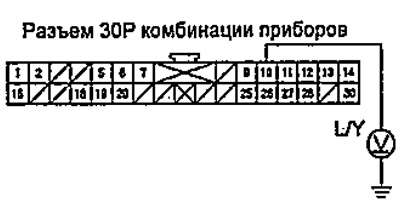
If the voltage is as described but the speedometer does not work correctly, replace the instrument cluster.
If the voltage is not as described, check the speed sensor and the electronic control unit "PGM-FI". Replace the instrument cluster if necessary.
d) Make sure that the voltage pulses at the "31P" terminal of the "PGM-FI" electronic control unit reach approximately 0-5 V or 12 V.
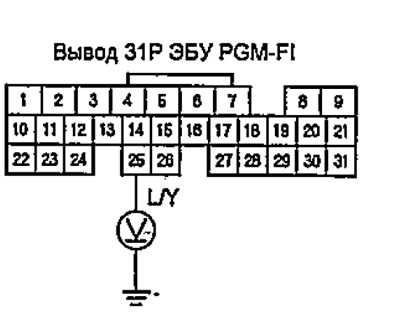
If the voltage is as described, there may be damage in the "L/Y" wire harness.
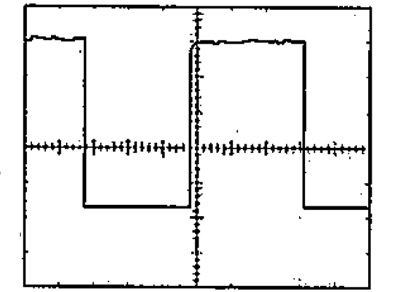
If the voltage does not match the description, check the speed sensor. Signal oscillogram (signal amplitude 0-5 V or 12 V, pulse frequency depends on the speed of rotation of the front wheels).
[Original published on this resource «HONDABOOK»]