
Check the serviceability and installation condition of fuse No.9 (10A) in the fuse box on the driver's side (contact A9).
Check the ground G503 (contact A20).
1. Raise the car (all 4 wheels off the ground).
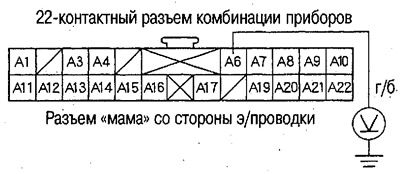
2. Disconnect the 22-pin connector A from the instrument cluster and connect an analog tester or oscilloscope to terminal A6.
Caution: To avoid damage, do not place the instrument cluster face down for a long time.
3. Turn the ignition key to the ON (II) position and slowly turn the front wheel by hand (at a speed corresponding to a driving speed of more than 2 km/h).
4. Measure the voltage at pin A6. Make sure that the voltage changes periodically, from 0 to approx. 5V.
If the voltage does not change, replace the instrument cluster.
If there is no voltage, do the following.
5. Measure the voltage at pin #9 of the 32-pin PGM-Fi control unit connector and check that it alternately changes from 0V to approx. 5V.
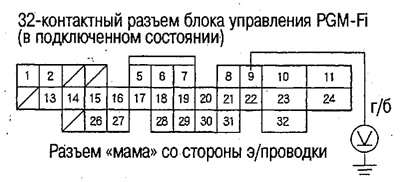
If the voltage does not change, check the blue-white wire for an open circuit.
If there is no voltage, proceed to step 6.
6. Disconnect the 32-pin PGM-Fi control unit connector and check the continuity between connector pin #9 and ground.
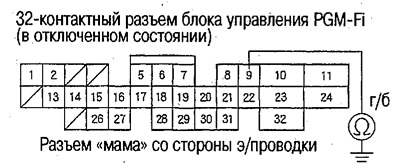
If there is continuity, check the blue-white wire for short circuit.
If there is no continuity, check the connection of the control unit connector for reliability, and also check the PGM-Fi control unit.
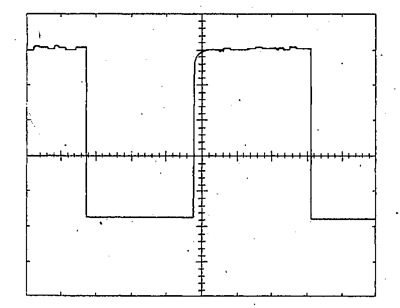
If you check with an oscilloscope, the vehicle speed signal will look like the one shown in the figure and will vary within 0-5V. In addition, the duration of the signal period will depend on the speed of the front wheel.
[The original is located on the website: hondabook.ru]