
Note: When the ignition key is in the "ON (II)" position and the engine is not running, the indicator light comes on for a few seconds and then goes out.
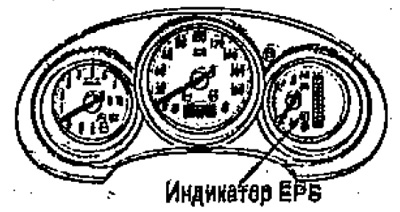
2. If the indicator does not go out, diagnose the electric power steering.
a) Make sure that the steering wheel position corresponds to the straight-ahead driving position.
6) Turn the ignition key to the "ON" position (do not start the engine).
c) Short the "SCS" terminal to ground. To do this, connect the tester to the "DLC" diagnostic connector or connect the "DLC" diagnostic connector (A) to the special tool (B), and short the "4" and "9" terminals of the special tool with a wire.
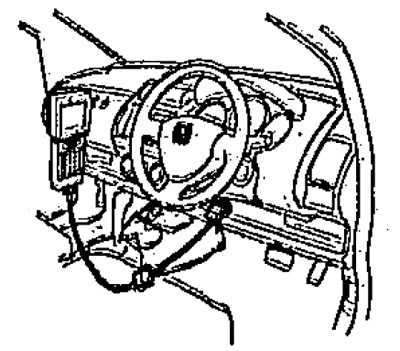
Diagnostics using a tester
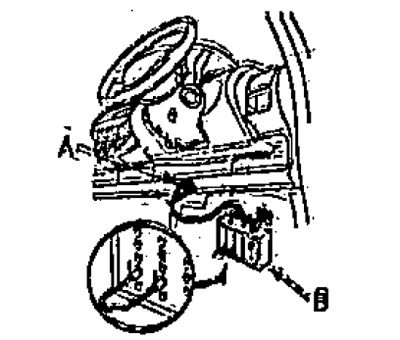
Diagnostics using a special device
3. Read the fault codes by the number of flashes of the EPS indicator.
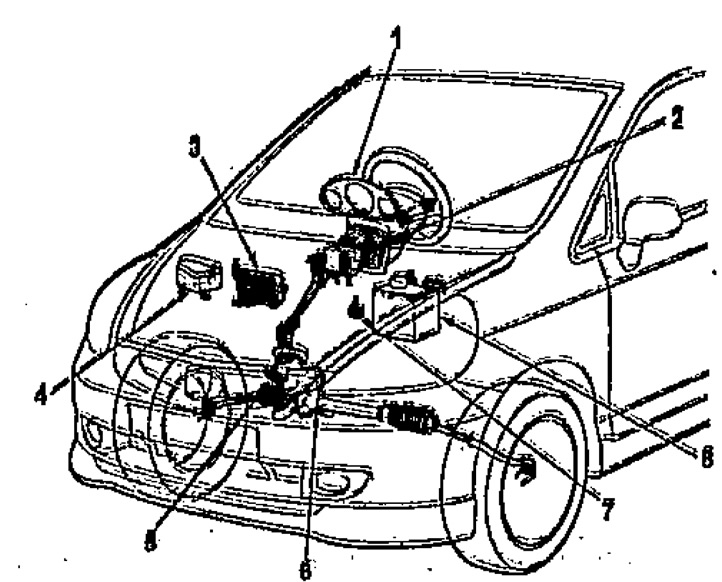
Component arrangement:
1 - instrument cluster (EPS indicator),
2 - relay block in the passenger compartment,
3 - EPS control unit,
4 - relay block in the engine compartment,
5 - torque sensor,
6 - steering gear assembly,
7 - diagnostic connector DLC,
8 - battery.
Note:
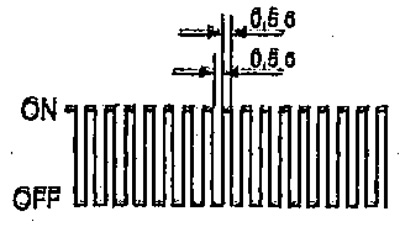
- If there are no faults, the indicator flashes continuously at a frequency of 1 time per second.
- The fault codes are repeated until the ignition key is turned to the "OFF" position.
- If there is a malfunction, after a pause of 3 seconds, the codes are displayed,
- The output of codes starts from the smallest.
- The first sequence of flashes corresponds to the first digit of the diagnostic code, which consists of two digits. After a pause of 2 seconds, the second sequence of flashes is displayed, corresponding to the second digit of the code.
- See the figure "Reading fault codes".
- If, with the ignition switched off ("OFF"), you short-circuit the "SCS" output to ground and then start the engine, the system will switch to the code reading mode. If you do not start the engine, but turn on the ignition ("ON"), the system will switch to the code erasing mode.
4. After reading the fault codes, erase them.