
Caution: When removing and installing the cable, do not twist or bend the cable excessively. A deformed cable may cause poor parking brake performance or cable breakage.
1. Loosen the wheel nuts.
2. Raise the car with a jack so that the wheels are raised.
3. Remove the rear wheels.
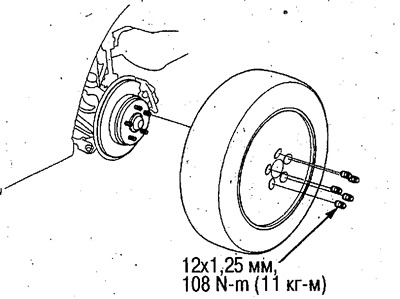
Before installation, clean the contact surfaces of the wheels and brake discs.
4. Remove the cotter pin and unscrew the castle nut of the upper arm ball joint. Screw the nut (12 mm) onto the ball joint pin so that the ends of the nut and pin are aligned.
5. Using a special tool, disconnect the upper arm ball joint from the knuckle.
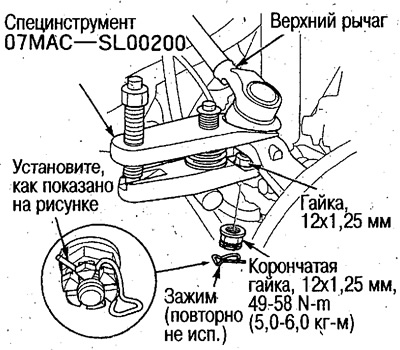
About using a special tool see chapter Front and rear suspension.
6. Remove the wheel sensor and electrical wiring (see below).
7. Disconnect the rear stabilizer link from the stabilizer mounting bracket (2WD models (see chapter Front and rear suspension)).
8. Loosen the shock absorber mounting bolt and remove the stabilizer bracket (2WD models) or remove the brake hose/wheel sensor wiring bracket (4WD models).
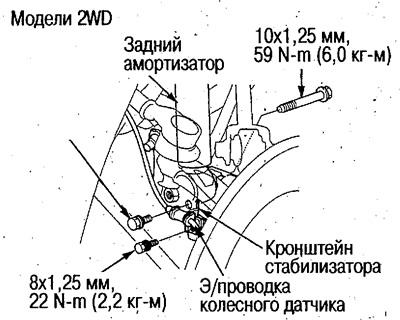 |
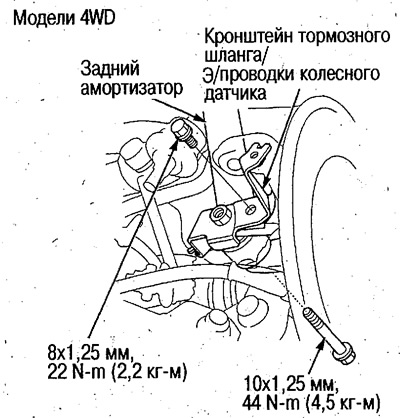 |
9. Disconnect the transverse and lower arms from the knuckle.
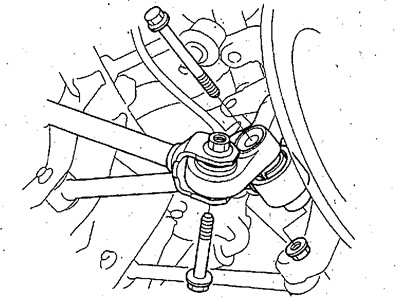
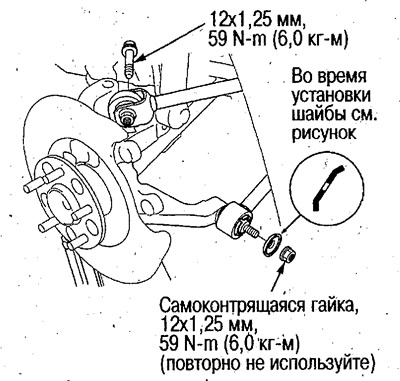
10. Disconnect the retaining and control arms from the knuckle.
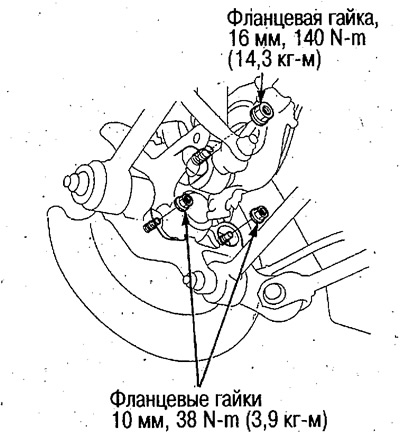
11. Unscrew the mounting nuts and remove the support disk from the knuckle.
12. Remove the brake caliper and brake hose from the knuckle (see above).
13. Remove the brake pads (see above).
14. Disconnect the parking brake cable from the trailing arm.
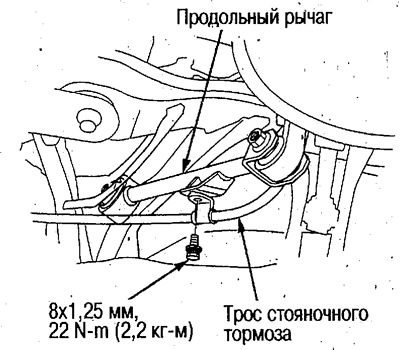
15. Disconnect the parking brake cable from the support disc.
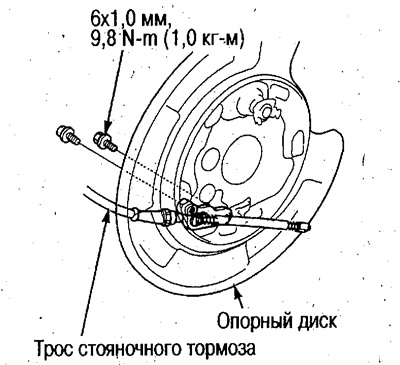
16. Perform installation in the reverse order of removal, paying attention to the following.
Be careful not to damage the ball joint boots when installing the upper control arm.
Tighten the upper control arm castle nut to the minimum specified torque, then tighten the nut further until the cotter pin can be installed.
Install new cotter pins.
Install the suspension arms in the following order:
- Install components and tighten bolts/nuts by hand.
- Transfer the weight of the car to the suspension by supporting it with a jack.
- Tighten the bolts/nuts to the required torque.
Clean the contact surfaces of the brake disc and wheel from foreign particles:
17. After installation, perform the following checks and adjustments.
Parking brake (see above).
Wheel alignment angles (see chapter Front and rear suspension).