Contents: How to start troubleshooting ⇊ Engine/Powertrain Control Module…⇊ Final procedure (must be performed…⇊ Substitution of a known good ECM/PCM…⇊ Removal the ECM/PCM module ⇊ Checking the contacts in the ECM/PCM…⇊
How to start troubleshooting
When the Malfunction Indicator Lamp (MIL) comes on, check for a Diagnostic Trouble Code (DTC) as follows:
Note: This operation can also be performed using the Honda PGM Tester connected to the (5-pin) data connector.
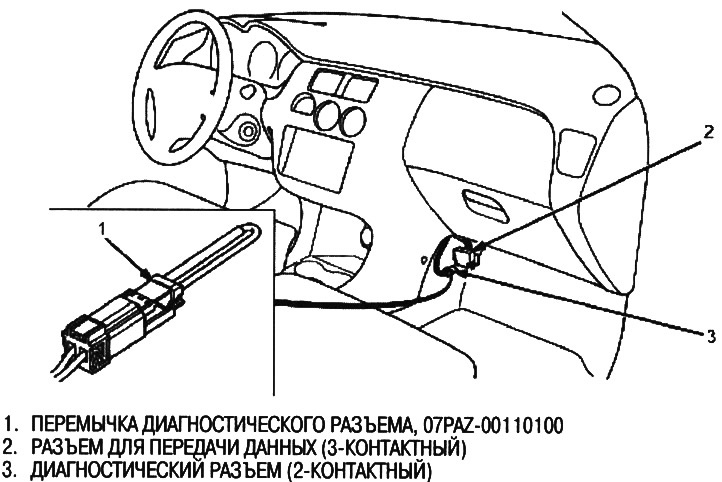
1. Install a jumper wire into the diagnostic connector as shown in the figure. (The 2-pin diagnostic connector is located under the instrument panel on the passenger side.) Turn the ignition switch to the ON (II) position.
The picture below shows the left-hand drive model; the arrangement on the right-hand drive model is symmetrical.
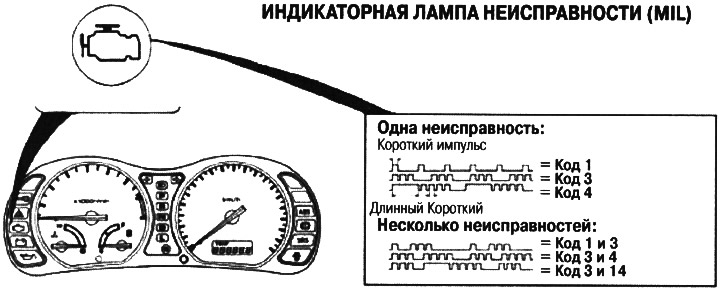
2. Record the diagnostic trouble code (DTC); the MIL malfunction lamp gives a code that differs in the duration and number of flashes, the MIL lamp can indicate several malfunctions, giving out separate codes one after another. Codes from 1 to 9 are indicated by separate short flashes. Codes from 10 to 65 are indicated by a series of long and short flashes. The number of long flashes indicates the first digit, the number of short flashes - the second. Sometimes the first flash is more difficult to see; to check the code, always read the flashes at least twice.
Engine/Powertrain Control Module (ECM/PCM) Reset Procedure
Note: This operation can also be performed using the Honda PGM Tester.
1. Turn the ignition key to the OFF position.
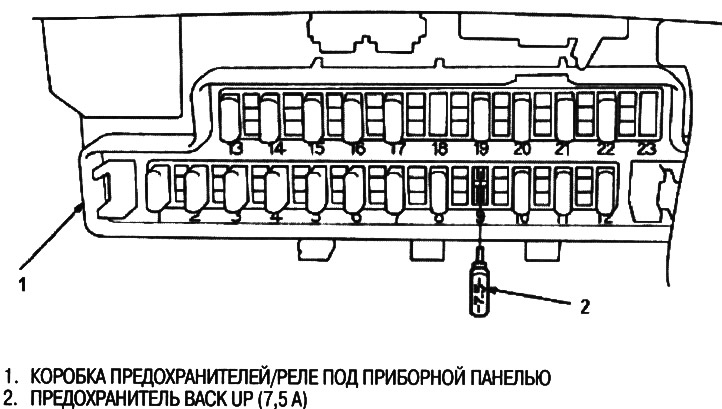
2. Remove the BACK UP (7.5A) fuse from the under-dash fuse/relay box for 10 seconds and reset the ECM/PCM.
The picture shows a left-hand drive model; the arrangement on the right-hand drive model is symmetrical.
Final procedure (must be performed after any fault has been found and corrected)
1. Remove the jumper from the diagnostic connector.
Note: If the jumper is left in the diagnostic connector when no diagnostic trouble codes are stored in the ECM/PCM memory, the MIL lamp will illuminate when the ignition switch is turned to the ON (II) position
2. Perform the ECM/PCM module reset procedure.
Substitution of a known good ECM/PCM module (models KG, KE, KQ, KU, KN)
If you require a known good ECM/PCM module to test the vehicle, use the following procedure. It allows you to swap such a module from the donor vehicle without having to program it to the ignition key of the vehicle being tested.
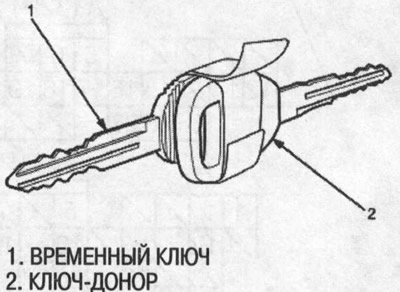
1. Make a temporary ignition key for the vehicle being tested from a blank without an immobilizer chip.
2. Remove the ECM/PCM module from the vehicle under test.
3. Write down the VIN number of the vehicle being tested on the ECM/PCM module you just removed to avoid confusing it with the module of the donor vehicle.
4. Remove a known good ECM/PCM from the donor vehicle and install it in the vehicle under test.
5. Tape the donor vehicle ignition key to the temporary key of the vehicle being tested, head to head. The ECM/PCM will then recognize the donor vehicle key code and allow you to start the engine with the temporary key.
6. After completing the checks, reinstall both ECM/PCM modules and destroy the temporary key.
Removal the ECM/PCM module
If any code requires voltage or resistance tests at the ECM/PCM connectors to diagnose, remove the glove box, passenger side sill molding, and wheel well panel. Remove the ECM/PCM cover mounting bolts. Perform the system check according to the procedure for these DTCs on the following pages.
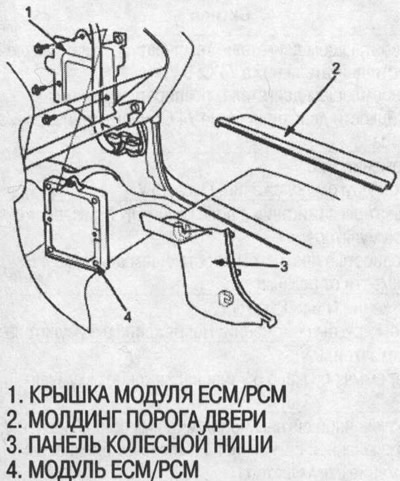
The picture shows a left-hand drive model; the arrangement on the right-hand drive model is symmetrical.
Checking the contacts in the ECM/PCM module connectors
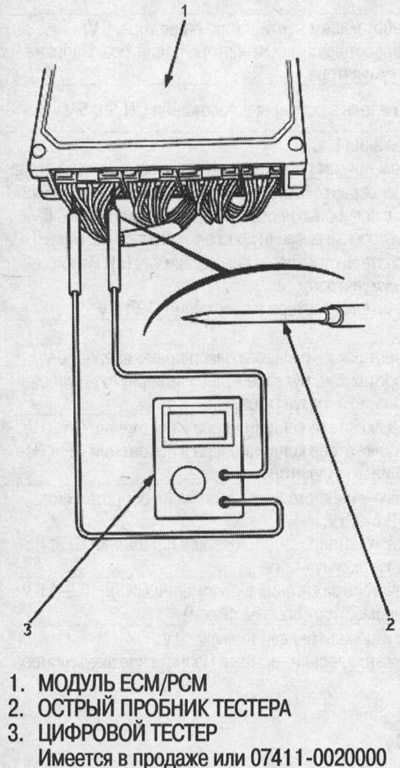
When checking the contacts in the ECM/PCM module connectors, carefully insert the sharp probe of the tester into the connector from the harness side until it touches the contact part of the wire.