Contents: Examination ⇊ Replacement ⇊
Examination
Attention:
- The engine has many parts made of aluminum alloys. These parts can be damaged by contact with alcohol or methanol based coolants. Do not use alcohol or methanol based coolants. Use only ethylene glycol based coolants.
- Use only soft (demineralized) water to prepare the coolant from a concentrated solution. Water containing mineral salts reduces the cooling efficiency.
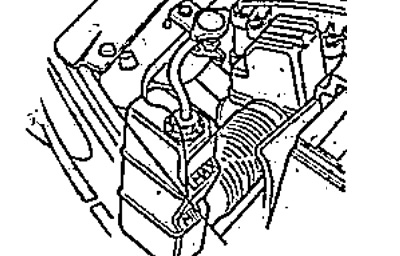
Make sure that the coolant level in the expansion tank on a cold engine is between the "MAX" and "MIN" marks on the tank wall. If the level is lower, add coolant.
Replacement
Note:
- It is recommended to use a coolant that contains more than 50% ethylene glycol, but not more than 70%.
- To avoid burns, do not remove the radiator cap when the engine is hot, as the liquid and steam are under pressure.
1. Drain the coolant from the expansion tank.
2. Remove the radiator cap, unscrew the radiator drain cock.
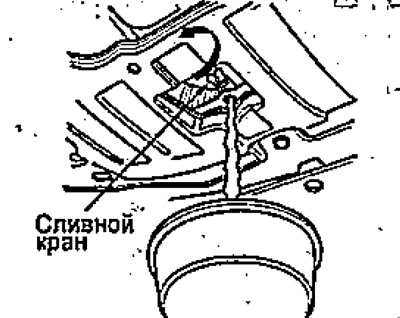
3. Loosen the cylinder block drain bolt. Drain the coolant.
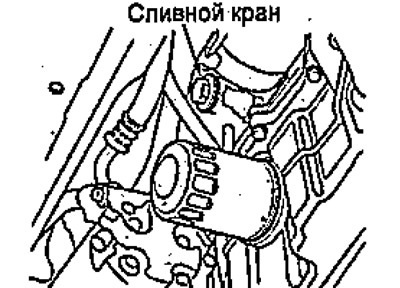
4. Flush the cooling system with flushing fluid until only clean fluid comes out of the system.
5. Allow the cleaning fluid to drain completely.
6. Tighten the radiator drain cock and the cylinder block drain bolt.
Caution: Coolant may damage painted surfaces of your vehicle.
7. Fill the radiator with coolant.
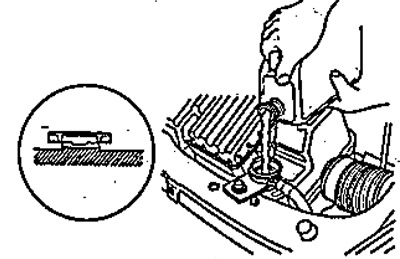
8. Temporarily tighten the radiator cap. Warm up the engine at 1500 rpm until the radiator turns on.
9. Turn off the engine. Check the coolant level in the radiator. Add liquid to the radiator and expansion tank up to the "MAX" mark on the tank wall.
Note: To avoid burns, do not remove the radiator cap when the engine is hot, as the liquid and steam are under pressure.
Filling capacity:
- full volume - 5.2 l
- when replacing coolant - 3.6 l
10. Close the radiator cap tightly.
11. Start the engine and let it run for a while at 1500 rpm. Make sure the coolant level has not dropped. If it has, top up the coolant.