
Contents: Examination ⇊ Replacement ⇊
Examination
1. First of all, check the condition of fuse #9, 10 A, in the fuse/relay box under the dashboard of the vehicle. Replace the blown fuse with a new one. If the new fuse also blows immediately (without engaging reverse gear), check the wiring in the circuit section between the reverse light switch and the fuse box. If the fuse blows when reverse gear is engaged, check the wiring in the section between the switch and the combination rear lights.
2. Select reverse gear with the gearshift lever and turn on the ignition - the white reversing signal lights in the rear combination lamp assemblies should light up. Turn off the ignition.
3. If the lights do not turn on, check the functionality of the corresponding lamps.
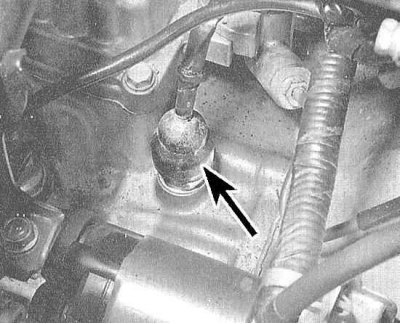
4. If the fuse and lamps are OK, find the reverse light switch sensor in the upper part of the manual transmission housing, disconnect its wiring connector and connect an ohmmeter between the two exposed contacts.
5. When the reverse gear is engaged, there should be conductivity between the connector contacts (the sensor-switch is closed). In any other position of the lever, the sensor-switch should be open (no conductivity).
6. If the results of the described check are negative, replace the sensor switch.
7. If the switch is OK, check the condition of its grounding circuit. If the grounding is OK, check all electrical wiring for breakage.
Replacement
8. Disconnect the electrical wiring from the sensor switch.
9. Unscrew the sensor switch from the transmission housing.
10. Remove and discard the old washer.
11. Replace the washer and install a new sensor switch.
12. Connect the electrical wiring.
(The article was taken from the website: hondabook)