
HondaBook.ru
Auto companies Volkswagen Auto companies Ford Auto companies Lada Auto companies Skoda Auto companies BMW Auto companies Mazda Auto companies Peugeot
English Русский
Български
Беларускі
Український
Српски
Hrvatski
Română
Polski
Slovenský
Magyar
Bookmark Contacts Sitemap   


Accord Civic Fit / Jazz CR-V HR-V Others Articles
HR-V 1 (1998-2006, petrol)

Engine coolant temperature gauge (Honda HR-V 1)

  • Main
  • Honda HR-V
  • 1 (1998-2006, petrol)
  • Power unit
  • Cooling system
  • Engine coolant temperature gauge
0
Contents: Testing the pointer ⇊ Testing the sensor ⇊

Testing the pointer


1. Before testing, check fuse #6 (7.5A) in the fuse/relay box under the instrument panel on the driver's side.

2. Make sure the ignition switch is in the OFF position, then disconnect the YELLOW/GREEN wire from the coolant temperature gauge sensor and ground it with a jumper wire.
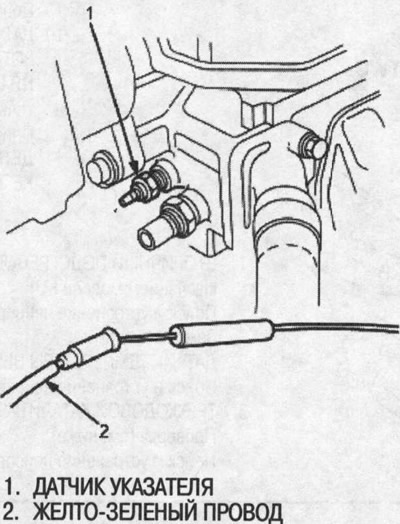
2. Make sure the ignition switch is in the OFF…


3. Turn the ignition switch to the ON (II) position.

Make sure that the coolant temperature gauge needle starts to move toward the "H" mark. Before the needle reaches the "H" mark on the gauge scale, turn the ignition switch to the OFF position. Failure to do so may damage the gauge.
  • If the pointer does not move at all, check for a break in the YELLOW/GREEN wire. If the wires are OK, replace the coolant temperature gauge.
  • If the coolant temperature gauge is normal, test the temperature gauge sensor.

Testing the sensor


1. Disconnect the YELLOW/GREEN wire from the coolant temperature gauge sensor.
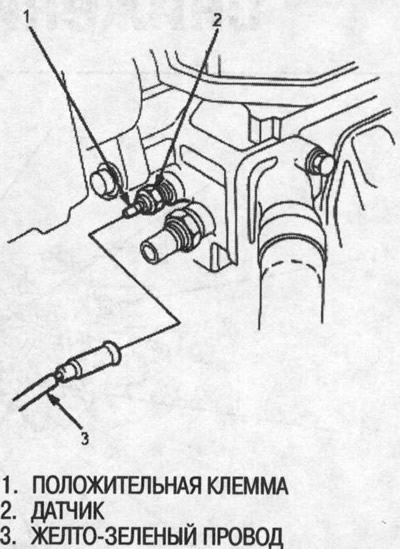
1. Disconnect the YELLOW/GREEN wire from the…


2. Using an ohmmeter, measure the change in resistance between the positive terminal and the engine (ground) with the engine cold and with the engine warmed up to operating temperature.


Temperature56°C85-100°C
Resistance, Ohm13746-30

3. If the results obtained differ significantly from the nominal values specified above, replace the sensor.

[Full text available on the portal: www.HondaBook.ru]
This article is available at: russian, bulgarian, belarusian, ukrainian, serbian, croatian, romanian, polish, slovak, hungarian
This information has been verified: Emil Safonov
Share with friends:
◀ Previous
HR-V 1: Cooling system
Next ▶

Testing the Radiator Fan Switch
Testing the Fan Motor
Fan — component layout and wiring diagram
Water Pump — Checking and Replacing
Water pump — design description
Engine Cooling System Specifications
See also other articles from Honda manuals:
Checking the condition and replacing the engine coolant temperature… Honda Accord 6 (1997-2002)
Checking and replacing the engine coolant temperature sensor (ECT) Honda Civic 6 (1995-2000)
Coolant temperature sensor Honda Fit 1 (2001-2008)
Coolant temperature sensor Honda CR-V 1 (1995-2001, petrol)
Starting the engine Honda Avancier 1 (1999-2003, petrol)
Link in different formats to this article
Comments and feedback from visitors
No comments yet


How much will 28 + 24 ?


HR-V 1 (1998-2006, petrol) 
  • General information
  • User manual
  • Maintenance
  • Power unit
  • Engine repair
  • Lubrication system
  • Cooling system
  • Fuel injection and control
  • Power and exhaust system
  • Engine electrical equipment
  • Transmission
  • Clutch
  • Mechanical gearbox
  • Automatic gearbox
  • Rear differential
  • Drive shafts and cardan
  • Chassis and running gear
  • Steering
  • Car suspension
  • Brake system
  • Body and interior
  • Exterior (external elements)
  • Interior (internal elements)
  • Doors, locks and windows
  • Electrical equipment
  • Equipment and devices
  • Lighting system
  • Electrical circuits
HondaBook.ru © 2018–2026 • Mobile version • Sitemap: EN BG BY UA RS HR RO PL SK HU • Feedback • Driver Information • Search system • Bookmark
Accord 3 (1985-1989) • Accord 6 (1997-2002) • Civic 3 and 4 (1983-1991) • Civic 5 and 6 (1991-2000) • Civic 6 (1995-2000) • Civic 7 (2000-2005) • Civic 8 (2005-2011) • Fit 1 (2001-2008) • CR-V 1 (1995-2001) • CR-V 2 (2002-2006) • HR-V 1 (1998-2006) • Avancier 1 (1999-2003) •
 
This website uses cookies to ensure proper functioning. By clicking "OK," you agree.